
11th (Service) Battalion. Suffolk Regiment. Regimental number 41204.
Previously, Northumberland Fusiliers, Regimental number 27282.
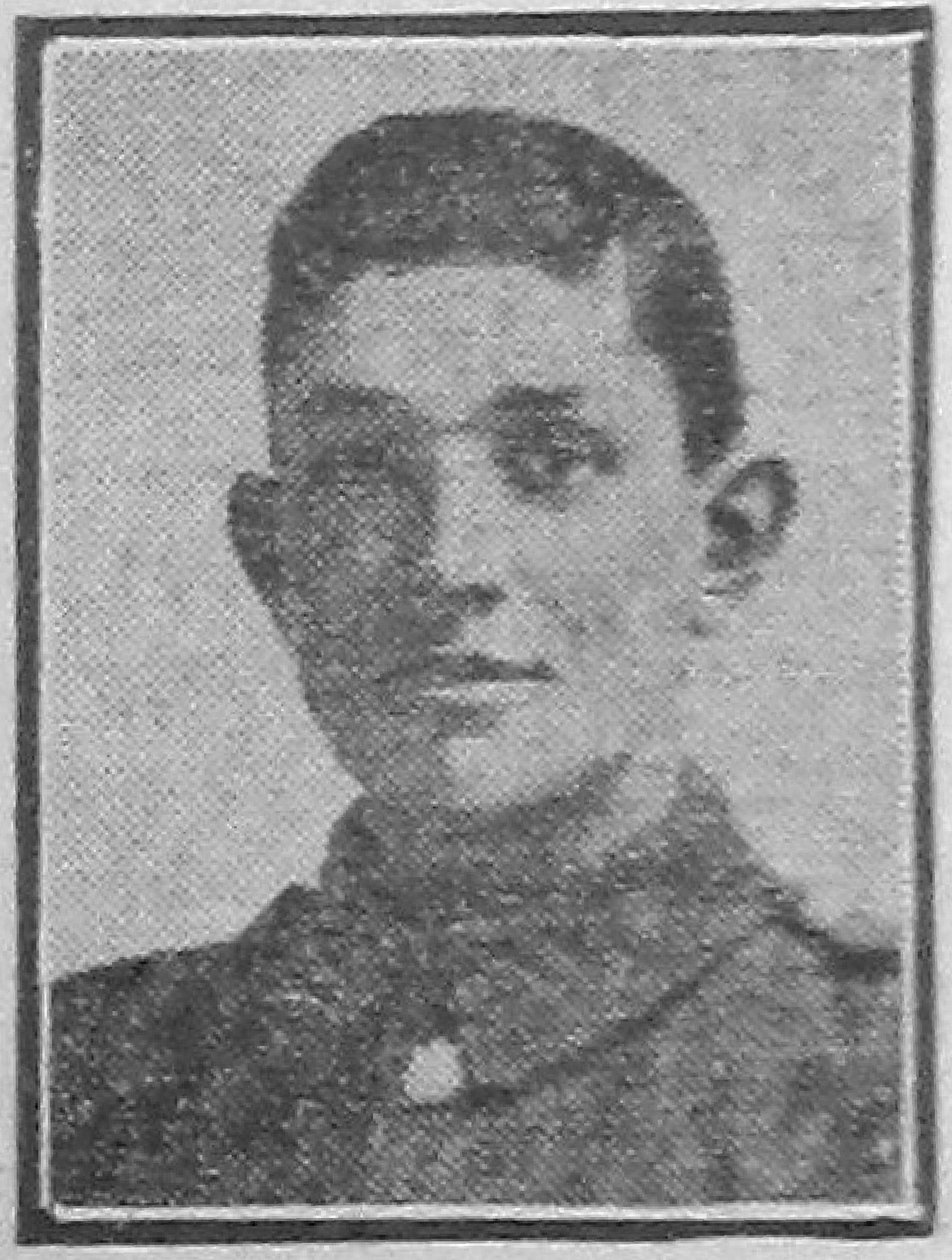
Early life:
John’s parents were James Edward Armstrong and Margaret Armstrong née Brooksbank and they were were married at St. Mary’s Church, Eastwood in Keighley on the 20th of October 1883. They were both aged 23, single and James was employed as a labourer.
In the 1891 census they were living at 12, Thames Street off Parkwood Road in Keighley, with head of the household John Brooksbank, a 22 year old carter, who was Margaret’s younger brother. He had two boarders called John Cryer who was a 37 year old engine firer and Eliza Brooks a 21 year old mill hand. The Armstrong family were husband James aged 28 employed as a labourer, wife Margaret aged 31; son George aged two, then rather oddly their two girls Clara aged four and Eliza aged six were both recorded with the surname Brooksbank. Perhaps that was just an error in the census taker’s account but there’s evidence to suggest they used Brooksbank as a middle name.
Eliza died aged just nine, her death was recorded at Keighley in the first quarter of 1894.
John was born on the 10th of March 1898 whilst the family was living at 8, The Walk, Parkwood. He was baptised John Edwin Armstrong on the 14th of December 1899 at St. Mary’s Church on Dalton Lane.
Their father James moved abroad to the United States of America in 1900. Perhaps it was to set up for the family joining him later but that didn’t work out after Mary died. He was still there, recorded living at Manhattan, New York in 1910. According to Margaret’s marriage record, he was deceased in 1920 and this was confirmed in Mary’s marriage record, stating that he was deceased in 1921.
The remaining family were all together in the 1901 census, but they were recorded as visiting the Baldwin home at 5, Oak Street, Keighley on that night. The head of the household was widowed John Baldwin aged 48, a general labourer with his son John W. aged 23, employed as a general carter.
The Armstrong family were mother Margaret aged 40, daughter Clara aged 14 a worsted spinner; son George aged twelve; daughters Mary aged ten and Margaret aged six and the youngest child was John aged three.
Their mother Margaret Armstrong died in 1902 leaving the children effectively orphaned. and their ages wound have been Clara, fifteen; George, thirteen; Mary, eleven; Margaret, seven and John would have been aged just four at the time.
In 1908 John was living at the Cottage Home, Highfield Lane, Keighley (he was George’s next of kin in an Army service record) This was presumably the Cottage Hospital, later known as Victoria Hospital on Highfield Lane.
By 1911 the children were scattered in different houses locally. Clara was 25 and living at 12, Thames Street in Parkwood, Keighley, with her Aunt Eliza Ann Metcalfe and her family. George was aged 22, he had moved to 17, Amelia Street in Saltaire and married Sarah Hannah Godfrey later that year. Mary was aged 19 and boarding at 23 Malsis Road in Keighley. The two youngest were in the care of the Board of Guardians, Margaret was 15 and living at Hainworth Road Young Ladies home. John was aged thirteen and at Clarendon Street Children’s home and was attending school whole time.
War service:
John was aged 19 when he enlisted with the West Riding Regiment on the 15th of May 1915 with the regimental number 16081. He gave his age as 19 years and two months which was not true as he was actually just 17 years old. He stated that he was a labourer and living at 12, Partridge Street. His medical details were: 5 feet 8 inches tall with a 38 inch chest and weight of 142 lbs. His brother George was his stated next of kin living at 18, William Henry Street, Saltaire.
His Army service was short lived and he was discharged after 42 days at Halifax on the 25th of June 1915. The reason given was ‘not being likely to become an efficient soldier.’ ‘Recruit within three months considered unfit for service under King’s Regulations, para 392 (iii)(c).’ His character on discharge was ‘good.’
The medical reason was given, ‘Defect: Vision & old infantile paralysis, left whole limb.’
John re-enlisted around October 1915 as Edward Armstrong (using his father’s middle name) with the Northumberland Fusiliers with the Regimental number 27282. It’s likely that he changed his name slightly as he’d already been found unfit to serve a few months previously.
He ended up serving with the 11th (Service) Battalion of the Suffolk Regiment with the Regimental number 41204. This is the only regiment on his medal records, suggesting he was transferred before he went overseas, and this is supported by the newspaper account of his death.
Letters sent between home and John:
Sadly they were not dated but we have attempted to put them in a rough chronological order:
Dear Sister
Just a few lines in answer to your which I received today and thanking you for the envelopes as they came at the right time as I had a few letters to write
I had a letter from our George, and he does not like it but he will have to get used to it, just the same as every one else. I have had a photo of our Ivy(?) which she got took at Morecambe.
The war is going to be over in three months time.
Well I hope Aunt Eliza Ann and Uncle Tom are keeping well and also Willie, we are out for a few days next but we are having it wet at present. Well I think I have told you all this time, from your ever loving brother, John
15th Northumberland Fusiliers, No. 6 Hut, No. 8 Lines, A Coy, Rugeley Camp, Stafford. 28.6.1916.
Pte. J Armstrong No 27232
Dear Sister
Just a few lines hoping this will find you in the best of health as it leaves me at present. Sorry I did not see you before I went away, I was on as far as Dean Smith on Wednesday afternoon just to see Sam my mate, but I could not see you.
So well I had a letter from our Mary and she told me that you looked troubled, there is no need for you to be troubled as I am all right, she says our George is going in the Cyclist Corps in a fortnight.
I have had my photo taken, just above the belt they will be ready next Saturday I will send you one if they are good. I will not be coming home for a week or two, I would like to come at Whitsuntide But I am afraid I cannot, it takes me seven or eight hours to come. We had a grand time ???? and I am keeping out of mischief and off beer, I have had the chance many a time to be treated, but I refused it.
We do fairly get put through it, I am learning bayonet fighting, I have got my rifle and bayonet.
I heard Willie had been over, if you send me his address I will write to him. I would not be kicked out now, there is a draft of over seas going to France on Tuesday, will you write duck as soon as possible
I have been vaccinated and in about three weeks I am going to be inoculated.
We have good grub but not enough of it, but the beds are not so nice the straw sticks up into our backs and the pillows are like iron.
One of our soldiers got shot while he was firing on his course last week, They say we will be ready for France in about four months time, so now for a close, no more this time.
From your brother, John. Write back as soon as possible.
By Worth
[‘By Worth’ is the motto of the town of Keighley]
The early war diary entry states they were ordered to mobilise on 13th December 1915 and went abroad on the 31st.
They assembled at SUTTON VENY and crossed from SOUTHAMPTON to HAVRE. We think John served with them for the whole period until his death in 1917. There are no Army service records for this part of his service and we assume he got leave during this period whilst serving between the front lines, support lines and in the rear in billets.
Dear Sister
Just a few lines hoping this find you all in the very best of health as it leaves me at present.
Well I am well away for France, I am now waiting at Folkestone for the boat to take me over.
I am going to do my little bit now I will let you have my address later. I have made my allowance to our
George.
I think this is all at present, from your ever loving brother, John
Dear Sister,
Just a few lines in answer to you and thanking you all very much for the parcel which you sent me, for it was a very nice one. I have it jumping into the trenches, we have gone into the Reserve line for 8 eight days.
I got John and Edith’s post cards alright and I think they are very nice.
I had a letter from Aunt Hannah? and she says Willie might be home in a few weeks from now I have not yet had a letter from our George saying how he likes the Army. I think he will write me in a week
or two’s time.
I fear to think that he will have to some out here as well but I hope that he never sees this place. We have been as high as the thighs in water Thank God they cannot take any more out of our family, now they have got us both.
You must excuse me not writing before now as I could not get envelopes no more. I have had to buy this one. I hope I have the luck all the way through, I have been in two scraps while I have been ???? of about??
I hope Uncle Tom and Aunt Eliza Ann are still keeping well and also Willie. I will come to a close now, from your loving brother,
John.
Dear Sister
Just a few lines hoping this will find you in the best of health as I am keeping. Excuse me not writing before now as we have been very busy. Last Monday we went out and we slept out in the field all night and we did not come back till Tuesday night, then on the Wednesday we moved into some more lines and we haven’t had a minute to spare.
I received the shelling, I do not like it in these lines a bit.
They stopped our pay this week for Barrack room damages, so I have had to draw out of the bank. I heard that Edith’s sister has got a concert party together and she was going to Shipley to open it, I suppose you
will be going to see it. Tell me when she comes to Keighley, then I will try and get a pass. You must excuse, short letter as I have nothing much to say, so no more this time.
From your Brother John
Pte. J. Armstrong. No 27282. E Lines No 6 Hut 15 Batt NF F Coy. Brocton Camp. Staffordshire.
This letter was written by John’s eldest sister Clara Metcalfe:
Mrs Metcalfe
No 12 Thames Street, Keighley Yorkshire. Sat Aug 16.
Dear Brother, just a few lines hoping you are in the best of health we were very glad to hear that you are alright, hoping you have the luck to keep, so I have written a letter to our George as well and I told him I had had one from you, and you said he had not written to you yet, but I think he will as soon as he has time.
He does not like it any better, and Charlie and Harry are always wanting to know when their Dada is coming home. Aunt Eliza Ann had a letter from Sarah Ann this morning and she said she was very lonely without him and she had told Auntie Clara that Charlie and Harry are good boys. Did you get the envelopes I sent you? I hope you did, will you write back and let me know if you want any thing and then I will send it in the parcel. I am glad you enjoyed the other parcel and Edith says she hopes you are still smoking her health.
Willie is still at York he says there are plenty of theatres and pictures and plenty of girls. I think that would just suit you, they are expecting Willie Brooksbank home any time now, but I think he has been away long enough to have a leave. Our George said it would be grand if you all get over when he does come, so that you could all four have your photos taken together, it would be all right.
Dear Brother if anything should happen to you will you write straight away to Aunt Eliza Ann then you could be seen to, like other lads. Hoping that you have the luck to keep alright, but we never know. I think it will be a good job when the war is over and you all get home again. We were very glad to hear that you like your parcel, I am only waiting to see if there is anything in particular that you would like sending and I will only be to pleased to send it. I will do what I can for you while you are out there so I can not say any more. I am sure it most be awful for you, but you must cheer up and make the best of it. I think all the lads must be fed up by now. So I think that his all this time, from your ever loving sister Clara, Aunt Eliza Ann and Uncle Tom.
Good night and God bless you. Wishing you the best of health and luck xxxxxxx
Dear Sister
Just a few lines hoping this will find you all in the very best of health, as it leaves me at present.
I have not much news to tell you only I have had two of my mates wounded and one killed, but I have still got some more. Will you please send a few envelopes in the next parcel as I can not get any that is why I am so sorry for not writing and I cannot write to Edith and you must send me a pipe of some kind as we cannot get any and I am short, we get tobacco given to us, I can smoke that when I have not any. Let my Uncle Tom get it, he understands them better than you, I want a straight stemmed one. Well I hope Willie Metcalfe is still keeping well and I hope he has the luck to stay with you a bit longer in England. I am going to send Edith a field card, so you must give me her address I hear our George has removed into George St now, I hope Charlie and Harry are two terriers.
Well we are out for a rest just now.
Well I think I have told you all at present, from your ever loving brother, John.
WO-95/2458/3. War diary, 11th Service Battalion, Suffolk Regiment:
The battalion had been training hard in the days before, for an attack on German lines. The attack took place on the 26th of August and was a success and all objectives were gained by 4.50 am and consolidated. The month’s casualties were: Officers, killed, 2; wounded, 5; missing, 1. Other ranks: Killed, 34; wounded, 126; missing, 2.
Narrative of operations for this attack:
APPENDIX VI
The National Archives’ reference WO 95/2458/3 Crown Copyright
REPORT ON OPERATIONS BY THE 11th SUFFOLKS ON MALAKOFF FARM on the morning of 26th Aug 1917.
FORMING UP. The Battalion was formed up in the SUNKEN ROAD running from UNNAMED FARM to HUZZAR POST. The Battalion Front being from the wire North of ENFILADE TRENCH to the cross roads at F.29.d.9.2. As this road was only sunken in parts this was a difficult operation but was carried out without any incident. A covering party of two platoons went out about 120 yards in front, this party states it did not hear the Battalion forming up. The first Company was in position about 1 am., and the whole Battalion about 2.30 am. It was a very cold night and therefore the men were very cold before starting off.
FRONTAGE. The Battalion attacked on a three Company front.
D Company on the Right, B Company in the Centre, A Company on the Left:
FORMATIONS. The Battalion went over in two waves of sections, 75 yards between waves. The two platoons forming covering party “mopped up” RIFLE PIT TRENCH, and the remaining two platoons of C Coy were in reserve in the SUNKEN ROAD.
ATTACK. The first wave moved off at Zero, as soon as it had passed the covering party this party followed the first wave. RIFLE PIT TRENCH was found empty. MALAKOFF TRENCH and SUGAR TRENCH were occupied. At the junction of SUGAR and MALAKOFF TRENCH there was hand to hand fighting and bombing, the Machine Guns here caused a few casualties but the crew was soon killed.
The second wave pushed on to find the objective, On reaching its objective on the right Officer Commanding D Coy noticed TRIANGLE TRENCH was strongly occupied he immediately decided to push on and take it. This he did and got thirty prisoners.
This prompt action made all the difference to the operations, it allowed us to consolidate behind. A trench was immediately started to join up TRIANGLE TRENCH and MALAKOFF SUPPORT. The Centre Company lost ground going through the FARM owing to the bad going, but as previously arranged the troops on either side of the FARM immediately bombed down MALAKOFF SUPPORT. The Left Company took all objectives up to time and established a block 30 yards North of junction of MALAKOFF TRENCH AND MALAKOFF SUPPORT.
VICKERS GUNS. As soon as all objectives were gained the Vickers guns were told to move up, and took up position in SUGAR TRENCH.
STOKES GUNS. As soon as all objectives were taken the Stokes Guns which were by Battalion Headquarters were sent up, they proved very useful in keeping down Machine Gun fire from TRIANGLE TRENCH.
NOTES.
Moving in Sections proved to be the best way of moving in the dark, it stopped straggling also preventing the over zealous from running into the barrage.
The second water bottle was found very useful.
More Picks and Shovels should be taken over.
Wire should be got up quickly.
Heavy made obstacles are too heavy to be carried, they take a long time to get up and are not much good.
Mills bombs (No.23) were found very useful. Mills bombs (No. 20) were of no value.
In very wet weather breech covers should be taken over.
Stokes Ammunition should be taken over in boxes as owing to wet weather the Ammunition was useless.
BARRAGE. Artillery and Machine Gun Barrage was excellent.
SIGNALLING. A report centre was established in a shell hole in No. Mans Land before Zero, this proved the greatest of benefits.
POINTS LEARNT. 1. The advantage of training over a system as Pitlock Trenches.
2. The benefit of lectures and letting all Ranks see Maps and Area- planes Photographs. Each N.C.O. had a map of the trench system to be taken.
3: Not to believe Heavy Gunners.
1.9.17. Signed, Lieutenant Colonel Commanding 11th (S) Battalion, SUFFOLK Regiment.
After the attack, the 11th Suffolk Regiment were consolidated in MALAKOFF SUPPORT TRENCH and had observation down the valley. Over 100 prisoners had been taken.
—
John was killed in action during the above attack, on the 26th of August 1917. He had served for two years. His death was reported in the Keighley News.
Keighley News 6th October 1917, page 3 (includes photo):
Private J. E. Armstrong, (19), of Keighley, was killed in action on August 26. He enlisted in the Northumberland Fusiliers about two years ago, but on going to France was transferred to the Suffolk Regiment. His sister has received a letter from Private Armstrong’s sergeant, who says: “Your brother was killed outright and suffered no pain. It was a loss to me, and he was liked by all the boys in the platoon. He was a brave fellow and died a hero’s death.” Private Armstrong was formerly employed by Messrs Heaton & Co., Low Mills.
Remembrance:
John has a Commonwealth War Graves Commission headstone and he is buried in grave 24 of row C, plot I of Hargicourt British Cemetery, Aisne in France.
Locally, he is named on the war memorial board at St. Andrew’s Church in Keighley and he is also named twice in the Borough of Keighley 1014 – 1918 Great War roll of honour book at Keighley Library.
The first name is lacking in details but indicates he was serving with the Northumberland Fusiliers (which he did, but not at his death) but there was no similar man who died in the Great War. We think this is a simple error made at the time by the war memorial committee and they did not realise these two names were one and the same man.
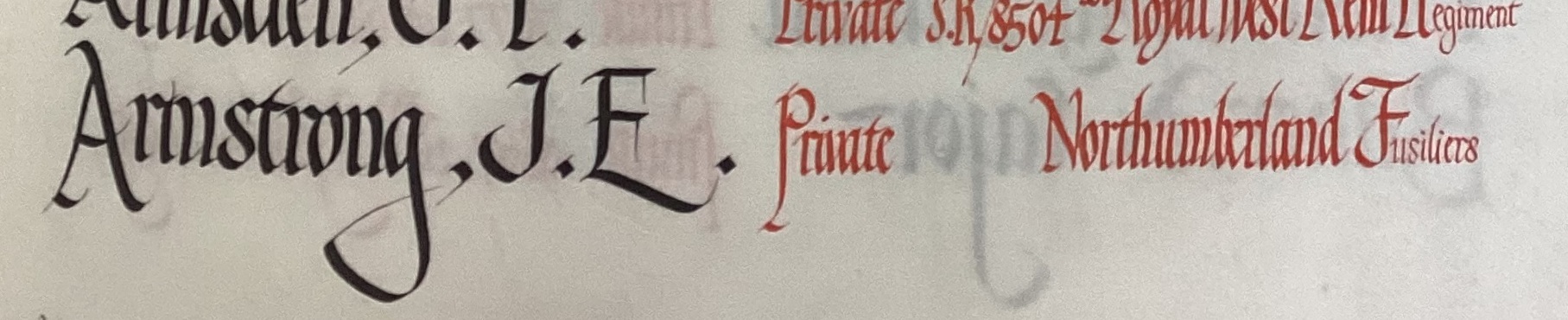
The second name has all his details and matches up perfectly with all the other Army records we have found.

Post war:
His brother George was his next of kin and received his remaining Army pay of £1 5s 10d on 16th of July 1919 and a war gratuity of £5 4s 2d on the 11th of December 1919.
George appears to have applied for a Dependant’s Pension but none of the pension cards show an amount being paid to him.
He would have received John’s medals (inscribed as E. Armstrong) plus a war memorial plaque and memorial scroll inscribed with his name. Any of John’s personal effects would have been sent to George as well.
George was aged 32 and living at 58, George Street in Saltaire during the 1921 census, with his wife Sarah Hannah aged 33 and their children Charles Godfrey aged nine, Harry aged seven and Clara aged one. George was employed as a dyer’s labourer.
In the 1939 register, George was aged 52 and a spinning warehouseman. He was also an Auxiliary fireman in the civil defence for Saltaire during the second world war period. They were living at 24, Baker Street in Shipley with Elizabeth Godfrey, a widow aged 77 on unpaid domestic duties. Three children were living with them – Harry aged 26, Clara aged 19and Dorothy aged 15.
George died aged 74 on the 10th of May 1963 and his death was registered at Blackpool in Lancashire, suggesting they had retired to the coast. The probate record gives an address of 64, Chepstow Road in Blackpool and he left £672 5s to his son Charles Godfrey Armstrong.
Information sources:
West Yorkshire, England, Church of England Marriages and Banns, 1813-1935.
1891 England Census.
England & Wales, Civil Registration Death Index, 1837-1915.
England & Wales, Civil Registration Birth Index, 1837-1915.
West Yorkshire, England, Church of England Births and Baptisms, 1813-1910.
1901 England Census.
1910 United States Federal Census.
1911 England Census.
British Army World War I Pension Records 1914-1920.
Keighley News archives at Keighley Library.
Commonwealth War Graves Commission.
Soldiers Died in the Great War, 1914-1919.
British Army World War I Medal Rolls Index Cards, 1914-1920.
World War I Service Medal and Award Rolls, 1914-1920.
Army Registers of Soldiers’ Effects, 1901-1929.
World War I Pension Ledgers and Index Cards, 1914-1923.
1921 England Census.
1939 England and Wales Register.
England & Wales, Civil Registration Death Index, 1916-2007.
England & Wales, National Probate Calendar (Index of Wills and Administrations), 1858-1995.
