
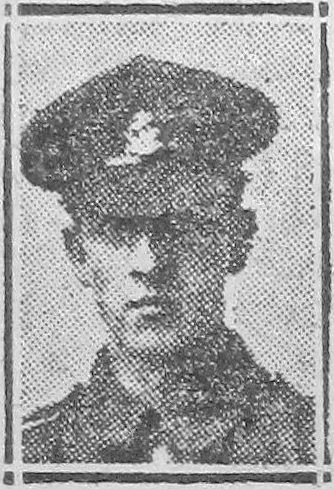
Known as Harry or Henry.
2/4th Battalion, Duke of Wellington’s West Riding Regiment. Regimental number 205649.
Early life:
Robert was the son of Robert Armstrong and Amelia Armstrong née Newton who were married at St. John The Evangelist Church in Baildon. John was aged 21 and a veterinary student and Amelia was 27 and a veterinary student. They both lived in Baildon at that time.
Robert Henry Newton Armstrong was born on the 6th of May 1895 and his birth was registered in Wharfedale. In the family he was known as Harry, probably to separate him from his father’s name of Robert.
In the 1901 census they were living at 12a, Simes Street in Bradford. Father Robert was a 26 year old drayman and carter and Amelia was aged 29 and looking after the family home. Their two children were Harry aged five and Madge aged four months – having been born on the 6th of December 1900.
Both Harry and Madge were baptised together at the Orthodox church of St. Mary Magdalene in Manningham on the 14th of August 1902. The family were living at 11, Arcadia Street and their father Robert was a driver.
By the time of the 1911 census they were living in Keighley. They were at 42, Bradford Street in 1909 then 22, Eastwood Square in 1910. In 1911 they moved to 57, Emily Street and this became their permanent home.
Robert was now aged 39 and employed as a mechanic labourer at a machine works. Amelia was now aged 43 and they had been married for 18 years. They’d had five children, two of whom had died and three were still living. They were Henry aged 16 and employed as a dyer’s apprentice, Madge aged eleven and Daniel aged five who were both at school. Their home was at 57, Emily Street and they had a boarder named John Shutt who was a foundry labourer working in a malleable iron foundry.
War service:
There are no Army service records for Robert Henry Newton Armstrong but other records can give us clues to his service. The newspaper suggests he entered France in December 1917 and supposing a period of three months training in the UK, gives us an estimated date for his enlistment in Keighley around August or September 1917. The Soldier’s Effects record suggests his service began around July 1917 so we’re somewhere close for him enlisting after summer 1917.
Overseas:
As said, Henry had entered France in December 1917 and was serving with the 2/4th Battalion West Riding Regiment for his whole time overseas. He was killed in action on the 20th of July 1918.
The 2/4th Battalion war diary shows movements and locations where he would have served and we have outlined them here by month.
December 1917:
Beaumetz (camp). Entrained to Bailleulmont. Route march to Montenescourt. Route march to Chelers. Route march to Vendin-Les-Bethune. Route march to L’Ecleme. Route march to Vendin-Les-Bethune. Route march to Chelers.
January 1918:
By rail from Tinques to Maroeull and the Gavrelle section of the line.
February 1918:
Oppy (in the line near Gavrelle), Anzim St. Aubin (billets), moved to Stewart’s Camp at Roclincourt. Moved into billets at Villers-Brulin via train at Ecurie.
March 1918:
From Villers-Brulin to Ecoivres in the line at the Arleux sector. Springvale camp at Ecurie, moved into camp at Mount St. Eloi. Moved to hutments at Duisans then into the line at a position near Achiet-le-Petit. A major operation took place here between the 25th and 31st.
Souastre (camp)
April 1918:
Into billets at Henu. Dugouts and cellars at Sailly-Au-Bois then in support at Ablainzevelle and then into the front line.
Divisional reserve at Pigeon Wood and then Corps reserve at Warnimont Wood.
May 1918:
Bois De Warnimont, moved into the line at Bucquoy.
June 1918:
Went into huts at Valley Camp, Souastre. In the field near Rettemoy Farm. From here into billets at Henu.
WO-95/3086/1. War diary of the 2/4 Duke of Wellington’s West Riding Regiment:
HENU.
July 1918.
14th. The Battalion received orders to move South, and entrained at MONDICOURT at 9 pm.
16th. The Battalion detrained at MAILLY and proceeded by bus to CHALONS, and from there by conte March to RECY.
17th. The Battalion moved by route march to CHERVILLE.
19th. The 1st moved by route march to GERMAINE, and bivouaced in the forest de Rheims.
20th. The Battalion went into action in the vicinity of MARTAUX, and the wagon lines were moved into the Forest de Rheims near COURTAGNON. (For narrative of operations see appendix).
30th. The Battalion came out of the line, and moved to the wagon lives, near COURTAGNON.
31st. The Battalion moved by route March into bivouacs in the Forest de Rheims between ST IMOGES and GERMAINE.
Narrative of Operations for 20th July onwards:
(The National Archives’ reference WO 95/3086/1)
Map References, REIMS S.0. Sheet 34 1/50,000. Flle.de JONCHERY-SUR-VESLE 1/20.000.
At midnight JULY 19/20 1918 the battalion marched from GERMAINE to an assembly point in the FORET de LA MONTAGNE DE REIMS about 500 metres South of COURTAGNON.
At 8 a.m. July 20th the battalion moved off from this position to the attack.
The left boundary of the battalion rested on the North bank of the river ARDRE and the battalion frontage extended to about 700 yards in a North-Easterly direction.
The 2/4th Hants were on the right of the battalion and on the South side of the river ARDRE the 51st Division continued the line.
The line of the general advance was North-Westerly in the direction of POURCY-MARFAUX-CHAUMUZY-BLIGNY. T
The 185 and 187 Infantry Brigades had objectives allotted on this front and the intention was that the 186 Infantry Brigade would leap-frog through them and proceed to a further objective.
The 2/4th Duke of Wellington’s Regt. moved in column of route and when clear of the Ferme de Courtagnon broke into company artillery formation. Two companies in the front line and two companies in support.
The artillery barrage which was to support the advance of the 185 and 187 Brigades did not appear to have started or if so it was not perceptible.
As the battalion approached POURCY it came under severe machine gun fire from the BOIS DE COUTRON and it necessitated shaking out into an extended line.
At this time the attack by the 51st Division did not appear to have started and the left flank of the battalion was exposed.
Owing to the nature of the country the 2/4th Hants, had to follow for some distance in rear of the 2/4th Duke of Wellington’s and they were not yet up on the right flank.
For a little while the Battalion seemed in rather an exposed position and its flanks were likely to be turned if the enemy made any counter-attack.
It was about this time 10 a.m. that the enemy artillery began to open fire, but at first it was very slight and with no special direction.
The casualties were beginning to become heavy but the advance continued in two waves.
After passing through POURCY the machine gun and artillery fire became more intense but the line continued to advance.
When within about 600 yards of MARFAUX the battalion came into touch with the 185 Inf. Brigade which was held up and unable to advance.
At this point the two waves merged into one and mixed with the units of the 185 Brigade tried to press forward. The companies on the left by the river ARDRE never came into touch with the 185 Inf. Brigade.
The advance proceeded slowly, and being held up by several strong points and a farm MIN d’ARDRE.
The platoons on the left stormed and took the farm and another platoon took a strong point slightly North of the farm killing the occupants and securing two machine guns. On the right close to the road a platoon of another company attacked a post, took 14 prisoners and two machine guns.
By this time the right flank had rather extended beyond their boundary and were working in conjunction with the 185 Inf. Brigade., through the southern edge of the BOIS DE POURCY, meeting much machine gun fire.
Nearly 50% of the battalion by this time had become casualties but with splendid spirit they gradually worked their way forward.
On the left isolated units pressed forward to within 70 yards of MARFAUX and one platoon on the Northern edge of MARFAUX actually entering the village, but the village was held in strength and they had to retire by twos and threes.
At about 3 p.m. the advance was completely held up, and the battalion was very much disorganised, small units being well up to MARFAUX but the general line was about 300 yards on the Eastern side of MARFAUX. At nightfall the line was reorganised. On the right it was situated in the old French line and on the left some distance in front of this line and about 400 yards from MARFAUX.
On July 21st the line remained in the same position and no advance was made. Opportunity was taken to organise the remainder of the men into one unit under the only company commander left.
Henry was killed in action during this operation on the 20th of July. His death was reported a month later in the Keighley News. He was buried at Jonchery Sur Vesle and his grave was later exhumed and on 19th of September 1919 he was reburied in Marfaux British Cemetery.
Keighley News, 24th August 1918:
Private Robert H. N. Armstrong (24), West Riding Regiment, of 57, *Henry Street, Keighley, has been killed in action. He had been nine months in France, and had previously been in hospital with trench fever. He was formerly employed by Messrs. Ward Haggas & Smith, machine tool makers, Keighley, as a crane driver.
*actually it was Emily Street, not Henry Street.
Remembrance:
Henry’s grave is at grave 1, row C, plot II of Marfaux British Cemetery. His mother Amelia requested an inscription which said simply: ‘TILL WE MEET.’
Henry is remembered locally in the Borough of Keighley roll of honour at Keighley Library.

Post war:
His mother Amelia was the sole legatee in his will and she received his Army pay of £12 9s 7d on the 23rd of November 1918. She later received a war gratuity payment of £3 10s 0d on the 9th of December 1919. Amelia would have also received his British War Medal and Victory Medal around 1920 or 1920 and a bronze war memorial plaque and memorial scroll inscribed with his name.
She also applied for a dependant’s pension and received a payment for life of 10 shillings per week, beginning on the 11th of February 1919.
On the 5th of April 1920, Henry’s sister Madge was married to Robert Heaton at Holy Trinity Church on Lawkholme Lane in Keighley. He was 21 and she was 19. They had two children, Dorothy born in 1920 and Marjorie born in 1922.
In 1921 Robert and Amelia were still living at 57, Emily Street in Keighley. Robert was aged 49 and a textile machinery fitter for P. Smith and Son (although too ill to work at this time) Amelia was 53 and on home duties. Living with them was their son Daniel aged 15, employed as a bobbin taker-off for J. P. Heaton worsted spinners at Low Mills; Also living here were their son in law Robert Heaton aged 22 employed as an engine fitter by the Keighley Gas and Oil Engine Company at Dalton Lane, his wife (their daughter) Madge Heaton aged 20 and their baby daughter Dorothy aged just nine months.
Henry’s father Robert died at the age of 49 in 1922, his death was recorded at Keighley in the third quarter of the year.
Henry’s sister Madge:
Madge’s husband Robert Heaton died at the young age of 27 in 1927. His death was registered at Keighley in the first quarter of the year.
Madge remarried in 1932, to Thomas Plumb. She was aged 32 and he was aged 29.
In the 1939 register, Henry’s mum Amelia was aged 75 and incapacitated. She was living at 260 Guard House Road in Keighley with Thomas and Madge Plumb and their two children Dorothy N. Heaton and Marjorie N. Heaton, who were by now aged 19 and 17.
Amelia died the next year aged 75 and her death was registered in Keighley in the first quarter of 1940.
Madge died at the age of 67 in 1968 and her death was registered in Keighley in the last quarter of the year.
Information sources:
West Yorkshire, England, Church of England Marriages and Banns, 1813-1935.
England & Wales, Civil Registration Birth Index, 1837-1915.
West Yorkshire, England, Church of England Births and Baptisms, 1813-1910.
1901 England Census.
West Yorkshire, England, Electoral Registers, 1840-1962
1911 England Census.
WO-95/3086/1. War diary of the 2/4 Duke of Wellington’s West Riding Regiment.
Keighley News archives at Keighley Library.
Commonwealth War Graves Commission.
Marfaux British Cemetery, France.
Soldiers Died in the Great War, 1914-1919.
British Army World War I Medal Rolls Index Cards, 1914-1920.
World War I Service Medal and Award Rolls, 1914-1920.
Army Registers of Soldiers’ Effects, 1901-1929.
World War I Pension Ledgers and Index Cards, 1914-1923.
1921 England Census.
England & Wales, Civil Registration Marriage Index, 1916-2005
England & Wales, Civil Registration Death Index, 1916-2007.
1939 England and Wales Register.
