
Lees, Cross Roads and Bocking war memorial.
Cross Roads Primitive Methodist Sunday School roll of honour.
St. James Church, Cross Roads war memorials.
Lees Methodist Church war memorial.
People from Lees and Cross Roads who served in wartime.
This page contains details of Lees, Cross Roads and Bocking people who served in the Great War and the Second World War.
The Second World War:
There is also a WW2 Roll of Service mounted on the wall at St. James Church (see the relevant page listed above). It is a rectangular framed and glazed board with three sheets of paper containing 283 names. There is no date on this roll, but we believe it’s from the Second World War because some of the military terms are from that era. Also, at least eight (possibly more) of the men named on it were killed in the Second World War:
They are:
Askam, Joseph
Birtwhistle, Eric
Cleverly, George Edward
Green, Wilfred Sutcliffe
Smith, J. W. (Sadly we cannot identify this man)
Sunderland, Cecil
Taylor, Jack.
Thornber, Jack
The 1914 – 1918 Great War.
On Saturday 16th July 1921 the Cross Roads memorial park was opened and the new war memorial and building was unveiled in a prestigious ceremony for the close-knit communities of Bocking, Cross Roads and Lees. This was reported in detail in the following week’s issue of the Keighley News.
Keighley News. Saturday 23rd July 1921:

WAR MEMORIAL AT CROSS ROADS.
RECREATION GROUND GIFT
MAJOR CLARKSON UNVEILS MEMORIAL TABLETS.
The inhabitants of the village of Lees, Cross Roads, and Bocking have reason to congratulate themselves on having brought to a successful conclusion their war memorial scheme.
While people in larger places have made little or no progress in the direction of perpetuating the memory of those who laid down their lives in the recent war, a committee of forty ladies and gentlemen representing every public body in Lees, Cross Roads and Bocking have worked hard and diligently on the memorial scheme and last Saturday saw the consummation of their efforts when a recreation ground, in which stands a neat little building, was formally opened, Two areas of the ground are reserved for the children as a playing field, and in the grounds are a tennis court and a bowling green, the latter being in course of completion. It should be stated, however, that the tennis court and the bowling green are not part of the committee’s war memorial scheme, but permission was given to the committees of the two clubs to establish them within the memorial ground. The cost of these have been borne by the two clubs, but the rent in respect of each will be paid to the War Memorial Committee. For the land, the committee are indebted to Mr T. H. Haggas who made a gift of 14,580 square yards, leaving a margin of 3,690 square yards to be purchased for £200.
THE MEMORIAL BUILDING.
|
|
|


The memorial building measures 38ft by 15ft and has a centre portion in which is a concave recess where tablets have been placed containing the names of those who died or served during the war.
About 260 men from the village served and thirty-nine lost their lives.
Their names are:-
William Ackroyd, Arthur Bower, Ernest W. Caley, Horatio Claughton Frank Clayton, Fred Coates, Bertie Colledge, Richard Davies, Nelson Dufton, George Earnshaw, Tom Ellis. George Feather, M.M, A. Gott, John H. Hitch, Arthur Hutchinson, Harry Liddemore, Luther McKechnie, Harry Mitchell, Luther J. Murgatroyd, Herbert Nicholson, Fred Nixon, Tom Nixon, Norman Preston, Ernest Richmond, Charles Robertshaw, Fred Roe, Percy Shackleton, Herbert Shread. Harry C. Snaith, Wright Stanley, Joseph Stell, Raymond D. Tilbrook, Vernon Turner, Walter Wagstaff, Raymond Walmsley, Walter Walsh, George C. F. Wane, Frank Waterhouse and Horace Wood.
The cost of the original scheme was £2,277, but later the committee dispensed with the terrace, asphalt paths, and other smaller items, leaving the probably cost of the scheme as carried out at about £1,700.
The compilation of the scheme is largely due to the generosity of well-known local ladies and gentlemen, societies, and the general public, all of whom have responded liberally.
It is worthy of note that among the subscriptions were the following: Mr. E. H. Gates, £250; Mr. M. H Merrall, £250; and Lees and Cross Roads Cooperative Society, $200.
The opening on Saturday last was marked by the deepest reverence, and was attended by a large company, including discharged and demobilised ex-service men. Mr. T. H. Haggas (chairman of the committee) presided and was supported by Major A. B. Clarkson, D.S.O., M.C., the Rev. J. Wood (Vicar of St. James’s and treasurer to the committee) Mr. J. Dickinson (secretary), and the members of the committee.
A PERMANENT REMEMBRANCE
|
|
|


Mr. Wood conducted the devotional portion of the service, and after the hymns “Oh God our help in ages past” and “For all the saints who from their labours rest” had been sung, the Chairman gave a brief address, in the course of which he outlined the movement which had resulted in the establishment of the memorial. After expressing his gratification at having been invited to that afternoon’s function, Mr. Haggas explained that in 1919 representatives from all the public bodies and the principal workplaces in the village were asked to meet to consider what kind of a war memorial should be erected in the village to the memory of those who had fallen in action and those who had served in the Great War.
Eventually it was decided that a recreation ground would be a permanent remembrance to those men, and would further be a reminder to the public that it was in recognition of the men of the village of Lees, Cross Roads, and Bocking who served. After a public meeting had been called the scheme was assented to and tenders were let. The memorial was one that they believed would suit people of all ages. There was the central part for the older people, and there was portion for a play ground for the children. It was agreed also by the committee who had the matters in hand to allow a tennis court and a bowling green to be constructed in the memorial land on condition that every inhabitant of Lees, Cross Roads, and Bocking might be a member on payment of a nominal sum. Then there was the building or room which would act as a shelter, and thus their scheme had reached fruition. The memorial in the building – the rest house – contained tablets bearing the names of the men who served. It would thus be seen, went on Mr. Haggas, that the committee had been anxious to do everything in their power to ensure that the men who had served should be remembered. “Our thanks are due to those who have helped to retain England’s freedom,” added Mr. Haggas, “and it is the hope of the committee that everyone will make use of this recreation ground.”
PLEA FOR EX-SERVICE MEN.
|
|
|


|
|
|


Major Clarkson then unveiled the memorial tablets, and in doing so said: I unveil these memorial tablets erected as an abiding witness of the love for freedom, truth, justice and mercy, which moved the heart of this country to enter into war, and also in proud and grateful memory of those connected with this village who gave their lives in that great struggle.
In the course of a brief address the Major said he wished to thank the committee and the inhabitants of the village for so kindly asking him to unveil the memorial. He considered a great honour, and he felt that one reason why he had been asked to do so was because at the outbreak of the war be had the honour to command the local company of the Territorials. He had never ceased to be proud of the local men who fought.
Proceeding, he congratulated the inhabitants of the villages on the memorial they had erected as a reminder of the self sacrifice of the men who bad served and fallen. “I would like to put in a plea for the ex-service man,” proceeded Major Clarkson, “To me it is a horrible thing to see ex-service men, and 99 per are deserving, out of work. It is shocking to see ex-service men and their families in want, and I sincerely hope that the people of this district will bear that in mind, for it seems to be the fashion nowadays to forget the war and what the ex-service man has done.”
OUR DEBT TO THE FALLEN.
Major Clarkson said he often wondered if the people of this country realised from what they had been saved. Here everything was in good order, while in France villages had been entirely obliterated. He instanced Hooge, on the Menin road, and said that though it was indicated on the map, He could find no trace of it. The position of the inhabitants was terrible, for their homes had been wrecked; yet here in England people could live in comfortable homes. We here had been saved from all this this suffering by the armed forces of the Crown. He wished, he said, to recall the words of a man who, although not a Yorkshire-man, bore a Yorkshire title. During the War of Roses, 450 years ago, when Richard, Duke of York, was endeavouring to drive Henry VI from the throne, the Duke got into Sandal Castle, near Wakefield, and in his refusal to surrender to the usurper he made use of the words: “Sure I had rather died with honour than live with shame; for of honour cometh fame, and of dishonour riseth infamy. I hope that you in this district reverence and respect their memory,” In conclusion, he said he wished to say a few words to the relatives of the men who had fallen. “We sympathise with you, we know what it was to lose our best friends, and I would like to recall the words of Rupert Brooke, who wrote to his mother:
If I should die, think only this of me
That there’s some corner of a foreign field that is for ever England.
There shall be in that rich earth a richer dust concealed.
A dust which England bore, shaped, made aware,
Gave, once, her flowers to love, her ways to roam;
A body of England’s, breathing English air,
Washed by the rivers, blest by suns of home.
“Try and think of your men as Rupert Brooke wished his mother to think of him.” appealed Major Clarkson in conclusion.
|
|
|
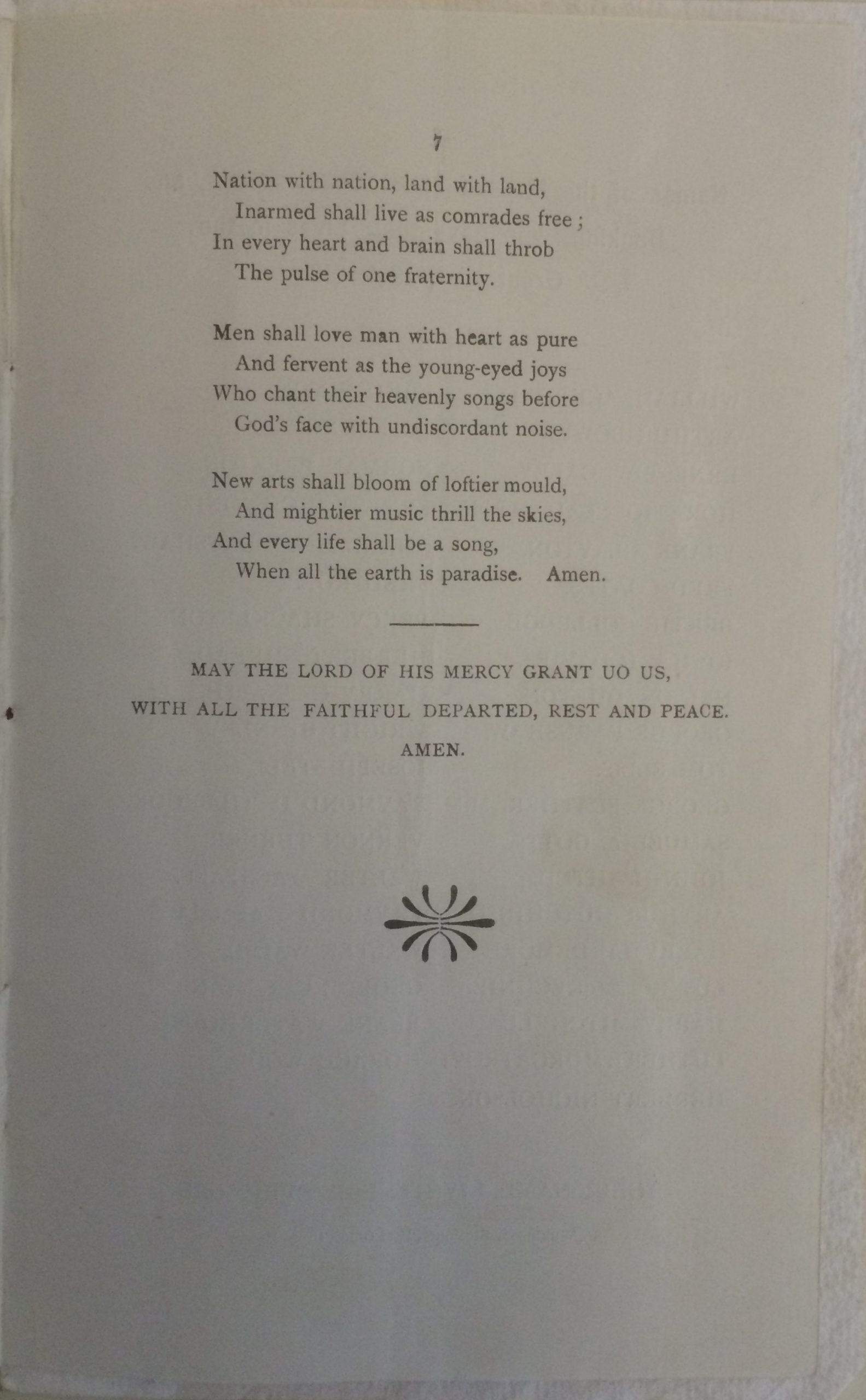

After the Last Post and Reveille had been sounded, Messrs. Robert Ashton, George Grainger, and Sam Williams, on behalf of the ex-service men of the village, placed a chaplet on the memorial, and following the singing of “These things shall be in a loftier place.” Mr. Robert Ashton presented a solid silver flower on behalf of the ex-service men to Mrs. T. H. Haggas, who gratefully acknowledged the gift, which came as a surprise to her. Mr. Ashton was a Reservist in the R.F.A., and both he and Mr. Williams (10th West Riding Regiment) were disabled on active service in France.
The united choirs of James’s Church, Cross Roads Primitive Methodist, and Bocking Wesleyan chapels were present at the service, and the singing of the hymns was conducted by Mr. John Hillary, Cross Roads. The Keighley Borough Band was also in attendance, Mr. John Winterbottom acting as band steward.
About 100 ex-service men were present, and at the close of the service they filed through the Memorial Hall past the shrine, which contained many wreaths of flowers from the relatives and friends of the fallen.
An excellent meat tea was served to the widows and families of men who had died and the ex-servicemen and their families and friends to the number of about 500, at Messrs, Gates’ Dining Room, St. James’ Church School, and Lees Wesleyan School. Mr. F. Brayshaw (chairman of the Tea Committee) was ably assisted by the lady members of the Memorial Committee, as well as the wives of the members.
The heavy thunderstorm which broke across the district about 6 o’clock, resulted in a postponement to August 9 of the evening programme, which included selections of music from the band and sports competitions. For this the war committee are indebted to the Keighley Borough Band. The collections in the church during the afternoon amounted to 13 guineas.
A large number of handsome garden plants have been given to the recreation ground by the various places of worship, clubs, the Institute, the Cooperative Society, employers and others.
Here are the names of those people from Lees, Cross Roads and Bocking who served in the Great War of 1914 to 1918:
Their names appear on a war memorial in the Bowling Club building in Cross Roads Park.
42 people from Lees, Cross Roads and Bocking who died in the Great War:
| William Ackroyd Ellis Bailey * Arthur Bower Ernest W. Caley Horatio Claughton Frank Clayton Fred Coates Bertie Colledge Richard Davies Nelson Dufton George Earnshaw Tom Ellis George Feather MM Samuel A. Gott |
John H. Hitch Arthur Hutchinson Harry Jowett * Harry Liddemore Luther McKechnie Harry Mitchell Luther J. Murgatroyd Herbert Nicholson Fred Nixon Tom Nixon Norman Preston Ernest Richmond Charles Robertshaw Fred Roe |
Sam Schofield Percy Shackleton Herbert Shread Harry C. Snaith Wright Stanley Joseph Stell Raymond D. Tilbrook Vernon Turner Walter Wagstaff Raymond Walmsley Walter Walsh George C. F. Wane Frank Waterhouse Horace Wood |
* Ellis Bailey and Harry Jowett were both from Cross Roads but moved away before the war and are not named on any of the Lees, Cross Roads or Bocking war memorials.
225 people from Lees, Cross Roads and Bocking who served and returned from the Great War:
| Aldersley, W E Alderson, J Ambler, G R Ambler, W Aplin, F Armstrong, W Ashton, R Aspinall, Asa Atkinson, A W Bailey, F Bailey, G Bailey, Har. Bailey, Herb. Bailey, J Bailey, L S Bailey, R Bailey, S Bailey, V Bairstow, W Baldwin, F Barker, E Barker, G Barker, H Barrett, G Barwick, J Bates, A Bell, C S Bell, F Biggins, T W Binns, Arthur Binns, C Binns, F Binns, P Birkinshaw, C J Blezard, T H Bonson, T R Bowker, John R Boyes, Wilfred Boyes, William Bradbury, H Bravery, J Brearley, Herbert Brown, N Bryan, A Buckle, R Burnett, J Carr, William Clayton, A Clayton, R E Coe, C Coe, N Colledge, G Colledge, H Colledge, J R Cooke, A Cooper, W Crabtree, A Crabtree, Ar. Crabtree, H Crabtree, H N Crabtree, J Cunningham, D Dawson, G W Dawson, Wilfred Denby, C Dent, C Dickinson, C Dickinson, F Dobson, F Dodgson, Albert Earnshaw, E Edmondson, Arthur Edmondson, H Eldridge, A F Ellison, J |
Farrar, Allan Feather, Arthur Feather, B Feather, William Featherstone, H Featherstone, L Ferris, H C Firth, A Frankland, F Furness, G Garnham, C Garnham, G. H Gerrard, G Gill, A Gill, T Glossop, J R Goodby, E Grainger, G Greenbank, William Greenwood, A Greenwood, E Greenwood, Harold Greenwood, J Greenwood, W Greenwood, W W Haigh, Edward Haigh, Percy Hardaker, A Hardaker, R Harland, W Hartley, J T Heaton, W Helliwell, W Henson, A Henson, Albt. Hey, Har Hey, Hed Hey, J Hickman, J Hillary, J Hitch, C Hodges, S. M.M. Holmes, J Holmes, R Hornby, A Hornby, H Horner, R Horsman, R Horsman, W Howker, W Hutchins, A Kay, L Leach, Harry Leach, William Learmonth, F T Lee, J Liddemore, G A Liddemore, J Liddemore, O Liddemore, T Liddemore, V Maddocks, J W Mason, H Mason, W McKechnie, A Midgley, P Mitchell, F Moore, E R Murgatroyd, F Murgatroyd, G Myers, C Naylor, J Nicholson, F Nixon, G Nixon, T D |
Oates, H Phillip, T Pickles, F Pickles, J Pickles, J R Pickles, W Place, H Rainford, S Raistrick, H Ratcliffe, C. D.C.M Raw, A Redman, J W Rhodes, H Rhodes, S Robinson, A Roe, J. M.M. Rogerson, H Rundle, S Ryder, A Ryder, G. M.M. Sharp, P Shaw, A Shaw, J Shaw, J W Shoesmith, W Smith, D Smith, F Smith, H Smith, L Smith, W Southern, Henry Southwell, B Southwell, E Spencer, S Stell, D Stoney, R A Storey, C E Storey, F W Storey, G Storey, H Storey, M E Sugden, A Sugden, W Summerson, T A Sunderland, A Sunderland, A E Sunderland, H Sunderland, Michael Tattersall, G Taylor, A Taylor, W Thompson, A Thompson, F Thompson, N Toothill, A Toothill, G Toothill, H Uttley, J Uttley, R Uttley, V Walmsley, H Warner, H Waterworth, J W M.M. Watson, W Watts, H C G Whitaker, S White, Arthur White, E M.M. White, Herbert Wildman, J R Wilkinson, Fred Wilkinson, F Williams, S Wood, B B Woodward, J |
