
Private. 1/6th or 1/7th or 9th Battalion, Duke of Wellington’s (West Riding Regiment). Regimental number 3256 then 300126.
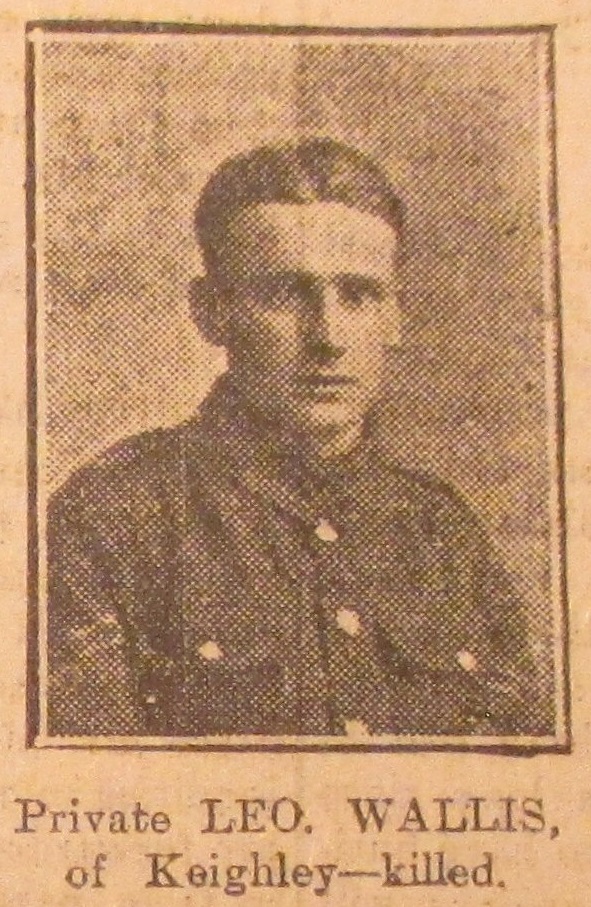
Early life:
Leopold’s parents were Thomas Wallis and Mary Ann Thompson Wallis née Wilson, who were married at St. Peter’s Parish Church in Howden, East Riding of Yorkshire on the 21st of November 1895. Thomas was aged 29 and a seaman living at Howden, Mary Ann was aged 23 and a spinster living at Howden.
Leopold was born on the 18th of April 1897, registered in Keighley in the second quarter of the year. He was baptised at St. Andrew’s Church on the 4th of July the same year. They were living on Bradford Street and Thomas was employed as a teamster.
In the 1901 census Leopold was aged three and living at 15, Rupert Street in Keighley with his parents Thomas aged 34 employed as a general labourer. Mary Ann was aged 28. His siblings were Florence Mary aged ten, Fred aged seven and Harold aged just eight months.
By the time of the 1911 census Leopold was aged 13 and living at number 39 Nashville Terrace in Keighley with his parents Thomas aged 45 and employed as a wireman for the National Society(?) (The National Telephone Company), mother Mary was aged 38. They had been married for 21 years and produced six children, all of whom were still living. Fred (aged about 17) appears to have left home at least for the date of the census. Living here were Florence Ann aged 20 and employed as a spinner for a worsted mill; Leopold aged 13 and employed as a doffer at a worsted mill; Harold aged ten and attending school, Gordon Chesalin aged six and at school. The youngest was Lloyd George, aged just 18 months.
Leopold seems to have had a bad time of things and could not hold a job down, having had several of them. He appeared in court, reported by his father for obtaining a ham under false pretences and this appears to be the final straw as the story went much deeper than a half pound of ham. The Children’s court report is printed in the newspaper about the case.
Keighley News, Saturday 9th December 1911, page 7:
AN INCORRIGIBLE KEIGHLEY BOY.
HAD THIRTY-FIVE SITUATIONS IN EIGHTEEN MONTHS.
A sad story of youthful depravity was told at the Keighley Children’s Court on Monday last in a case in which Leopold William Watson Wallis (14), mill- hand, residing in Clifton Street, Keighley, was charged with obtaining half a pound of ham, valued at sixpence, by false pretences from John Williams, grocer, Bradford Road, on November 28.
GOT HAM BY FALSE PRETENCES.
Superintendent Birkhead stated that at the time the lad was employed by the Stockbridge Finishing Company and whilst there he had on several occasions visited Mr. Williams’s shop and made purchases for men employed at the works. On November 28, after paying for several articles, he handed a note to Mr. Williams which read, “Will you let the boy have had a round of ham for Harry Clough until Friday night. Mr. Williams, knowing such a person was employed at the works and traded at his shop, supplied the defendant with the ham. Later in the day Clough discovered that the ham had been obtained in his name, and when he spoke to the lad about it he commenced sulking and refused to say anything. The case was reported to the police by the lad’s father, who desired proceedings to be taken.
John Williams, grocer, Bradford Road, Keighley and Harry Clough, cloth finisher, employed by the Stockbridge Finishing Company, and residing at Morton Banks, corroborated.
Defendant pleaded guilty, and told the Bench that on the day in question he had nothing for his dinner except bread and butter, and he wanted something else. He meant to pay for the ham on Friday night.
SENT TO A REFORMATORY.
In answer to the Chairman (Mr. Shem Paget), Superintendent Birkhead said he had been informed that the lad would steal anything he could lay his hands upon from his father’s house. His father gave him a very bad character. He had worked at almost every place in the town; in fact, he believed that during the past eighteen months he had had no less than thirty-five situations, and had never yet taken home a full week’s wages. Even on the day when he was dismissed at the Stockbridge Finishing Company’s works he only took home 2s. 2d., having spent 2s. 7d. of his wages. It was at the father’s request that proceedings had been taken, and he believed he wishes to make application that the lad be sent to a reformatory school.
Mr. Willis also spoke to his son’s bad character, and added that on one occasion he had threatened his mother with a knife, and she had to call in neighbours to prevent mischief.
The Chairman: Don’t you think it would meet the case if he were placed under the care of the probation officer for a few weeks?
The Father: He cannot get work. No one will have him.
The Chairman: The Bench have decided to adjourn the case for a week in order to consider it more fully. You must be here next Monday.
The lad said he would rather go away that day if he had to go away at all.
After consultation the Bench decided to send the lad to the Calder Vale Farm Reformatory until nineteen years of age, and the father was ordered to contribute 2s per week towards his son’s maintenance.
Calder Farm Reformatory School was located about half a mile South East of Mirfield in West Yorkshire. It was in a rural setting with fields cultivated by the inmates and a completely different way of life to what Leopold was used to.
Their record for Leopold shows he was aged 14 and born on 18th April 1897. His home address at the time was 39, Clifton Street (which is actually the same address as 39, Nashville Terrace) when he was admitted for ‘Obtaining half a pound weight of ham under false pretences.’ His sentence was until 19 years of age and he could read and write well. His religious denomination was Congregational.
Leopold was generally sound and healthy, had not been vaccinated but was free from cutaneous disorder, of sound intellect, not subject to fits and had good eyesight – although his right eye was slightly defective.
Leopold was registered number 1584 at Calder Farm and admitted on the 4th of December 1911. He was 4 feet 8 inches tall with a fresh complexion, light brown hair and brown eyes and a slender figure. He weighed 5 stone and had three teeth missing. He also had a cut scar on his right forehead.
Leopold had attended school at Wesley Place Council School in Keighley and his reading and writing ability were described as ‘fair’ and were to Standard five.
Apparently he had read harmful literature. He was a mill worker and he had never slept out.
With regard to his crime he stated he got the eatables in another man’s name because he was hungry. He had only had bread and butter for his dinner.
His father Thomas was employed as a wireman by the National Telephone Company. His parent’s character for industry, honesty and sobriety was fair. Leopold was under parental control but they had not treated him harshly. His other relative was his Aunt, E. Farrar at Clarence Arms of Argyle Street in Hull.
War service:
Leopold does not seem to have spent the full five years at Calder Farm, because he appears to have enlisted (or attested) at Greenfield in Lancashire in September 1915. Perhaps he offered to enlist as a reason for early release for the reformatory school. He did not go overseas until early 1916 and was probably called up under the Derby Scheme at that time. His Regimental number with the West Riding Regiment was 3256, followed by a change to a six figure number 300126, probably in early 1917.
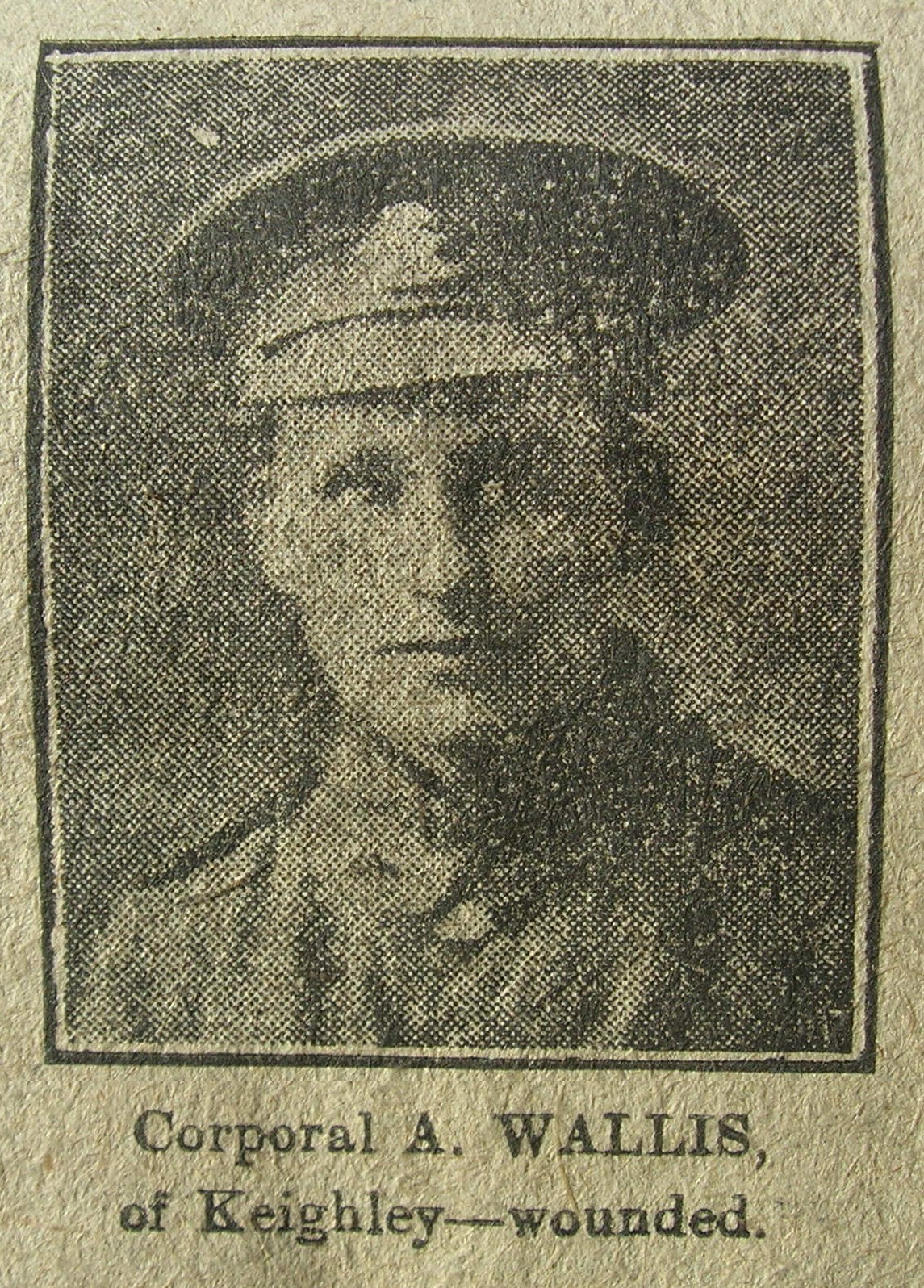
Leopold was wounded in 1916, although we have no further details apart from a newspaper report on a ‘Corporal A. Wallis’ living at the same address being wounded on 3rd September 1916. We believe that the newspaper made a typographical error and put an A instead of an L for Leopold’s initial. It would also mean that he held the rank of corporal at some point. The photo at the top of this page also shows he was wearing Corporal’s stripes on his uniform. Perhaps he was demoted to private at some point. No ‘A’ Wallis is recorded with this family.
Keighley News, 2nd February 1918, page 3:
Private Leo Wallis, of the West Riding Regiment, of 2, Buxton Street Keighley, has been reported killed, after being missing for nine months.
He enlisted in September, 1915, and had been in France about two years. He was wounded in November 1916. Before enlistment he was employed by Messrs. Prince Smith & Son, Keighley.
Records conflict with regard to who Leopold served with. The medal roll shows he was serving with the 1/7th Battalion West Riding then went to the 9th Battalion West Riding when he was killed in action. The Commonwealth War Graves Commission indicates he was with the 1/6th Battalion West Riding before being attached to the 9th Battalion.
The Soldiers’ effects record shows he was serving with the 9th Battalion when he died.
The Borough of Keighley roll of honour shows he was with the 6th Battalion.
The important detail is that all the records apart from the roll of honour agree he was serving with the 9th Battalion West Riding when he was killed, so we have included a transcribed section of their war diary for the days either side of and including the 25th of April 1917.
W0/95/2014/1_2: War Diary:
9th Battalion, Duke of Wellington’s West Riding Regiment.
April 1917.
TRENCHES BY ARRAS. 19th April:
The Battalion was relieved by the 10th Sherwood Foresters at 4.0 pm and returned to billets at ARRAS. the Battalion is billeted in ROE DES CAMBRI. These billets are bad being very much broken down by shell fire. The total casualties for the tour in the trenches was, 1 officers wounded, 1 sick. 14 other ranks wounded and 4 killed.
ARRAS. 20th April:
The Battalion spent the morning in cleaning up. At 2.30 pm. de Battalion moved to better billets in the centre of the town & close to the GRAND PLACE.
ARRAS. 21st April:
The Commanding Officer Lt. Col. tr. V. L. P. Leach inspected the equipment of the companies in the morning, the rest of the day was given to the men for rest etc.
ARRAS. 22nd April:
The Battalion was held in readiness to proceed to the trenches at 4 hours notice. In the morning inspections were held under company arrangements. At 8.0 pm the Battalion was placed under half an hours notice to move and in consequence the whole Battalion was confined to Billets.
TRIANGLE RESERVE TRENCH. 23rd April:
The Battalion moved up to THE TRIANGLE, at 4.30 am and at 8 pm. again moved up to the support trench in ORANGE HILL.
SUPPORT TRENCH ORANGE HILL. 24th April:
At 12.30 am. The Battalion was ordered to move out from the support line Orange Hill & occupy trenches in MONCHY WOOD with a view to advancing through NORTHHUMBERLAND FUSILIERS & attacking, towards KEELING COPSE in the afternoon.
The Battalion was shelled near the Sunken Road again in MONCHY. No trenches could be found in MONCHY WOOD & the Battalion was withdrawn to the support line on Orange Hill again, with the exception of B’&’C’ Coy which remained near MONCHY. We had 1 officer casualty Second Lieutenant FIELDEN & 4 other ranks, all these were wounded.
Trenches H36.d.8.8. to I.31.c.8.6. 24th April.
The Battalion spend the day in the support trench on ORANGE HILL & at 9.0 pm the Battalion moved up to the front line trenches held by the 7th EAST YORKS running from H36.d.8.8. to I.31.c.8.6., ready to make an attack on RIFLE TRENCH. (map 51B N.W.).
The C.O. received final instructions at 8.30 pm. The jumping off place for attack was given as a taped line running from O.1.a.6.9. to H.36.d.7.3. and the advance was to start from zero.
The Battalion proceed to SUNKEN ROAD at H.36a.4.4.
The Battalion resting under the shelter of the bank, & the following instructions were given verbally to Company Commanders. Letters A & D Companies will assault RIFLE TRENCH extended in two lines at 20 paces distance.
A Company frontage from the junction of BAYONET and RIFLE TRENCH to I.31.a.6.7 and D Company from latter point to junction of RIFLE TRENCH with HARNESS LANE.
B Company will follow in support with tools for consolidation extended over the whole Battalion front. C Company will take over the left of the EAST YORKS line trench from I.31.c.4.5 to when it joins HARNESS LANE and will remain in reserve under orders of the C.O. The Battalion moved off to their positions at 2.0 pm. (actually 2.0 am)
25th April:
The Battalion advanced from their positions at 3:20 am. with riflemen & bombers in the front line & Lewis gunners & rifle bombers in the 2nd line and 1 Lewis gun squad and 1 bomb squad from B Company and C Company joining A & D respectively. by and, AVD respectively. The advance was steady, and our artillery barrage opened at 3.35 am which was 5 minutes before the time arranged. The enemy were quiet except for intermittent shelling of MONCHY & Battalion Headquarters.
At 3.35 am the enemy fired very many Very lights, red light breaking into 2 & golden rain being sent up, & there was a certain amount of machine gun fire.
At 3.37 am the enemy barrage opened shell falling over and just short of our first line trench, & a terrific machine gun & rifle fire barrage opened on our advancing troops, the advance still went on steadily till we were about 100 yards from the enemy trench when whistles were blown & the machine gun & rifle fire grew even worse and our men were forced to retire back to our trench, where they were reorganized & sent over again but met with the same reception again until for the third time they went over but had to retire, then 2 platoons of C Company on reserve went in strengthen them and they went over for the 4th time but failed to reach the trench except on the right of the line where the fire opposite was not so heavy, but had to retire at night. The following telephone messages were received from of OC C Reserve Company.
4-0 am OC Reserve Company and the East Yorkshire Regiment report that some men of our D Company had retired back to our front line trench.
4.25 AM. OC our Reserve Company reports that men of our A, B, & D Companies had retired back to his trench and state that they got 3/4 of the way but were driven back by heavy machine gun fire. They thought some of our men were in Rifle Trench and could hear bombing going on. No officer had returned to our trench as far as he could see.
4.45 am. OC Reserve Company reports the men to who had retired had gone over again in good style.
5-0 am. OC Reserve Company reports that party of our men had again retired saying they had been stopped by the Machine Gun fire and shells.
5-45 the EAST YORKS report that our attack has been blotted out in places, & that their bombing party had bombed up BAYONET TRENCH and are going along RIFLE TRENCH and are in touch with some of our men.
8-0am. Our situation was not quite clear but it appeared that we had got into RIFLE TRENCH on the right of our front only,
The EAST YORKS had failed in their bombing attack in conjunction with our own attack, & we were back in our original positions.
Dawn was breaking after our 4th attempt was tried & the CO thought that any further attempt would be useless.
Our casualties were heavy having 4 officer wounded, viz Captain MOLYNEUX, Lieutenant HUXTABLE and Second Lieutenant SELWAY & Second Lieutenant DRIVER and 3 officers missing. Viz, Second Lieutenant HATHERALL. (believed killed) Second Lieutenant SMITH. (believed wounded) Lieutenant CHAPMAN (believed killed) and 210 other ranks.
The Battalion came out of the trenches at night and proceeded to ARRAS.
26th April:
The Battalion entrained at ARRAS station at 10:30 am. and proceed to SAULTY detraining there & marching to SUS ST LEGER, where we went into the same billets that we had before, arriving at 6-20P.M
At some point on the 25th of April, Leopold went missing. His body was never found and eventually he was declared dead on or around that date.
Remembrance:
Leopold is remembered on the Arras Memorial and his name appears in the Borough of Keighley Great War 1914-1918 roll of honour book, which is on display upstairs at Keighley Library.

Post war:
Leopold’s parents would have received his personal effects and his medals which were the British War Medal and Victory Medal, plus a bronze war memorial plaque and scroll inscribed with his name.
His mother as sole legatee in his will, received his outstanding Army pay which amounted to £2 2s 2d on 22nd April 1918 plus a 10s payment made to her on 20th January 1920 and a war gratuity payment of £7 on the same date.
His mother Mary Ann applied for a Dependant’s Pension and received 5 shillings per week beginning on the 6th of November 1918. On her death in 1945, Thomas applied to receive the pension but appears to have been refused on the grounds that he had no prior dependence on his son.
Mary Ann died in 1945 and Thomas died in December 1949, registered at Keighley in 1950.
Information sources:
East Riding, Yorkshire, England, Church of England Marriages and Banns, 1754-1950.
England & Wales, Civil Registration Birth Index, 1837-1915.
West Yorkshire, England, Church of England Births and Baptisms, 1813-1910.
1901 England Census.
1911 England Census.
Keighley News archives at Keighley Library.
West Yorkshire, England, Reformatory School Records, 1856-1914.
Commonwealth War Graves Commission.
Soldiers Died in the Great War, 1914-1919.
World War I Service Medal and Award Rolls, 1914-1920.
Army Registers of Soldiers’ Effects, 1901-1929.
World War I Pension Ledgers and Index Cards, 1914-1923.
1921 England Census.
