
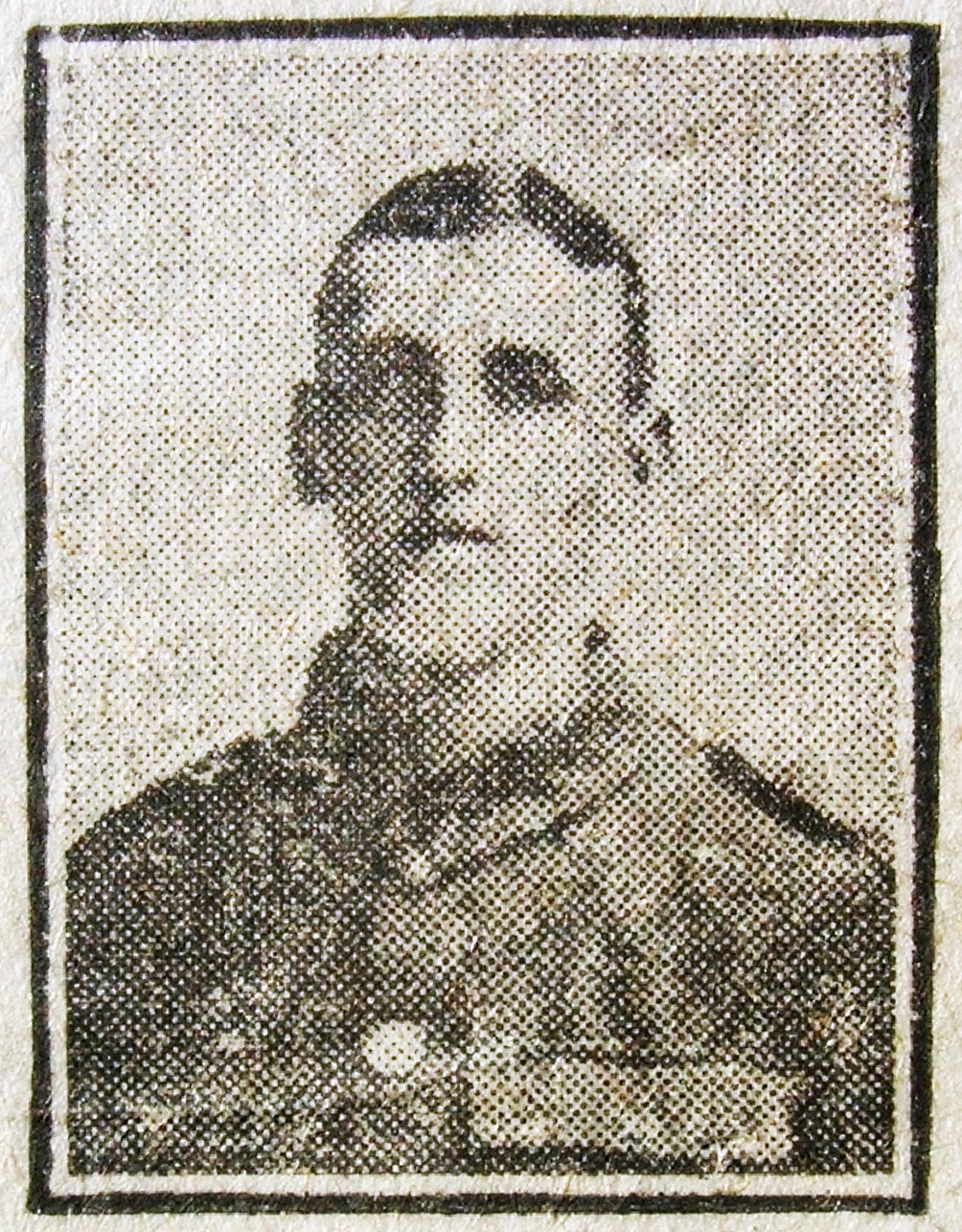
Private. 1/5th Battalion, Duke of Wellington’s West Riding Regiment. Regimental number 5879 and 242149
Early life:
George’s parents were Benjamin William Ely and Ellen Ely née Rutter Stones, who were married at Spilsby in Lincolnshire in the last quarter of 1892.
George was born in the first quarter of 1892 at Toynton St. Peter and registered at Spilsby in Lincolnshire.
Their daughter Edith May died aged just one on the 20th of November 1897.
Their son John Clifford died aged just one on the 20th of April 1899.
In the 1901 census George was eight years old and as recorded living at Fenside, the home of his maternal grandparents William and Mary Rutter. He may have been there only temporarily.
His parents were living at 4, Fruit Street in Keighley and it’s possible they’d moved here to get settled in and had two children with them at that time. Perhaps it made things easier temporarily for them.
Benjamin was aged 30 and was employed as a labourer in an iron works, Ellen was aged 28 and looking after the family home with their two youngest children Alice M. aged seven and Ellen G. aged just one.
By the time of the 1911 census George was aged 18 and living here in Keighley at 3, Riverside off Dalton Lane with his parents Benjamin aged 40 a labourer for the Rustless Iron Company (known as TRICO and still a going concern today) and Ellen aged 38. They had been married for 18 years, produced nine children, two of whom had since died (mentioned earlier.) The surviving children all still lived at home and were George William, a wool comber; Alice Marion, aged 17 and a wool spinner; Ellen Gladys aged eleven; Elsie Damarious aged nine, Arthur Edward aged seven, all of whom were attending school. The two youngest were Nancy Elizabeth aged four and Fredrick Herbert who was aged just ten months. Apart from George, all of the children were born at Keighley.
As they were living at Dalton Lane, it’s likely the closest school which the children might attend was the school at Thwaites, now known as Strong Close Nursery School.
George’s brother Frederick Herbert died at the age of three on the 3rd of September 1913.
War service:
According to the Keighley News article, George enlisted with the West Riding Regiment early in 1916 and went out to France in late July 1916, as the Battle of the Somme was raging. He served with the 1/5th Battalion and the Regimental number 5879 although this seems to have been changed later, to the six figure number 242129.
George was involved in a major attack on the German lines on the 3rd of September 1916 in which he lost his life. He was one of the men declared wounded and missing after the battle. Eventually he was declared ‘death presumed on or since 3.9.16.’ He has no known grave.
War diary:
WO-95/2800/2_1. 1/5th Battalion West Riding Regiment, War diary:
The National Archives. WO-95/2800/2_1.
1/5th Battalion West Riding Regiment. 147th Brigade. 49th Division.
War diary transcription for 2nd and 3rd September 1916.
Ref Map 57D.SE. & BEAUMONT 1/10,000.
Sept 2:
The Battalion left FORCEVILLE at 5.30 pm to go into Action. A halt was made at MARTINSART WOOD where a hot meal was served to the men.
(57 D. SE.)
The battalion moved forward via PIONEER ROAD – AVELUY – HAMEL Road, track about Q.35.c.7.0, via tram line, AUTHUILLE BRIDGE, NORTH BLUFF, ULSTER AVENUE, ELGIN AVENUE to new assembly parallels in front of our old British Line about Q 24 d 8.4 – R 19 C 1.11⁄2 (Ref Map. BEAUMONT. 1/10,000).
The battalion was in position about 3.45 am. A. B & D Companies occupied the Assembly Parallels and C Company in in dug outs in the old British front line. Battalion Headquarters and the HQ Company were accommodated in WHITCHURCH STREET (about Q.30. b 8.6)
Ref Map BEAUMONT 1/10,000 and Special Divisional Operation Map.
Sept 3:
The 39th and 49th Divisions assaulted the German Lines astride the River ANCRE, simultaneously at 5.10 am.
The task of the 49th Division was to capture and consolidate the German front line and support trenches as follows, front line from R. 19. C 8.4 (inch) to River ANCRE. Support Line from R 19. c. 9.5 (inch) to River ANCRE. The objective of the 39th Division was the German trench from Q 18 b 1/2. 2 to Q 17. b. 5. 8. The assault was preceded by an intense Artillery barrage on the German front line for 3 minutes, under which the assaulting infantry advanced. The barrage lifted from the front line at 5.13 am on to the Support Line for a further 5 minutes. Heavy artillery, in addition to 18 pounders, fired within limits of safety on THIEPVAL, Trench system R.25.b.4.0. – R.19.c.85.20. – R.19.d.05.30. Trench System forming south front of SCHWARBEN REDOURT, STRASSBURG TRENCH and ST PIERRE DIVION.
The attacking troops of the 49th Division were 146th Brigade and 147th Brigade.
The dispositions of the 147th Brigade were as follows;- 1/4th West Riding Regiment, Right assaulting battalion with it’s objective, front line, R.19.c.8.4. (inclusive) to R.19.c.5.4. inclusive), German support line from R.19.c. 9.5.(inclusive) to R.19.c.6.6.(inclusive)
1/5th West Riding Regiment, Left assaulting battalion with its objective, front line from R.19.c.5.4. (exclusive) to R.19.c.1.6. (inclusive). German support line from 219C 6.6. (exclusive) to R190.3.8 (inclusive).
1/7th West Riding Regiment in Brigade Support and accommodated in assembly slits in FORRES STREET, THIEPVAL Wood.
1/6th West Riding Regt in Brigade Reserve accommodated at the NORTH BLUFF (Q36 d).
The whole attack failed. The 146th Brigade did not reach its objective and although the 147th Brigade reached their objective they were unable to hold it.
The dispositions of the battalion were as follows.
A & D Companies had to capture the German front line from R.19.c.53.40.(exclusive) to R.19.c.1.6.(inclusive).
B Company had to capture the German Support Line from R.19.c.68.70 (exclusive) to R.19.c.3.8 (inclusive).
C Company was in Reserve. Half Company in dugouts N.W. of ELGIN AVENUE in the front line, and half Company in dugouts N.W. of ELGIN AVENUE at junction of ELGIN and WHITCHURCH STREET.
Headquarters and H.Q. Company were accommodated in WHITCHURCH STREET.
D Company seemed to take its position under our barrage fairly correctly but the 4th platoon instead of assaulting on both sides of EAST KOYLI Trench seemed to get the whole of the platoon on the East side of the trench leaving a serious gap in the middle of the company and actually at Point 25. This would not have mattered if the Battalion on our left had reached its objective.
As it was D Company had to withstand bombing attacks on its left, from its centre and later on from its right.
It was impossible to get bombs up to the 1⁄2 company between points 16 and 25. The Right half Company did receive bombs about 7.30 am, taken up over the open.
The company, according to the report of Second Lieutenant Da Costa, evidently made a very good fight for it and only retired when they had no more bombs, having previously seen the troops on his right retire to our front parallels.
They retired from the German Line about 9.30 am.
As regards A & B Companies no accurate information could be obtained. In the case of B Company no officers returned at all and of A Company only one came back.
What seems to have happened is as follows.
‘A’ Company to have got mixed up with the left Company of the 4th West Riding Regiment and assaulted with them. The result was that there was a bad bunch of men opposite the re-entrant between points 25 and 54. The Germans then turned a machine gun on to this party causing several casualties.
The party must then have swung to it’s left and right leaving a disastrous gap at the point where the communication trench meets the top of the re-entrant between points 25 and 54, enabling the Germans later on to bomb to the East and West along their front line.
B Company assaulted the for support line but only about one third of them seems to have reached it. They lost heavily coming out of the parallels and lost all their officers.
So far as can be ascertained no officers reached the German support line.
No messages were received back at HQ during the whole operation. The only information which was obtained was from wounded men returning and they for the most part said we occupied both German lines and had had very few casualties.
The Germans held the black in EAST KOYLI Trench and it proved a serious obstacle for us and was not cleared. Communication of any part was bound to go over the open.
From the reports of the 2 officers who returned to Battalion Headquarters from the battle it was ascertained that for the most part a really good fight was put up. If Battalion Headquarters had been able to have got any information back it is practically certain that the position would not have been lost.
The men fought splendidly and in many cases without N.C.O’s or officers, and the losing of the captured position was a piece of bad luck. As a proof of the hard fighting there were 350 casualties out of 450 who assaulted the German lines.
Keighley News. Saturday 9th of December 1916 page 3::
Mr B. W. Ely, who resides at 27, Frederick Street, Keighley, would be glad to receive any news concerning his son, Private George William Ely. attached to the West Riding Regiment, who has been posted as wounded and missing since September. Aged 24 years, Private Ely enlisted at the begin of this year under the Derby scheme, and had only been out at the front about five weeks. Formerly he was employed by the Colonial Combing Company, Keighley.
Remembrance:
George has no known grave and is remembered by name on the Duke of Wellington’s West Riding Regiment panels 6A and 6B of the Thiepval Memorial in France. Over 72,000 casualties are named on this memorial.

He is also named in the Borough of Keighley Great War roll of honour book for 1914 – 1918 which is on permanent display at Keighley Library.
Post war:
Benjamin was George’s next of kin and would have received his personal effects, if any. He would also have been issued with the British War Medal and Victory Medal awarded to George posthumously and a bronze war memorial plaque and scroll inscribed with George’s name.
Benjamin also received George’s outstanding Army pay which was £3 1s 9d paid to Benjamin on 4th September 1917.
A Dependant’s Pension was also applied for and there are three Pension cards to support this, although none of them mention any amount being paid to his next of kin, nor if it was refused.
Initially it was his mother Ellen who made the claim, but the cards show his father’s name and address after her death, indicating that they were informed by Benjamin about that fact His address was 27, Frederick Street, Keighley and later, 7, Prior Street, Bradford Road, Keighley.
In the 1921 census Benjamin and Ellen were living at 32, Dalton Terrace in Keighley. Benjamin was aged 50 and a furnace tenter for TRICO (The Rustless Iron Company); Ellen was aged 48 and on home duties. Also living here were Ellen Gladys aged 21 and a worsted twister; Elsie Damarious aged 19 and a worsted twister, Arthur Edward aged 18, a worsted mill doffer and Nancy Elizabeth aged 15, a worsted spinner. They all worked for Messrs. J. P. Heaton and Company, worsted manufacturers at Dalton Mills, Keighley.
In the 1939 register the family was the same, all living at home which was now 7, Prior Street in Keighley. Benjamin was aged 69 aged still working as a furnace tenter which was heavy work; Ellen was aged 67 and on household duties assisted by daughter Ellen Gladys aged 39 and a ‘mothers help;’ Elsie Damarious was aged 38 and employed as a woollen mill twister, Arthur Edward was aged 36 and a washbowl tenter in wool combing at a woollen mill. The youngest was Nancy Elizabeth aged 33 and employed as a rover at a woollen mill. Her record shows she changed her name to Spellman (or Bellman) in a later marriage.
George’s mother Ellen died on the 24th of July 1941 aged 68 Her death was recorded at Keighley. Benjamin died on the 30th of December 1949 aged 79. His death was recorded at Keighley in the first quarter of 1950.
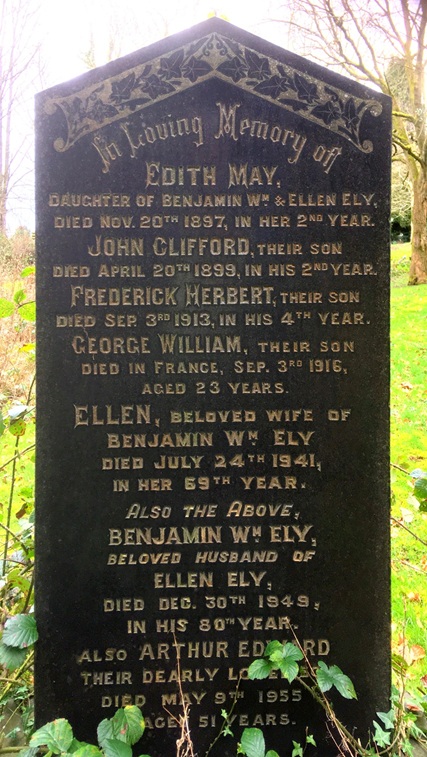
Their family grave is located at Utley Cemetery in Keighley and the inscription reads:
In Loving Memory of
Edith May, Daughter Of Benjamin Wm & Ellen Ely, Died Nov. 20th 1897, In Her 2nd Year. John Clifford, Their Son Died April 20th 1899, In His 2nd Year.
Frederick Herbert, Their Son Died Sep 3rd 1913, In His 4th Year.
George William, Their Son Died In France, Sep. 3rd 1916, Aged 23 Years.
Ellen, Beloved Wife Of Benjamin Wm Ely Died July 24th 1941, In Her 69th Year.
Also The Above, Benjamin W Ely, Beloved Husband Of Ellen Ely, Died Dec. 30th 1949. In His 80th Year.
Also Arthur Edward Their Dearly Loved Son, Died May 9th 1955 Age 51 Years.
Information sources:
England & Wales, Civil Registration Marriage Index, 1837-1915.
England & Wales, Civil Registration Birth Index, 1837-1915.
1901 England Census.
1911 England Census.
Commonwealth War Graves Commission.
Soldiers Died in the Great War, 1914-1919.
The National Archives. WO-95/2800/2_1.
1/5th Battalion West Riding Regiment war diary.
Keighley News archives at Keighley Library.
Thiepval Memorial. Département de la Somme, Picardie, France.
British Army World War I Medal Rolls Index Cards, 1914-1920.
World War I Service Medal and Award Rolls, 1914-1920.
Army Registers of Soldiers’ Effects, 1901-1929.
World War I Pension Ledgers and Index Cards, 1914-1923.
1921 England Census.
1939 England and Wales Register.
England & Wales, Civil Registration Death Index, 1916-2007.
Family grave photograph taken on 7th March 2020 by Andy Wade.
