
“D” Battery. 312th Territorial Brigade, Royal Field Artillery. Regimental no. 785975.
Previous Regimental no. 8210.
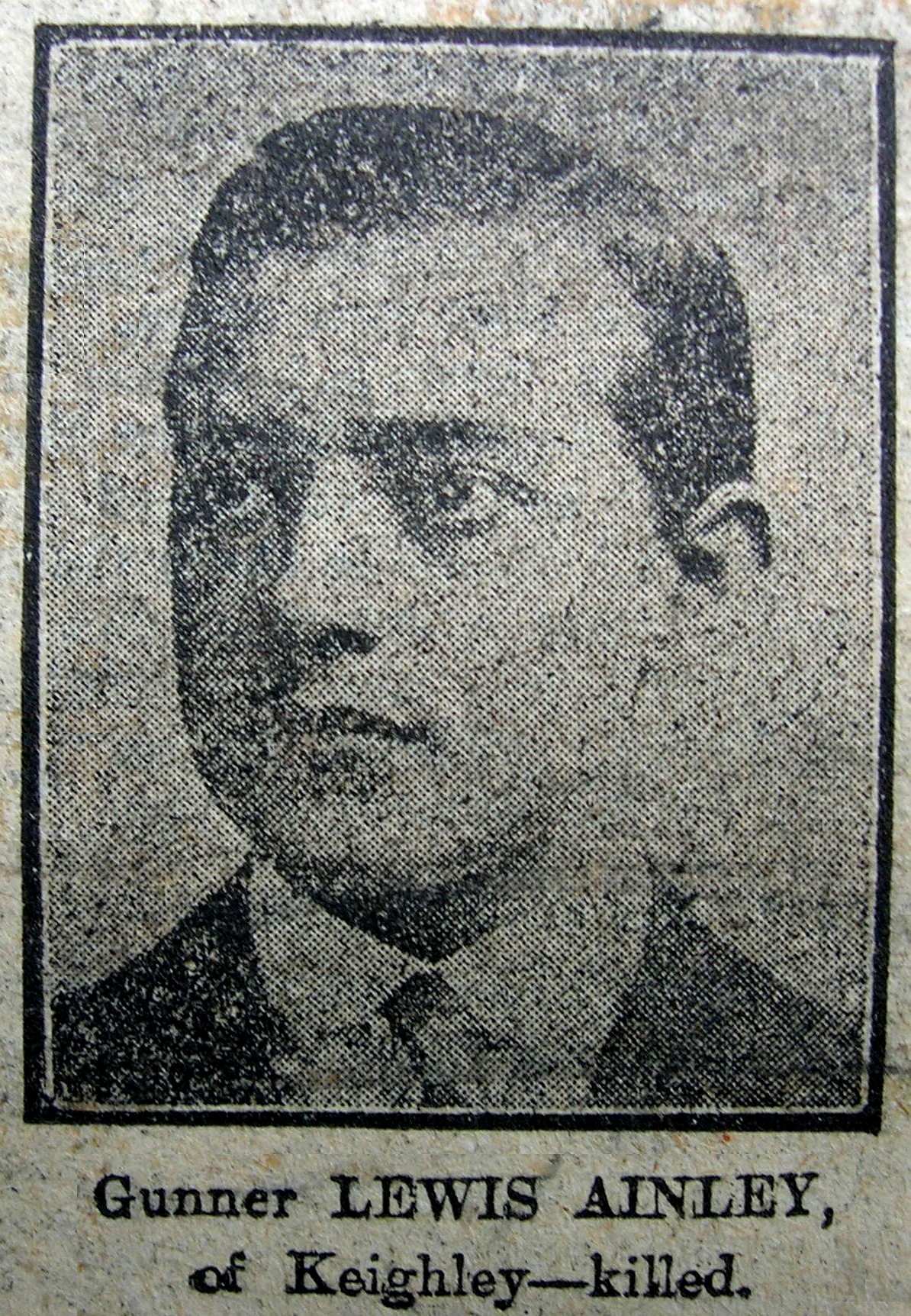
Early life:
Lewis’s parents were Albert Ainley and Ann Ainley née Wilcock who were married at St. John’s Church, Cragg Vale in Todmorden on the 2nd of October 1886. They were both aged 21, both were cotton operatives and perhaps they first met at work. Albert was living at Bottoms and Ann lived at Chapel Houses in Sowerby Bridge.
In the 1891 census they were living at Bank Bottom with Ann’s mother Grace Wilcock, a widow aged 55 and Ann’s sister Mary Hannah aged 23. Albert was 26 and a cotton twiner and Ann was 26 and a cotton operative. They had a son Frank who was aged three.
Lewis was born at Cragg Vale in Todmorden very early in 1897 and his birth was registered in Todmorden in the first quarter of the year.
In 1901 they were living at 43, Devonshire Street West in Keighley. Albert was 36 and a bread baker on his own account and Frank was 13 and his apprentice. Ann was also 36 and looking after the family home. Their daughter Florence was aged seven and would have been attending school, Lewis was aged four and probably still at home with his mother.
They must have been prospering because they could afford to pay Ann’s sister as a domestic cook, 33 year old Mary H. Wilcock. She described as a servant but we suspect the situation was more informal than that.
By 1907 they were living at 156 Fell Lane. The family suffered a tragedy when Ann died in January aged 42 and she was buried at the St. John in the Wilderness Church at Cragg Vale, which is further up the valley from Mytholmroyd.
Lewis’s father Albert remarried, to Lilly Greenwood. He was 42 and Lilly was a widow whose husband Fred had died aged just 30 in 1901. Lilly was 32 at the time of their marriage and had a son of her own, Fred Moore Greenwood aged about five. Their marriage was registered at Keighley in the third quarter of 1907.
By 1911 they were at 158, Fell Lane (which was rented from Smith Hoyle of Apsley Street) Albert was 46 and still a baker, Lilly was 36 and on household duties. They had been married for three years and had one child from that marriage. Florence was aged 17 and a mothers help, Lewis was fourteen years old and working as a baker for his father. Fred Greenwood was now aged nine and attending school; Annie was aged four and Marjorie Lavinia was aged just one.
Frank had moved out by this time and married Violetta Preston on the 29th of January 1912. He was now a master baker in his own right and they lived at Queen Terrace at Little Horton in Bradford.
War service:
His Army service record was one of those destroyed in a fire during the Second World War, but we can piece together some of his service from other records. According to the newspaper, Lewis attested with the Army at Keighley in June 1916 with the Regimental number 8210, and went out to the front in January 1917. This was around the time that all Territorial soldiers received a six-figure regimental number and Lewis was now 785975. He was serving with 312 West Riding Brigade of the Royal Field Artillery and they were mobilised at Northampton in early January and went to France arriving on the 5th and 6th of the month, as they’d been split into two groups for sailing across.
WO-95-3075-2. 312 West Riding Brigade R.F.A. War diary:
In January 1917 they were at OCCOCHES, AMPLIER; in February they were at LAVENCOURT, MAILLY MAILLET and on the 6th of March they were at STATION ROAD, BEAUCOURT carrying out shelling of German trenches and wire cutting:
4th March: 4 am. A and C Batteries moved up to forward positions. Battery positions now occupied A – L.34.c.1.7, B – R.5.a.2.7, C – L33.b.5.5, D – R5.a.3.5. (1/10,000 map ACHIET 5a)
Batteries engaged in wire cutting in G19.d.1.0 – G19.d.0.7.
5th March: 5.0 am. D Battery Howitzer no. 869 smashed by direct hit – no casualties. Wire cutting impossible owing to poor visibility. Batteries consolidating positions.
9.0 pm. Orders re night attack received from GXE.
6th March: 12.30 am. B Battery shelled area around ACHIET-LE-PETIT to prevent stragglers getting away.
7th March: Wire cutting programme continued around AHCIET-LE-PETIT. 2/Lieutenant Sparling and 2nd Lieutenant Edward reported arrival and posted to C and B Batteries respectively.
Lewis was just 20 when he was reported killed in action on the 6th of March, this date is in several documents but some of the graves registration documents clearly indicate he was killed on the 7th of March. We are unlikely to know the truth of the matter. We do know he was serving with D Battery and the 5th March direct hit of the howitzer (with ‘no casualties’ reported) may actually be when he was killed. Reporting of dates of death was important but mistakes would always be made. We will never truly know when he died but we do know he was buried in a battlefield grave at Triangle Cemetery which was half a mile North East of Petit-Miraumont village on the road to Pys. It was a German cemetery containing 181 graves of German soldiers and eight soldiers from the UK.
His grave was later exhumed from here along with several others by the 117th Labour Company on July 11, 1919. Lewis was moved to grave 2, row D, plot I of Queen’s Cemetery, Bucquoy.
As an aside, we know that Sergeant Stoker and three gunners Widdop, Howard and Cross of B Battery 312 Brigade RFA were all killed together on the 9th of March 1917, just a few days after Lewis, but there is no mention of this incident in the war diary, so we cannot rely too much on the diary record, which after all is a war diary for the unit’s operations, movements, numbers and types of shells fired etc and nothing more.
Keighley News Saturday March 31, 1917.
Private Lewis Ainley (20), West Riding Regiment, second son on Mr and Mrs Albert Ainley, of 134, Fell Lane, Keighley, has been killed in action.
Keighley News Saturday April 7, 1917.
TRIBUTE TO A KEIGHLEY GUNNER.
A letter paying tribute to the late Gunner Lewis Edward Ainley, of the R.F.A., second son of Mr and Mrs Albert Ainley, of 134, Fell Lane, Keighley whose death was recorded in our columns
last week, has been received from Maurice Clark, a Horsforth soldier home on leave. Writing on March 20, he said: “Although I had only known your son a very short time, I shall ever remember his beautiful quiet way and gentlemanly behaviour, and every man in the battery realised with a terrible shock what a dear friend they had lost… Since losing my dear brother I have felt that he is nearer to me in death than he ever was in life, and the thought of his looking over me helps me to strive for all that is best and good.” Aged 20 years, Gunner Ainley enlisted in June, 1915, and only went out to the front in January last. For twelve months he had acted as officer’s servant. Before enlistment he assisted his father in the bakery business.
Remembrance:
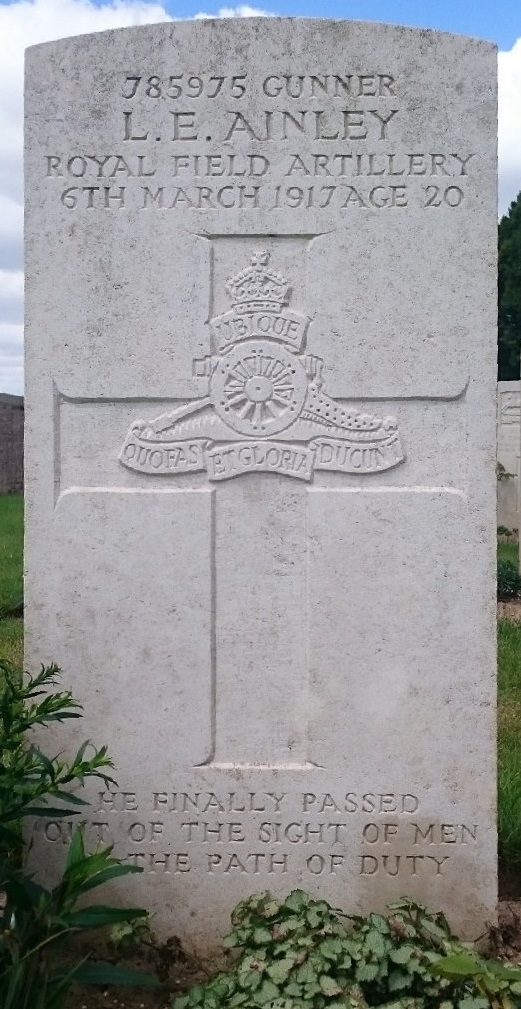
Lewis is remembered in his headstone at his grave in Queen’s Cemetery, Bucquoy. The family inscription on his war grave headstone reads: “HE FINALLY PASSED OUT OF THE SIGHT OF MEN BY THE PATH OF DUTY.”
Grave photograph by Wayne Ogden
He is remembered locally on several war memorials and rolls of honour. They are: Keighley’s Great War roll of honour in Keighley Library; St. Andrew’s Church WW1 Memorial Board at the church; The Great War Memorial at All Saints Church, Highfield and finally on the Fell Lane Wesleyan Sunday School Boys war memorial which is in the care of Cliffe Castle Museum.
(His name is misspelt in the Keighley roll of honour with Louis instead of Lewis.)

Post war:
His father Albert was his next-of-kin. He received his outstanding Army pay which was £2 17s 4d on the 16th of May 1917 and a war gratuity payment of £7 10s on the 21st of October 1919. He would also have received any personal effects and his medals which were the British War Medal and Victory Medal, plus a bronze war memorial plaque and memorial scroll inscribed with Lewis’s name. These usually arrived in 1920 or 1921.
His step-mother Lilly applied for an Army Dependant’s pension but none of the Pension record cards indicate if she received anything, as that section has been left blank.
In the 1921 census Albert and Lilly were living at 134 Fell Lane. Albert was 57 and still a baker on his own account and working at Rawdon Street Bakery, Keighley. He was currently out of work owing to a strike. Lilly was 47 and on home duties. Fred Moore Greenwood was an assistant grocer for Akeroyd grocers of Worth Village. Annie was aged 14 and on home duties. Marjorie Lavinia was aged eleven and at school whole-time.
In the 1939 Register, Albert and Lilly were still living at 134 Fell Lane. Albert was now aged 75 but apparently still a baker. Lilly was aged 65 and on ‘unpaid household duties.’
Albert died in hospital on the 16th of April 1949 at the age of 84 and his death was registered at the Worth Valley in the second quarter of that year. He left the sum of £1093 2s 11d to Fred Whitehead, wholesale baker and Frank Tempest warp-dresser.
Lilly died aged 82 in 1956 and her death was registered in the Worth Valley in the third quarter of the year.
Information sources:
West Yorkshire, England, Church of England Marriages and Banns, 1813-1935.
1891 England Census.
England & Wales, Civil Registration Birth Index, 1837-1915.
1901 England Census.
England & Wales, Civil Registration Death Index, 1837-1915.
West Yorkshire, England, Church of England Deaths and Burials, 1813-1985.
England & Wales, Civil Registration Marriage Index, 1837-1915.
West Yorkshire, England, Tax Valuation, 1910.
1911 England Census.
National Archives. WO-95-3075-2. 312 West Riding Brigade R.F.A. War diary.
Keighley News archives at Keighley Library.
Commonwealth War Graves Commission.
Soldiers Died in the Great War, 1914-1919.
Army Registers of Soldiers’ Effects, 1901-1929.
British Army WWI Medal Rolls Index Cards, 1914-1920.
WWI Service Medal and Award Rolls, 1914-1920.
Grave photograph kindly supplied by Wayne Ogden.
World War I Pension Ledgers and Index Cards, 1914-1923.
1921 England Census.
1939 England and Wales Register.
England & Wales, Civil Registration Death Index, 1916-2007.
England & Wales, National Probate Calendar (Index of Wills and Administrations), 1858-1995.
