
8th Battalion, Duke of Wellington’s West Riding Regiment. Regimental number 15403.
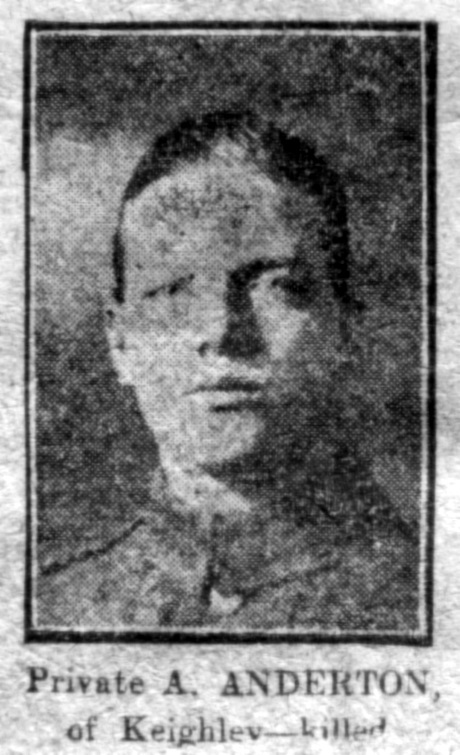
Early life:
Arthur’s parents were James Anderton and Charlotte Anderton née Tillotson, who were married at St. Wilfred’s Church, Calverley on the 24th of December 1884. James was 20 and a dyer, Charlotte was 21 and a silk picker and they were both from Windhill in Shipley.
They lived at Shipley and had a daughter Lily, born in 1887 and in the 1891 census they were all living at 3, Back Kitson Street in Idle, Bradford.
They had a second child Arthur, who was born in 1895 and his birth was registered at North Bierley in the last quarter of that year.
By the 1901 census they had moved again and were now living at 22, Clare Street, off Valley Road in Shipley. James was a 36 and a foreman in stuff finishing, Charlotte was aged 38 and at home with the family. Lily was now aged 14 and employed as a piece marker in stuff finishing. Arthur was aged 5 and may have started attending school.
In the 1911 census they have moved again and were now living at 62, Aireworth Terrace on Bradford Road, Keighley. Lily has left home having married Richard Lund in 1910. James is aged 46 and is a stuff finisher, Charlotte is also 46. They have been married for 26 years and produced two children, both of whom are still alive. Arthur is aged 15 and a stuff finisher like his father. They are working at a worsted stuff finishing works.
War service:
There are no Army service records for Arthur so we have to piece together the story of his war service from available records.
He enlisted at Keighley in February 1915 and joined the West Riding Regiment, serving with the 8th (Service) Battalion. According to medal records he disembarked at the Balkans on the 24th of November 1915 and would have first served with the 8th Battalion on the island of IMBROS just three weeks before the complete evacuation of Gallipoli. It’s possible he actually set foot on the Peninsula, but as the Battalion was in Brigade Reserve and suffering with extreme weather conditions, several of the men were suffering from frostbite. The Gallipoli Peninsula was evacuated and they retired to IMBROS on the 19th of December and went under canvas and were in training for the next few weeks.
Shortly afterwards the 8th Battalion moved to Alexandria in Egypt and served in the defence of the Suez Canal, based near Port Said.
In July 1916 the whole battalion sailed for Marseilles in France and disembarked from H.T. Ionian on the 1st of July 1916. They entrained and journeyed North to the Somme area, arriving at FLEURS on the 6th of July. The battle of the Somme was in full swing. The 8th Battalion were occupied in training at PENIN and BEAUMETZ On the 17th they marched to DAINVILLE and then to AGNY the next day where they went into Brigade Reserve and manned the AGNY defences. By the start of August they were in front line trenches, alternating between the front lines and Divisional Reserve with working parties and training being all part of the daily routine when not in the font lines. They were located half a mile to the South-West of THIEPVAL, near AUTHUILLE.
On the 14th of September they took part in a successful attack on heavily fortified German lines, details of their attack are in the Battalion war diary.
WO-95/1809/1. 8th Battalion West Riding Regiment War diary, September 1916:
12th Sept:
Battalion in Brigade Reserve. Battalion Training.
13th Sept:
Battalion in Brigade Reserve. Battalion practicing the Attack.
14th Sept:
Battalion in Brigade Reserve. Battalion practicing the Attack.
8.0 am. Battalion moved off and relieved the 6th York and Lancaster Regiment.
6.30 pm. X and Z Companies made an attack on enemy trenches, objective R31 D98 (Wunder Work) and R31 B33 Hohenzollern Trench.
W Company in support. Y Company in Battalion Reserve.
6.40 pm. Objective reached. Attacking companies advance 40 yards beyond and dug themselves in. Communication trench to ne position dug immediately.
15th Sept:
Battalion holding newly captured positions. Counter attacks repulsed with heavy losses to the enemy. The attack a complete success. Our losses, killed and wounded: 8 Officers, 250 Other ranks.
4.pm. Battalion relieved by 6th (Territorial) Battalion West Riding Regiment.
Battalion marched out.
WO-95/1806/2. 32nd Infantry Brigade (11th Division) War Diary:
In the Brigade war diary the attack was hailed as a complete success. Captured German prisoners stated that the attack on the Wonder Work was a complete surprise and our artillery fire was extremely effective, with surprise at the accuracy of the heavy guns. They were dissatisfied at the action of their own artillery.
Private Arthur Anderton was one of the 250 casualties, he had been killed on either the 14th or 15th. His body was either buried in a battlefield grave and the location was subsequently lost, or he was never found and has no known grave. He is one of their men named on the Thiepval Memorial and the Commonwealth War Graves Commission has details of 54 of the 8th Battalion men known to have been killed on either the 14th or 15th.
Arthur’s death was reported in the local newspaper.
The Keighley News. Saturday 23rd September 1916, page 3:
Information has been received this week by Mr. and Mrs J. Anderton, of 62 Aireworth Terrace, Stockbridge, Keighley, that their son, Private A. Anderton, of the West Riding Regiment, was killed in action in France yesterday week. The sad news was contained in a letter from Lieutenant E.J. Smith, of the same regiment, who said: “It is my painful duty to inform you that your son was killed on the 15th inst., whilst charging the German trenches. He was a bright and cheery lad, and will be very much missed by his officers and comrades.” He concluded his letter by offering the deepest sympathy of himself and the company under his command, and mentioned that death was instantaneous.
Private Anderton was only 20 years of age, and prior to joining the Army in February, 1915, he was employed by the Stockbridge Finishing Company, Keighley. Before being drafted to France about three months ago he had seen service at Alexandria, Port Said, Cairo, and in the desert. He was very well known, and his death will be keenly felt by a wide circle of friends.
Remembrance:
Arthur is remembered by name on the Thiepval Memorial which holds 72,309 names of the missing of the Somme. He is on Pier and Face 6 A and 6 B for the West Riding Regiment.
Locally he is named in the Borough of Keighley 1914 – 1918, Great War roll of honour book at Keighley Library.

His family did not forget him, and posted at least two ‘in memoriam’ notices on the anniversary of his death.
Keighley News ‘In Memoriam’ 8th September 1917, page 10:
IN MEMORIAM.
ANDERTON-In ever loving memory of our dear son and brother, Private Arthur Anderton, who was killed in action in France, September 15th, 1916.
One year has passed and still to memory dear,
Thy loving name we breathe, and shed a tear;
Time cannot alter love so deep and true;
The year brings back our grief anew.
But time may heal the broken heart,
Time may make the wound less sore;
But time will never stop the longing
For our loved one who has gone before.
May his reward be as great as his sacrifice.
From his sorrowing Father and Mother, 62, Aireworth Terrace, Bradford Road. Also his sorrowing Sister and Brother-in-law, Mr. and Mrs. Richard Lund, Holly House, Morton Banks.
Keighley News ‘In Memoriam’ 14th September 1918, page 8:
IN MEMORIAM.
ANDERTON-In affectionate remembrance of our dear son and brother, Private Arthur Anderton, who fell in action in France, September 15th, 1916.
E’en es be trod that day to God,
So walked he from his birth.
In simpleness and gentleness
And honour and clean mirth.
Why do we live when our hope lies dead?
He was our life and with him life has fled.
He was our only son, our price and joy,
Oh! would that we had died before our boy.
From his sorrowing Father and Mother, also his sorrowing sister and brother-in-law, Lily and Richard Lund, Holly House, Morton Banks.
Post war:
Arthur’s next of kin was his father James, who received Arthur’s remaining Army pay of £8 18s 8d on the 29th of December 1916. His mother ad sole legatee in his will, received the war gratuity payment of £6 10s 0d on the 26th of November 1919.
Charlotte applied for a Dependant’s Pension but the card does not indicate whether she received anything.
His parents would have received his medals in early 1920 or 1921. These were the 1914-1915 Star, British War Medal and Victory Medal, plus a bronze war memorial plaque and memorial scroll inscribed with his name. We do not know if they received any of Arthur’s personal effects, assuming there were any.
In the 1921 Census, James and Charlotte were living at 29, Unity Street, Morton Banks. James was aged 57 and a foreman at the Stockbridge Finishing Company limited. He was in charge of the finishing department. Charlotte was also aged 57 and was on home duties.
James died aged 66 on the 6th of March 1931. His widow Charlotte received the sum of £235 9s 7d in probate on the 16th of April 1931. Their home address was at 15, Howden Road in Silsden.
Charlotte died aged 71 in 1935 and her death was registered in Keighley in the third quarter of the year.
Information sources:
West Yorkshire, England, Church of England Marriages and Banns, 1813-1935.
1891 England Census.
England & Wales, Civil Registration Birth Index, 1837-1915.
1901 England Census.
Name Arthur Anderton.
1911 England Census.
Commonwealth War Graves Commission.
Soldiers Died in the Great War, 1914-1919.
The National Archives British Army War Diaries.
WO-95/1809/1. 8th Battalion West Riding Regiment War diary.
WO-95/1806/2. 32nd Infantry Brigade (11th Division) War Diary.
Keighley News archives at Keighley Library.
British Army World War I Medal Rolls Index Cards, 1914-1920.
World War I Service Medal and Award Rolls, 1914-1920.
Army Registers of Soldiers’ Effects, 1901-1929.
World War I Pension Ledgers and Index Cards, 1914-1923.
1921 England Census.
England & Wales, Civil Registration Death Index, 1916-2007.
England & Wales, National Probate Calendar (Index of Wills and Administrations), 1858-1995.
England & Wales, Civil Registration Death Index, 1916-2007.
1939 Register.
