
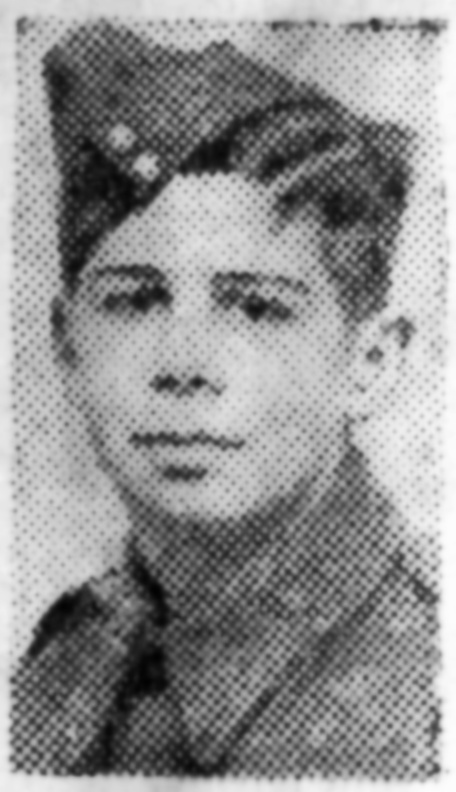
Private. 1st Battalion, East Lancashire Regiment. Regimental number 14555645.
Early life:
Jack’s parents were Summerscales Thornber and Lizzie Thornber née Norcross who had been married at Christchurch, Tintwistle in Cheshire on the 28th of January 1907.
In the 1921 census they were living at Marchap Cottage in Silsden and Summerscales was aged 39 and an out of work cow man who had been working for Heaton Breane of Middle Marchup Farm in Silsden. Lizzie was aged 32 and on home duties and their children at that time were William aged thirteen who was employed as a worsted spinner at Taylor Brothers, Waterloo Mills, Daisy Hill in Silsden; Henry aged twelve; Helena aged ten and Tom aged seven. The three youngest were at school for the whole time.
We found three likely children with the same surname and mother’s maiden name of Norcross, all these births were born and registered at Keighley.
They were Mary, born in the second quarter of 1922, Jack, born in the last quarter of 1924 and James, born in the last quarter of 1930.
As stated, Jack was born in Keighley in 1924 and his birth was registered here in the last quarter of that year. At the time of his birth they were living at 127, Dawslack in Keighley. This was located off Parker’s Lane, Low Utley.
In the 1939 Register the family were living at Cross Roads. Summerscales was now aged 58 and working as a shopkeeper, Lizzie was aged 51 and was on home duties. There are three redacted records which are probably some of their children.
Their home was located on Halifax Road and is referred to as 19, Cross Roads, numbering from the mini roundabout towards Keighley. Their house is opposite the bus shelter and close to the park entrance on Halifax Road.
War service:
We understand that Jack had been serving for two years when his death was announced in the local newspaper in March 1945, suggesting he had enlisted around March 1943 when he would have been aged 19.
At the time of his death he was a Private in the first battalion, East Lancashire Regiment and they were fighting in Normandy at that time.
War diary:
This is the war diary reference at the National Archives: WO 171/5224, 1st East Lancashire Regiment, 1945 January to March.
Unfortunately the battalion war diary has not been digitised by the National Archives so we cannot access it to give a detailed account of events. However, the Lancashire Infantry Museum website gives an excellent account which we have linked to and shown extracts from it here to give an idea of their operations when Jack died.
See the following page for battalion operations end 1944 to early 1945: Lancashire Infantry Museum website.
The first and fifth battalions were serving as part of the Normandy operation for push the German forces back from France and the Low Countries. They landed in France near the end of June 1944, with the 53rd and 59th Divisions respectively. They took part in many operations and bitter fighting, pushing or capturing many of the German forces as they went.
They were involved in the following operations:
Caen.
8th July 1944 at Caen, during which their B Company fought an action at St Contest.
The Bocage.
16th July to the end of August 1944.
Falaise.
12th to 19th August. They captured the town of Bois Halbout.
BELGIUM AND HOLLAND 1944-45
Antwerp.
The 1st East Lancashires joined in the pursuit across France, fighting several actions against enemy rearguards north of St Pol, 4th-6th September, before taking part in the clearance of the vital Antwerp docks, 9th-13th September.
Operation Market Garden.
The British 2nd Army was now closing up to the Dutch border where the Meuse-Escaut Canal was the first of a succession of water obstacles. Both Lancashire battalions took part in the Nederrijn battle on the flanks of the main axis. On the night of the 16th/17th the East Lancashires carried out a difficult opposed assault crossing of the Meuse-Escaut Canal at Lommel and went on to capture the town of Bladel, near Eindhoven, on the 22nd.
Overloon.
The partial success of Market Garden put the Allies in possession of a wedge of Holland with its point at Nijmegan, and the immediate object, which again involved both Lancashire battalions, was now to clear remaining enemy from west of the Maas.
s’Hertogenbosch.
Meanwhile, the East Lancashires were initially tasked to hold a section of the corridor to Nijmegan, defending an area near St Oedenrode. The 53rd Division was then ordered north to capture the important route centre of s’Hertogenbosch on the Lower Maas. The East Lancashires played a particularly distinguished part in this battle, leading a daring night infiltration attack on the 23rd/24th and then participating in four days of heavy street fighting before the town was cleared. Both battalions subsequently held defensive positions west of the Maas.
The Ardennes.
On 19th December the German launched a counter-offensive and broke through the American front in the Ardennes. 53rd Division was withdrawn to cover Brussels and then, as the battle stabilised, committed to the Allied counter-attack on the Ourthe. On 7th January 1945, after five days of hard fighting in the woods in severe arctic conditions, and without armoured support, the East Lancashires assaulted and captured the village of Grimbiemont.
GERMANY 1945.
The Rhineland.
The Allies now crossed the Maas into Germany and began to clear the enemy from between that river and the Rhine. The East Lancashires had considerable success in ten days very heavy fighting, 8th-17th February, in the Reichswald Forest, being singled out for congratulation by Montgomery. There was much close combat, including at least one bayonet charge, and many prisoners were taken.
Note: It was during this period when Private Jack Thornber died of his wounds.
After Jack died, both battalions then took part in the advances through Hochwald, near Goch on the 27th of February then to Weeze, Bussenhof and Trupphof, to reach Geldern, where they were the first British infantry to link up with a converging American attack.
They continued fighting from the Rhine to the Elbe, taking part in the battle for Bocholt, on the 28th and 29th of March, then they moved through the eastern border areas of Holland, mopping up enemy stragglers. The East Lancashires then took part in fighting on the Ems-Weser Canal near Ibbenburen on the 6th and 7th of April, and at the assault crossing of the River Aller on the 12th, with another heavy engagement at Kirchlinteln on the 16th, before occupying Hamburg on 4th May.
On May 8th 1945, ‘VE Day’, German capitulation ended the war in Europe.
The Keighley News, 3rd March 1945:
ROLL OF HONOUR.
Private Jack Thornber, son of Mr. and Mrs. Thornber, of 19, Cross Roads, Keighley, has died from wounds. Aged 20, he had served with the Forces two years. In civil life he was employed in the dairy department of the Keighley Industrial Co-operative Society.
Jack was aged twenty when he died of his wounds on the 12th of February 1945 and his body was initially buried at Marienbosch Cemetery in Holland. Along with several others, his grave was exhumed after the war and reburied in Jonkerbosch War Cemetery at Nimegen, Gelderland in the Netherlands on the 17th of April 1947. The location is grave number 3 of row C in plot 10.
His family requested that the following inscription be added to his headstone: In Loving Memory Of Our Beloved Son Jack, Died Of Wounds.
Remembrance:
Jack Thornber is named on the Borough of Keighley WW2 roll of honour board at Keighley Library and on the Cross Roads WW2 Roll of Service at St. James Church.
His brother Tom also appears to have served in the war.
Post war:
Jack’s father Summerscales Thornber died aged 78 on the 16th of November 1959, his mother Lizzie Thornber died aged 84 on the 5th of March 1973. They are buried in a family grave at Haworth Cemetery on Penistone Hill near Haworth.
Information sources:
Cheshire, England, Church of England Marriages and Banns, 1754-1939.
1921 England Census.
1939 register.
www.lancashireinfantrymuseum.org.uk/world-war-two.
Commonwealth War Graves Commission.
www.findagrave.com.
Keighley News archives at Keighley Library.
