
Private. 1st Battalion, Coldstream Guards. Regimental number: 18592.
Early life:
William’s parents were Joseph Hollindrake and Annie Hollindrake née Snowden who were married in the Keighley District in 1889. They were living at 6, Scholes in the 1891 census with their eldest son Mannasah, aged one. John was 26 and a Farmer and Annie was 27 and on home duties.
William was born in the second quarter of 1894. At the time the family were living at number 6, Scholes but shortly after this they moved to 14, Hollings which is by Sladen Bridge on the Haworth side of the Worth River. They lived here for seven or eight years and during this period Joseph and Annie had five more children who were Mary, born in 1892, then William in 1894, Ruth in 1897, Holmes in 1899 and Joseph junior who was born in 1900.
By the 1901 census they had moved from Hollings to Westfield Farm (or West Field Farm) which is on the South facing slope of the valley, alongside Tim Lane. They were here for many years afterwards. A few years later Joseph also rented Cook Gate Farm, buildings and land for a few years. This is at the top end of Lord Lane. It doesn’t appear that they lived there, perhaps it was just for the extra farming land.
The family consisted of Joseph aged 36, Annie aged 37 and the children Manasseh aged eleven, Mary aged nine, William aged seven, Ruth aged four, Holmes aged two and baby Joseph aged ten months. Also living with them was Joseph’s Aunt Susey Judson, a widow aged 64 and living on her own means.
Their next door neighbours were William and Florence Earle, both aged 31 years and both were cotton weavers.
In the 1911 census they were still living at Westfield Farm and father Joseph was now 46 with Annie aged 47. They had been married for 22 years and had six children. Joseph and Annie ran the farm. Their children were Manasseh aged 21 and a coal carter for a cotton and worsted mill, Mary aged 19 and a dairy worker for her parents farm; William aged 16 and an errand boy for a cotton and worsted manufacturer. Ruth aged 14 was a worsted spinner at a local mill (they were probably all at Springhead Mill, which was the closest one to their home) Holmes was aged 12 and half and half at school and on farm work. Joseph junior was aged ten and at school whole time.
War service:
There are no surviving Army service records for William but we think he joined the Coldstream Guards in early 1916, he was probably called up at Halifax under the Derby Scheme having attested towards the end of the previous year and he would have been aged around 22 at the time he left home.
He was a Private in the first battalion of the Coldstream Guards, with the Regimental number 18592.
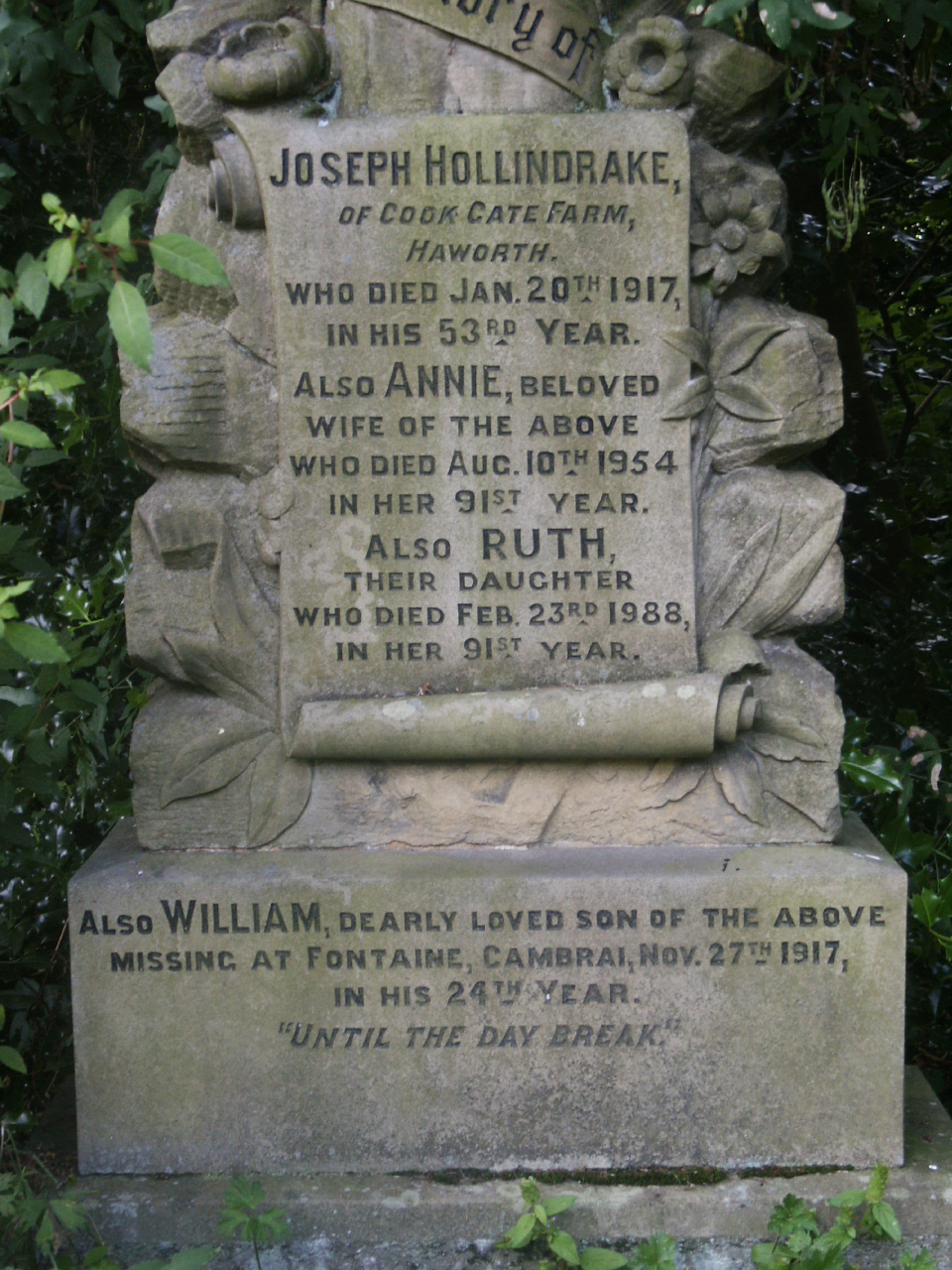
The family suffered a tragic loss when their father Joseph died aged 52 on the 20th of January 1917, leaving Annie to run the farm and it seems she did carry on there for a while, with the help of their now grown up children. Joseph left a sum in probate of £492 7s 10d to Annie. He was buried in the family grave in the Haworth cemetery on Penistone Hill, overlooking the farm.
Annie appears to have moved to Cook Gate Farm after the war and This is at the top of Lord Lane in Haworth, which is why William is named on the Haworth War Memorial.
William went missing in action at Fontaine, Cambrai, on the 27th of November 1911. He was aged 23 at the time.
The war diary of the First Battalion Coldstream Guards gives us a good idea of the battle conditions in which William met his end.
WO-95/1219/2. War Diary, 1st Battalion, Coldstream Guards.
November 1917.
16th: Company training.
17th: The Battalion moved by route march to PENIN.
PENIN
18th: The Battalion moved by route march to BAILLEULVAL arriving about 3.30 p.m. The Battalion Reinforcement party left to proceed to the Reinforcement Battalion.
BAILLEULVAL
19th: The Battalion moved by route march to COURCELLES-LE-COMTE arriving at 9 p.m. Lieutenant. Somerset returned from leave.
COURCELLES
20th: Standing to. Honours and Awards, MILITARY OROSS:- Lieutenant. G.B.F. Samuelson and 2nd Lieutenant. G. Bayzard.
21st:
Battalion moved by route march to BEAULENCOURT area arriving at 10 p.m.
BEAULENCOURT
22nd: Standing to, ready to move.
23rd: Battalion marched to LEBUCQUIERE arriving at 12 noon. Lieutenant Barclay from leave.
LEBUCQUIERE
24th: The Battalion moved by route march to RIBECOURT where it was unable to find billets and had to encamp and dig in, in a valley between RIBECOURT and TRESCAULT.
RIBECOURT
25th: The Battalion remained at RIBECOURT in the valley in the former No Mans Land between our front line and the Hindenburg line. A fine day after a very wet night.
26th: The Battalion moved up in the evening to relieve the 2nd Battalion Coldstream Guards in support on the MARCOING – ANNEUX Road near LA JUSTICE Farm, but during the evening orders were received that the 2nd Guards Brigade would attack BOURLON WOOD and the Village of FONTAINE- NOTRE-DAME in conjunction with the 62nd Division on our left. All arrangements had to be made during the night
as the attack was to commence at 6.20 a.m. on the following
morning Nov 27th. The assembly positions had to be reconnoitred also.
BOURLON WOOD.
27th
The Battalion moved forward to take up its position in the front line at 3.30 a.m. and was in position at 5 a.m. On our left in BOURLON WOOD were the Irish Guards, on our right the 3rd Battalion Grenadier Guards with the 1st Scots Guards on their right The Battalion front extended from railway on North edge of FONTAINE to East edge of BOURLON WOOD. Our order was No 4 Company on the left touching the Irish Guards, No 2 Company in the centre and No 3 Company on the right with 3 Platoons of No 1 Company supporting No 3 Company and one Platoon of No 1 Company supporting No 4 Company. The attack commenced at 6.20 a.m. on a very cold morning while it was still dark. Throughout the whole action there was the most severe fighting. The Battalion however reached its first objective and after a pause for reorganization the two Companies on the right who alone had a second objective, pushed on and won this line too. All Companies had by this time been through fighting of the severest nature and had suffered very heavy losses. The Germans had however suffered still greater losses, losing some 600 prisoners to the Battalion, and leaving a very large number of dead on the field. Still larger numbers of Germans were brought up and the Battalion was not in a position in its weakened condition to hold its very extended line on the final objective. No 4 Company, in particular, had suffered the heaviest losses as it had met with the strongest opposition and was also enfiladed continuously from BOURLON WOOD on which its left rested. A retirement was inevitable and the Battalion fell back in good order and in its own time to the Jumping off point in the Quarry near BOURLON WOOD. There reorganization took place and the Battalion consisting of 6 Officers and 200 men prepared to the Quarry. Touch was effected with the 3rd Grenadiers on the right and the 4th Grenadiers, who had been sent up in support, on the left. The Quarry had been very heavily shelled all the morning, but on the remnants of the Battalion falling back into it, the enemy very considerately ceased to shell it,
Though he continued to shell BOURLON WOOD and the main CAMBRAI Road. During the afternoon some fifty men came in, who had been out off or lost before. At 9 p.m. after nine hours in the Quarry, the Battalion was relieved by the 1st Battalion Grenadier Guards, and went out to FLESQUIERES where Officers and men were most hospitably taken in by the 3rd Guards Brigade Headquarters. During the Action Lieutenant Samuels on was killed and Lieutenant Clark mortally wounded. Lieutenant Newland, 2nd Lieutenant Peake, 2nd Lieutenant Perry, 2nd Lieutenant Lockwood, Lieutenant Somerset, Lieutenant Corbett, Lieutenant. Porter and 2nd Lieutenant Nickerson were wounded, Also Lieutenant Lord H. Kennedy was wounded at Brigade Headquarters. Some 310 Other Ranks were killed and wounded including Sgt Eeles, Sgt Dutton, Sgt Duffin killed.
At some time during this period, William was killed. He was reported missing but his body was never reported found and he probably still lies in that area having been buried during the heavy shelling they were experiencing at the time.
FLESQUIERES 28th
The Battalion moved to METZ by route march.
Post war:
Annie was the sole legatee in William’s will and she received a Dependant’s pension of 10 shillings per week (payable for life) beginning on the 30th of July 1918.
She received a payment from William’s Army account of £13 1s 2d on 15th September 1919 and this included a war gratuity of £7 10 shillings.
Annie would also have received William’s personal affects and his medal which were the British War Medal and Victory Medal, plus a bronze war memorial plaque and King’s certificate inscribed with his name. These usually arrived in early 1920, or as late as 1921.
In the 1921 census Annie was a widow aged 57 years and nine months and was now farming at Cook Gate Farm. After the death of Joseph and then William, perhaps she felt she had to give up West Field Farm and move closer into Haworth. Her daughter Mary was aged 30, Ruth was aged 24 and they were both worsted weavers for Hattersley, Sons & Co, Worsted Spinners and Manufacturers. Holmes was aged 22 and managing the farm for his mother Annie. Joseph was aged 21 and assisting in general farm work.
In the 1939 register, Annie was living at Lower Scholes Farm in Oakworth. She was aged about 76 and a retired farmer. With her was her daughter Ruth aged 43. She was single and an unpaid domestic worker and Poultry farmer. Living with them was Leonard Herd, a General farm labourer aged about 27.
Annie died on the 10th of August 1954 at the age of 90. Her death was registered in the Worth Valley. At the time of her death she was living at 38, Changegate in Haworth, just around the corner from Cook Gate Farm. She left effects of £1255 to Mary Herd (wife of Leonard Herd) and Holmes Hollindrake, farmer.
Remembrance:
William’s name is on the Cambrai Memorial at Louerval. Pas-de-Calais in France.
William lived for most of his life at Westfield Farm in Oakworth and he is named on the Oakworth Great War Centenary roll of honour at Oakworth Community Hall.
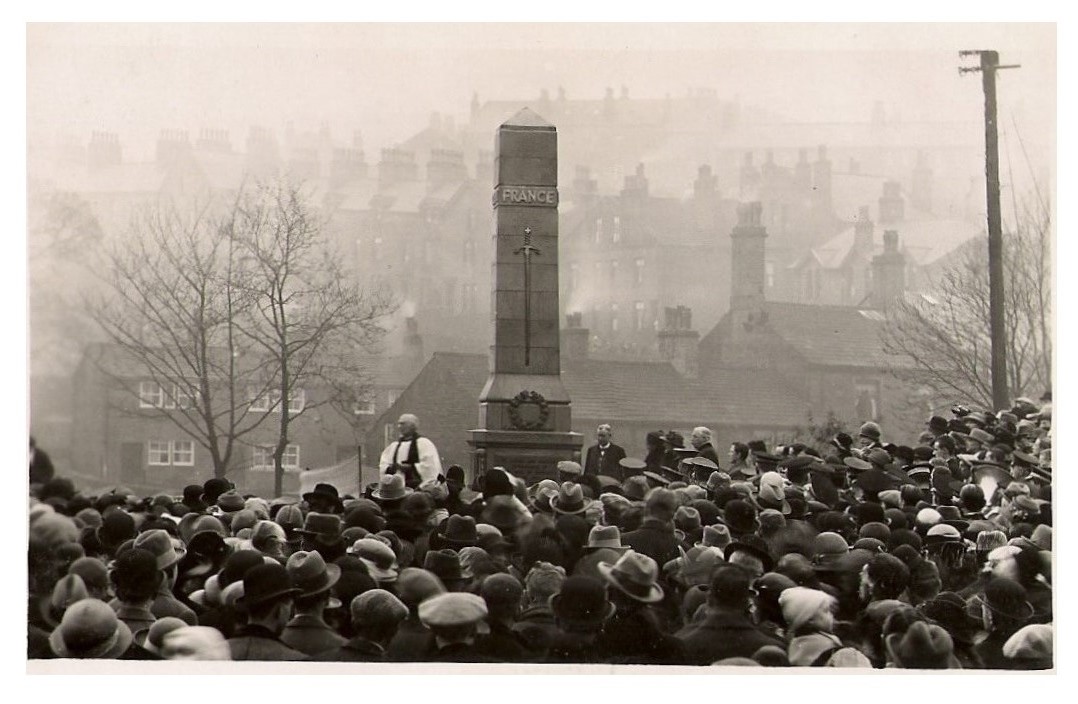
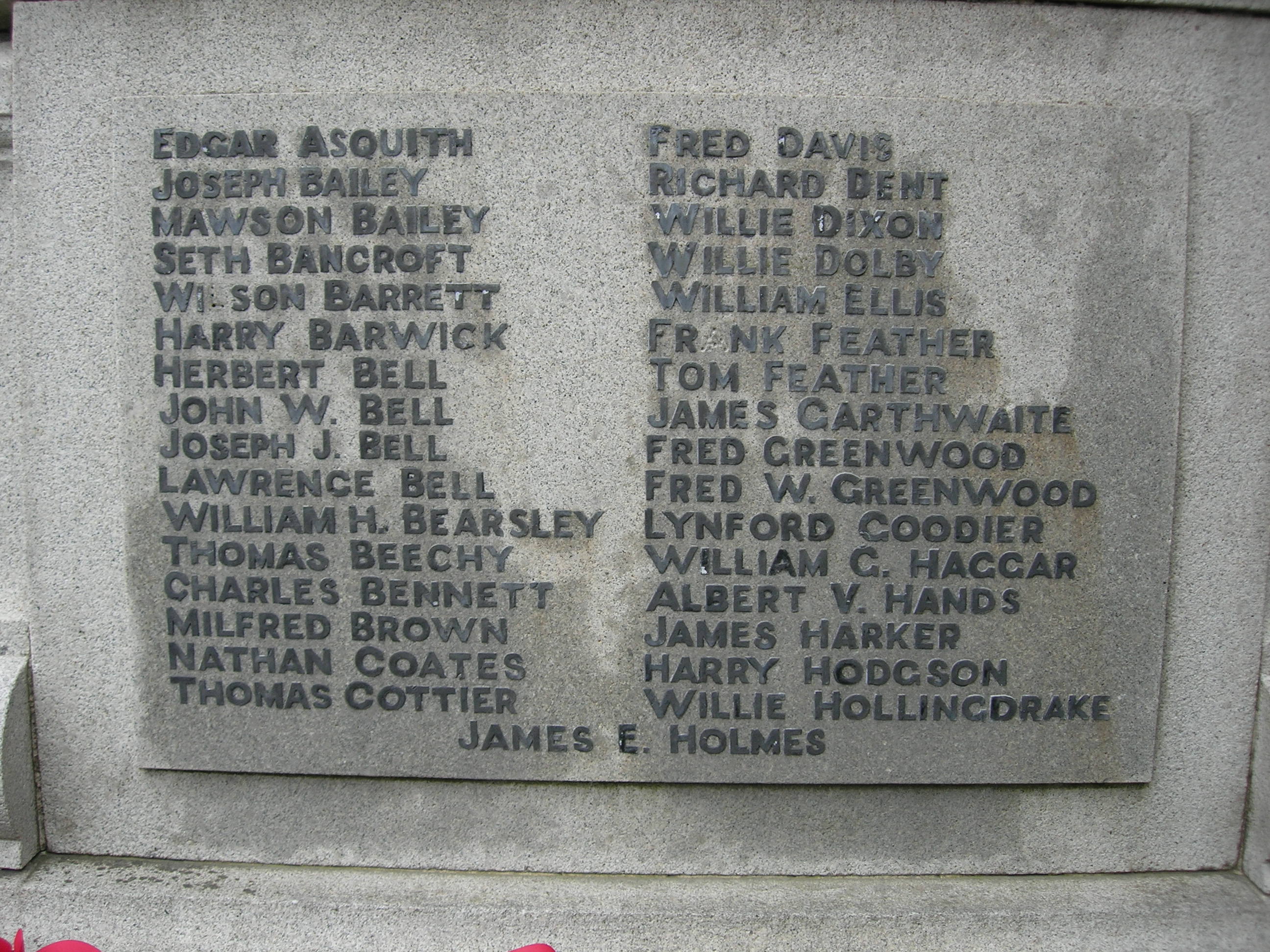
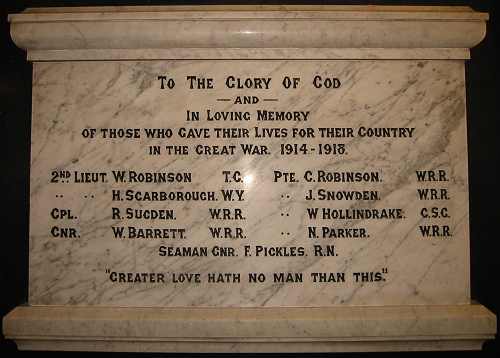
He is also named on the main Haworth War Memorial as Willie Hollingdrake and on the Haworth Roll of Honour board at St. Michael and All Angel’s Church as W. Hollindrake, and on the Haworth Baptist Church war memorial as Pte. W Hollindrake C.S.G.
William was also named with a memorial inscription on the Hollindrake family grave which is in Haworth Cemetery.
The inscription reads:
Also William, dearly loved son of the above missing at Fontaine, Cambrai, Nov 27th 1917, in his 24th Year. “UNTIL THE DAY BREAK”
Information sources:
England & Wales, Civil Registration Marriage Index, 1837-1915.
1891 England Census.
England & Wales, Civil Registration Birth Index, 1837-1915.
1901 England Census.
1911 England Census.
Commonwealth War Graves Commission.
Soldiers Died in the Great War, 1914-1919.
British Army World War I Medal Rolls Index Cards, 1914-1920.
World War I Service Medal and Award Rolls, 1914-1920.
Army Registers of Soldiers’ Effects, 1901-1929.
World War I Pension Ledgers and Index Cards, 1914-1923.
Hollindrake family grave at Haworth Cemetery.
West Yorkshire, England, Electoral Registers, 1840-1962.
1921 England Census.
1939 England and Wales Register.
England & Wales, Civil Registration Death Index, 1916-2007.
England & Wales, National Probate Calendar (Index of Wills and Administrations), 1858-1995.
