
10th Battalion, Duke of Wellington’s (West Riding Regiment.) Regimental number 13553.
He later served with the 2nd Battalion, when he was killed in action.
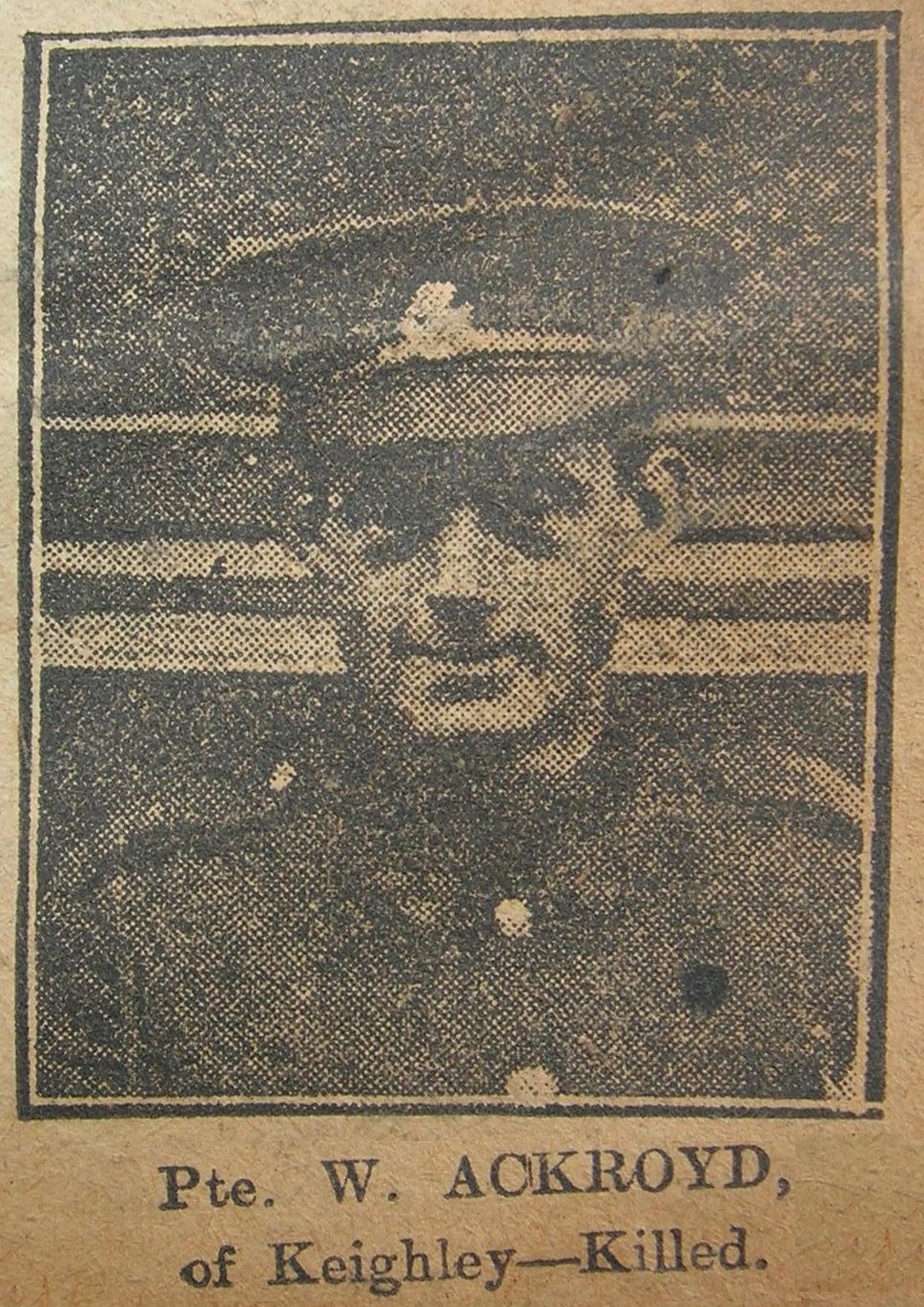
Early life
William was born in Keighley during the second quarter of 1885. His parents were John Ackroyd and Mary Ann Ackroyd née King. They were married at St. Andrew’s Church on the 18th of May 1872. John was 19 and a mechanic living at Wellington Street and Mary Ann was also 19 and a spinster living at Cavendish Street in Keighley.
In the 1891 census Willie was now aged six and was living with his parents at 72, Turkey Street, a rather run down area of town which was poorly serviced. His father John aged 38 was now employed as an iron turner and Mum aged 39 was looking after the family home. Also living here were Willie’s siblings who were Annie, aged 17 and working as a worsted twister; Albert aged 12 working as a worsted doffer (probably half-time at school as well); Irvin aged nine and Willie were attending school and the youngest was Mary Ellen aged two.
Many people lived close to the poverty line in this area of town and the whole area was eventually demolished between the wars and afterwards, mainly because of public health issues.
By the time of the 1901 census they were still living at 72, Turkey Street. Father John was now aged 48 and employed as a roller turner, Mary was aged 49 and a house keeper. (Annie has apparently left home and would be aged 27) The siblings living here were now Albert aged 22 and an iron machine turner. Irvin aged 19 was a bobbin carter, William aged 15 was a joiner’s labourer and Mary Ellen was aged twelve and worked as a worsted spinner.
William married Edith Driver at St. Paul’s Church in Denholme on the 8th of October 1904. He was a bachelor aged 20 and was working as a joiner, presumably having completed his apprenticeship. His home address was Leeds Street in Keighley, which ran parallel to Turkey Street. Edith was a spinster aged 21 and was employed as a twister and at that time she lived at St. Helena in Denholme.
They moved back to Keighley and had their first child who was Mary Elizabeth, born in Keighley on the 12th of April 1905, so presumably they knew Edith was a couple of months pregnant when they got married. Mary Elizabeth was baptised at a non-conformist church in Keighley on the 8th of May 1905. At that time they were living at 10, West Leeds Street and William was still a joiner.
Prison
Things went rather downhill from this point and the National Society for the Prevention of Cruelty to Children (N.S.P.C.C.) had been watching them for a while when they were brought to court for cruelty to a child (Mary Elizabeth) due to the squalor and appalling condition of their home. On the 28th of February 1907 William aged 21 was sent to Wakefield prison for one month with hard labour and Elizabeth aged 22 received two months prison, although we don’t know where she was sent.
The whole sad story was reported in the ‘Police Court Reports’ column of the Keighley News:
Keighley News, Saturday 2nd March 1907, page 2:
A SAD CASE: SHOCKING DISCLOSURES.
There were some shocking disclosures during the investigation of charges of cruelty to children proffered by the National Society for the Prevention of Cruelty to Children against William Ackroyd, labourer Pitt Street, and Edith Ackroyd, his wife Mr. C. P. Cass prosecuted on behalf of the society and described the circumstances as of a revolting character. Formerly prisoners resided in Pitt Street, but were arrested on Monday at Bradford. where they were living in lodgings. The facts of the case revealed a horrible of affairs. The Prisoners had been under the observation of the society for some time, and on the 16th January when Inspector Summerfield visited the house, he found it in a filthy and untidy state, particularly the bed room, which was in a shocking condition.
A warning was administered on that occasion, but when the inspector paid a visit on the 22nd January he found that the house had been broken up and that the parties had separated.
Subsequently it was ascertained that the male prisoner had gone to the home of his parents, taking the child with him, where, seen by Mr. Summerfield, it appeared in a much brighter and happier condition.
The female prisoner at that time was living in lodgings in Pitt Street, and when seen by the Inspector stated that she had taken out a summons against her husband for desertion, adding that the case would be heard on January 29th. On that date, neither of the parties appeared, the magistrates being informed that they had gone on the tramp together, the male prisoner leaving the child with his parents and departing without saying anything as to leaving the town. The only communication the father had received from the male prisoner since he went away was a card inquiring after the child.
Mr. Cass added that he was instructed to ask that the custody of the child should be vested in the male prisoner’s father, the Bench having power to sanction the adoption of such a course if they considered the parents unfit to care for it in a proper manner.
The grandparent held the opinion that nether of the prisoners was at present a fit person to take charge of a child, and regarded it as hopeless to try to alter them at present. Though unable to take the child without some allowance towards its maintenance, he was willing to do so if assisted in a small measure by the male prisoner.
Evidence was given by Inspector Summerfield: John Ackroyd, 72 Turkey Street, father of the male prisoner, and Martha Hum, wife of Frederick Hum, butcher, 30, Turkey Street corroborating the statements made by Mr Cass as to the condition of the house. The last witness also alleged that the female prisoner often went to the theatre, leaving her husband and child at home without food. Both prisoners pleaded for another chance promising amendment.
Alderman Brigg said the Bench did not remember in their experience a more disgusting story regarding the condition of a house. There was clear proof that both prisoners had neglected their duties in such a manner as to cause their child unnecessary suffering. The male prisoner had evidently drifted into a very loose way since his marriage, and the magistrates had been informed that he could earn at least two shillings a week more than he was doing, if he put in full time. He would be sent gaol for a month, and the female prisoner, who was apparently more at fault than her husband, would be sentenced to two months’ imprisonment, which would perhaps have the effect of teaching her habits of cleanliness.
The child was afterwards handed over to the custody of the male prisoner’s father, an order of 2s. per week being made upon the prisoner, and Martha Hum, wife of Frederick Hum.
—
At the time of the court appearance, Edith must have been about six months pregnant because on the 21st of July 1907 she gave birth to Edith, their second child. They were now living at 35, Park Lane, William was still employed as a joiner and their new daughter Edith was baptised at St. Andrew’s Church on the 7th of August that same year.
Despite the baptism being an apparent sign of stability, their family appears to have been fragmented since at least before the time of the prison sentences.
In the 1911 census, Mary Elizabeth is aged five and living at 59, Catherine Street in Keighley. The head of the household is her 38 year old uncle Herbert Wilkinson, along with her 37 year old aunt Annie Elizabeth (William’s elder sister) and their daughter Nellie aged 14.
Also boarding here were 59 year old Mary Ann Ackroyd (John’s widow); 29 year old Irvin Ackroyd and 22 year old Mary Ellen Ackroyd. From this it appears that William and Edith’s eldest daughter Mary Ellen is in the care of her grandmother and other family members.
Also in the 1911 census her sister Edith aged three was at 10, Lancaster Street in Denholme with her mother Edith aged 27 (stated to be married) working as a spinner at a worsted mill. They were visitors for the purpose of the census.
William Ackroyd is conspicuous in his absence and he has not been found in any official documents at this time.
William and Edith had another child, William Herbert, who was born on the 30th of August in Keighley and registered there in the third quarter of the year, implying that Edith was knowingly pregnant with him during the census in April of that year and assuming a full term birth, Edith would have been about five months pregnant in the census.
War service
William Ackroyd’s name appears in ‘Keighley’s Gallant Sons’ which was published in the Keighley supplement of the Bradford Daily Telegraph on the 6th of October 1915. He was listed as living at 72, Turkey Street and had joined the West Riding Regiment. At the time of his enlistment he was employed at Botany Mills, which was a large worsted mill at Morton.
The ‘Soldiers Died in the Great War’ record states he enlisted at Keighley.
There are no Army service records available for William’s time in the war but from medal records we know he entered France on the 26th of August 1915 with the 10th (Service) Battalion of the West Riding Regiment.
WO-95/2184/1. 10th Battalion West Riding Regiment War Diary:
According to the War Diary, the 10th Battalion was mobilised at Bramshott Camp on the 23rd of August 1915, entrained at LIPHOOK the next day for SOUTHAMPTON and embarked for the sea crossing, arriving in BOULOGNE on the 26th of August. The second and third parties went a different route, embarking at FOLKESTONE and arriving at HAVRE in France on 27th. Because of these arrangements and dates, we think William was with the first party.
Bramshott Camp was located between the village of that name and Liphook, giving excellent rail access to the South Coast. It was still there during the second world war period.
According to casualty records and a mention in the local newspaper, William was wounded three times.
He suffered from a gunshot wound to his right thigh and was discharged from ward 16A to number 14, Ambulance train on the 21st of November 1915.
This thigh wound must have resulted in a period of convalescence at home, possibly leave before returning to his unit, because he got Edith pregnant again and their fourth child Sarah Jane was born nine months later on the 12th of September 1916
There was another wound recorded on the 3rd of September 1916 and a further wound on the 21st of November 1916. All of these wounds were sustained whilst serving with the 10th Battalion West Riding Regiment.
William was admitted to Keighley War Hospital on the 8th of December 1916 and released to duty on the 25th of December 1916. He was in ward K for his treatment. He was still with the 10th Battalion at this point. William probably had a visit or two from Edith and perhaps a short leave at home for Christmas before returning to duty. That may have been his last opportunity for leave before he was killed.
At some point William was transferred to the 2nd Battalion West Riding Regiment and whilst serving with them he was killed in action on the first of May 1917.
WO-95/1508/1. 2nd Battalion West Riding war diary:
28th April 1917:
Bn. moved to HAUTEAVESNESS for further particulars see Operation order no. 23 attached.
2.55 pm. Bn. arrived at HAUTEAVESNESS.
29th April 1917:
6.16 am.
Bn. left HAUTEAVESNESS for shelters in G17 East of ST NICHOLAS. For further particulars see Operation order no. 24 attached.
30th April 1917:
8.30 pm. Bn. left G17 for TRENCHES N.E. of FAMPOUX. For further particulars see Operation order.
1.15 am. Relief complete. [Took over from 21st Battalion Northumberland Fusiliers – 2nd Tyneside Scottish.]
1st May 1917:
Battalion in the line. The day was comparatively quiet. Companies occupied trenches according to Operation order no. 26 attached.
About 2 pm enemy shelled trenches held by no. 2 company causing some casualties.
Casualties: 2 OR killed 5 OR wounded.
2nd Lieutenants’ McDowall R.A., Willey, E.R. and Harrison, D joined from 3rd Battalion.
2nd May 1917:
Battalion in the line. The day was quiet, there being little shelling.
At 11 pm Battalion HQ moved to RAILWAY ARCH at H18.d.3.2. while companies moved to ASSEMBLY TRENCHES South of the RAILWAY. Completion of the move was reported at 12 Midnight.
Casualties 2 OR wounded.
Three men from this battalion were recorded killed in action on the 1st of May. They were:
13553 Private William Ackroyd, buried at Brown’s Copse Cemetery.
15527 Private William Greenwood, named on the Arras Memorial.
24392 Corporal Godfrey Scott Midgley, named on the Arras memorial.
From this information we might surmise that William was one of the five other ranks wounded by shellfire and he was evacuated for treatment away from the front line, where he died shortly afterwards and was buried at Brown’s Copse Cemetery, whereas Private Greenwood and Corporal Midgley were probably the two men killed by shellfire and mentioned in the war diary as killed. They have no known grave and may just have been blown to pieces by the 2 pm enemy shelling, or their remains were buried close by and their graves were subsequently lost. For this reason they were eventually named on the Arras Memorial at Faubourg d’Amiens in Arras.
William’s widow Edith was notified of his death on the 5th of May 1917 and his death was reported in June in the local newspaper, along with his photograph.
The Keighley News. Saturday, 9th June 1917, page 3:
CULLINGWORTH.
News has been received by Mrs. Ackroyd, of 18, Lodge Street, Cullingworth, of the death in action of her husband, Private W. Ackroyd (31), of the West Riding Regiment. Private Ackroyd resided in Turkey Street, Keighley, before enlistment in September, 1914. He went to the front in the following June, and had been wounded three times. By trade he was a joiner, and prior to joining the Army, was employed by Messrs. J. H. Beaver, Bingley. He leaves a widow and four children,
Private W. Ackroyd (32), of the West Riding Regiment, was killed in action in May last. His home was at Lodge Street, Cullingworth, and previous to enlistment in August, 1914, he was employed at the Botany Mills, Keighley. Private Ackroyd, who had been wounded three times previously, leaves a widow and four children.
His grave at Brown’s Copse Cemetery is number 22 of row E in plot II. The Cemetery is near Rouex.
Remembrance
William is remembered in perpetuity on his headstone at Brown’s Copse Cemetery.
Locally he is named on the Borough of Keighley 1914 – 1918 Great War roll of honour book at Keighley Library.
He is also named on the Bocking, Cross Roads and Lees war memorial in the Bowling Club building in Cross Roads Park. Perhaps Edith requested this as she was living there for a while.

Post war:
In the third quarter of 1918, Edith gave birth to a fifth child, John ‘Ackroyd’ who was more than likely illegitimate, as he could not possibly be William’s son.
She was William’s next of kin and sole legatee in his will and she would have received his personal effects, his medals which were the 1914 – 15 Star, British War Medal and Victory Medal plus a bronze war memorial plaque and scroll inscribed with his name.
We know she received his outstanding Army pay which was for £6 2s 7d on the 12th of September 1917.
A further war gratuity payment of £12 was sent to her on the 21st of October 1919.
Edith applied for and received a Dependant’s war pension which was for 28s 9d per week beginning on the 19th of November 1917 and had already received a £3 grant on the 4th of July 1917. AT that time she was living at 7, Back Myrtle Terrace in Bocking, Cross Roads.
The pension payment included an amount for each child which would be paid until their 16th birthdays these were Mary Elizabeth, Edith, William Herbert and Sarah Jane. Notably, John was not named in the pension record.
On another pension record card Edith was now Mrs. Wild and was living at 34, Sun Street in Haworth.
She married Joseph Wild in early 1921 and their marriage was recorded at Keighley. They were living at 34, Sun Street in Haworth during the 1921 census.
Joseph was aged 36 and employed as a labourer for Hirst and Co., Stone Merchant’s of Keighley. Edith was aged 36 and on home duties. Their children living here were step-daughter Edith Ackroyd aged 13 and at school whole-time; step-son William H. Ackroyd aged nine and at school whole-time; step-daughter Sarah J. Ackroyd aged four, step-son John Ackroyd aged three and Joseph Wild aged just eight months and Joseph’s actual son.
Also here was widow Lizzie Ainsworth, a 34 year old worsted drawer for Messrs. Merrall’s and Son worsted manufacturers at Lees Ebor Mills and she was currently out of work.
Edith died aged 86 in 1969, with her death registered in the Worth Valley in the first quarter of the year.
See also Willie’s cousin Private James Ackroyd, who is also named in the Keighley roll of honour.
Information sources:
West Yorkshire, England, Church of England Marriages and Banns, 1813-1935.
England & Wales, Civil Registration Birth Index, 1837-1915.
1891 England Census.
1901 England Census.
West Yorkshire, England, Church of England Marriages and Banns, 1813-1935.
West Yorkshire, Non-Conformist Records, 1646-1985.
West Yorkshire, England, Prison Records, 1801-1914.
Keighley News archives at Keighley Library.
1911 England Census.
Keighley’s Gallant Sons at Keighley Library.
Military Hospitals Admissions and Discharge Registers, 1914-1918.
First World War, Daily Reports: Missing, Dead, Wounded and POWs, 1914-1918.
Commonwealth War Graves Commission.
Brown’s Copse Cemetery, Roeux.
Soldiers Died in the Great War.
Borough of Keighley 1914 – 1918 Great War Roll of Honour Book at Keighley library.
British Army World War I Medal Rolls Index Cards, 1914-1920
World War I Service Medal and Award Rolls, 1914-1920
Army Registers of Soldiers’ Effects, 1901-1929.
World War I Pension Ledgers and Index Cards, 1914-1923.
England & Wales, Civil Registration Marriage Index, 1916-2005.
1921 England Census.
England & Wales, Civil Registration Death Index, 1916-2007.
