
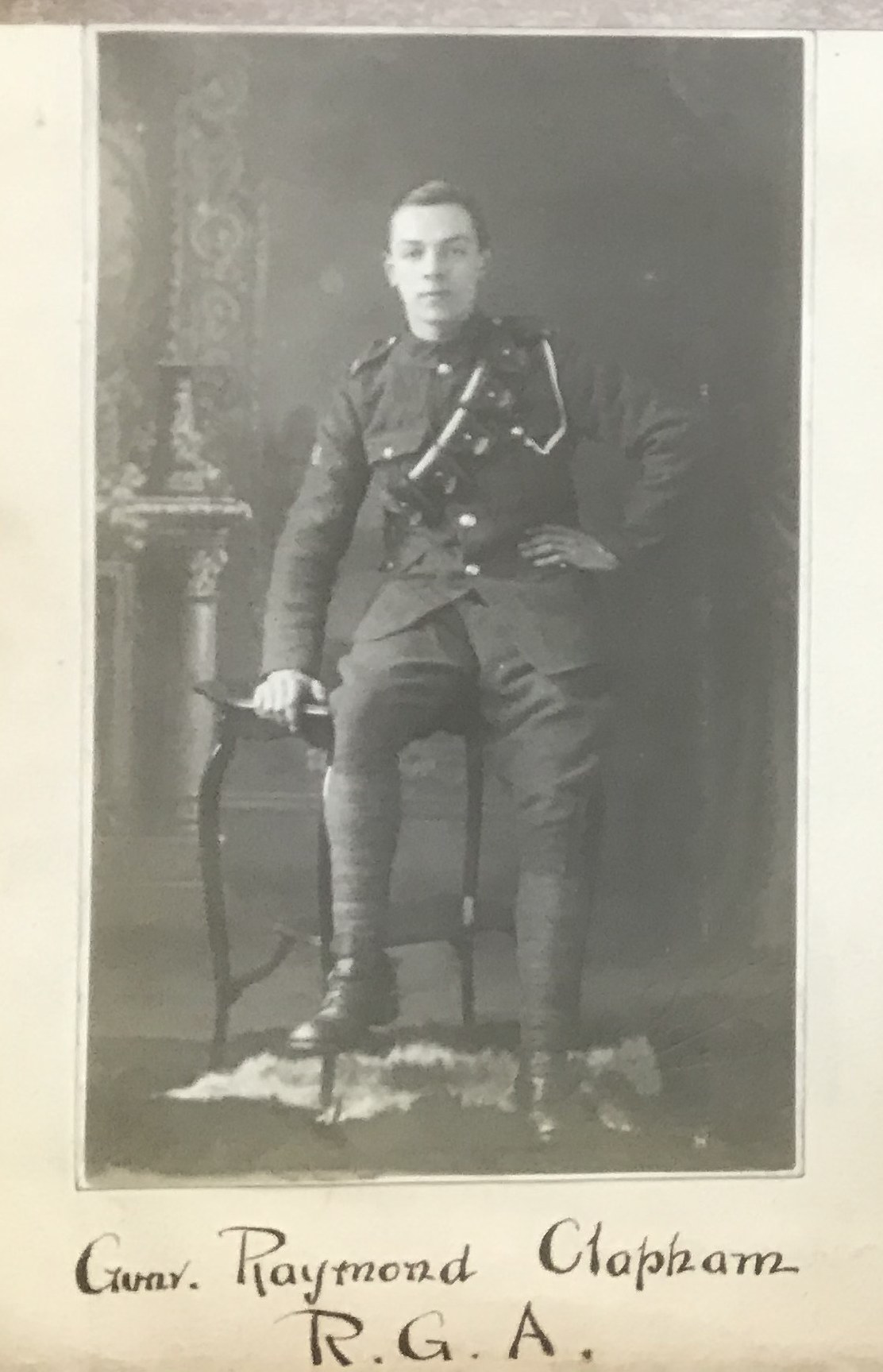
Gunner, 294th Siege Battery, Royal Garrison Artillery. Service no. 127074.
Early life:
Raymond was born in 1898 in Keighley, to parents Joseph and Ruth Clapham. His father was a blacksmith and wheelwright.
In 1901 Raymond was three and living at 10, Nashville Terrace, Exley Head with his parents. They were still there in 1911 when he was thirteen and he had a brother John aged eight and his father was recorded as a cart and wagon builder.
War service:
He enlisted in Keighley in April 1916 and had been serving in France since March 1917. According to the Battery War Diary they disembarked at Havre at 7am on 31 March 1917.
James was killed in action on June 21, 1917 at the age of 19, and was buried in grave 3, row A of plot III in La Plus Douve Farm Cemetery. His parents later lived at 128, Malsis Road, Keighley.
The Battery war diary does not mention his death as they rarely did, being concerned with Battery operations and mainly the amount of rounds fired.
Keighley News dated 30th June 1917:
News has been received by Mr & Mrs Clapham of 128 Malsis Road, Keighley, of the death in action on June 21 of their son, Gunner J, Raymond Clapham, of the Royal Garrison Artillery.
Aged 19 years, Gunner Clapham enlisted about ten months ago, and had been out at the front about three months.
He was an ‘Old Boy’ of the Keighley Trade and Grammar School, and upon leaving school he was employed for some time in the Keighley office of the Prudential Assurance Company. Latterly, however, he was employed in a bank at Leeds and Leyburn. He was of a cheerful disposition, and the news of his death will be received with deep regret by a wide circle of friends.
Keighley News dated 7th July 1917:
Gunner Clapham’s Popularity
Mr & Mrs Joseph Clapham of 128, Malsis Road, Keighley, have received letters with reference to the death of their eldest son, Gunner J. Raymond Clapham of the Royal Garrison Artillery, which was reported in last week’s “Keighley News.” Second Lieutenant Eric J. Quaile says: “He was in my section, and his cheerful disposition and willingness made him most popular with his comrades, added to which he was an excellent gunner. His death was instantaneous, and he had no time to be under any pain.”
The Rev. H. A. Norton, chaplain to the forces, writing on June 21, says: “This morning the enemy shelled heavily his battery position, after the arrival of the first shell he and the others were making for a safe placer when splinters of a shell struck him and caused his death. His Captain was also killed. We laid them to rest this evening in the presence of officers and men in a little cemetery near by. They spoke of him in the highest terms. I beg to express you my deepest sympathy in your sad bereavement. There is, however, comfort in the knowledge that he gave his life for his country and friends. A man cannot do more.”
Gunner Clapham, who was 19 years of age, was educated at the Keighley Trade and Grammar School. He was formerly on the staff of the London Stock Bank at Leyburn. He was a member of the Wesleyan Choirs at Exley Head, Keighley, and Leyburn.

Remembrance:
James is named on his Commonwealth War Graves Commission headstone in La Plus Douve Farm Cemetery which also bears a family inscription: “OUR BELOVED AND OUR PRIDE. FATHER AND MOTHER.”
Buried alongside him is his Captain, M.D. Wahl, who was killed at the same time.
James is remembered in Keighley’s Great War roll of honour book in Keighley Library, he is also named on the Exley Head war memorial outside the church and on the Exley Head framed roll of honour in the care of Cliffe Castle Museum. He is also remembered at Leyburn on their War Memorial, Leyburn village framed roll of honour, St Matthew’s Church memorial.
Post war:
Raymond was awarded the British War Medal and Victory Medal for his war service. These would have been sent to his parents along with his remaining Army pay and any personal effects. They would also have received a bronze war memorial plaque and scroll inscribed with his name.
