
B Company. 2/6th Battalion. Duke of Wellington’s (West Riding) Regiment. Regimental Number: 265947.
Previous Regimental number 3082.
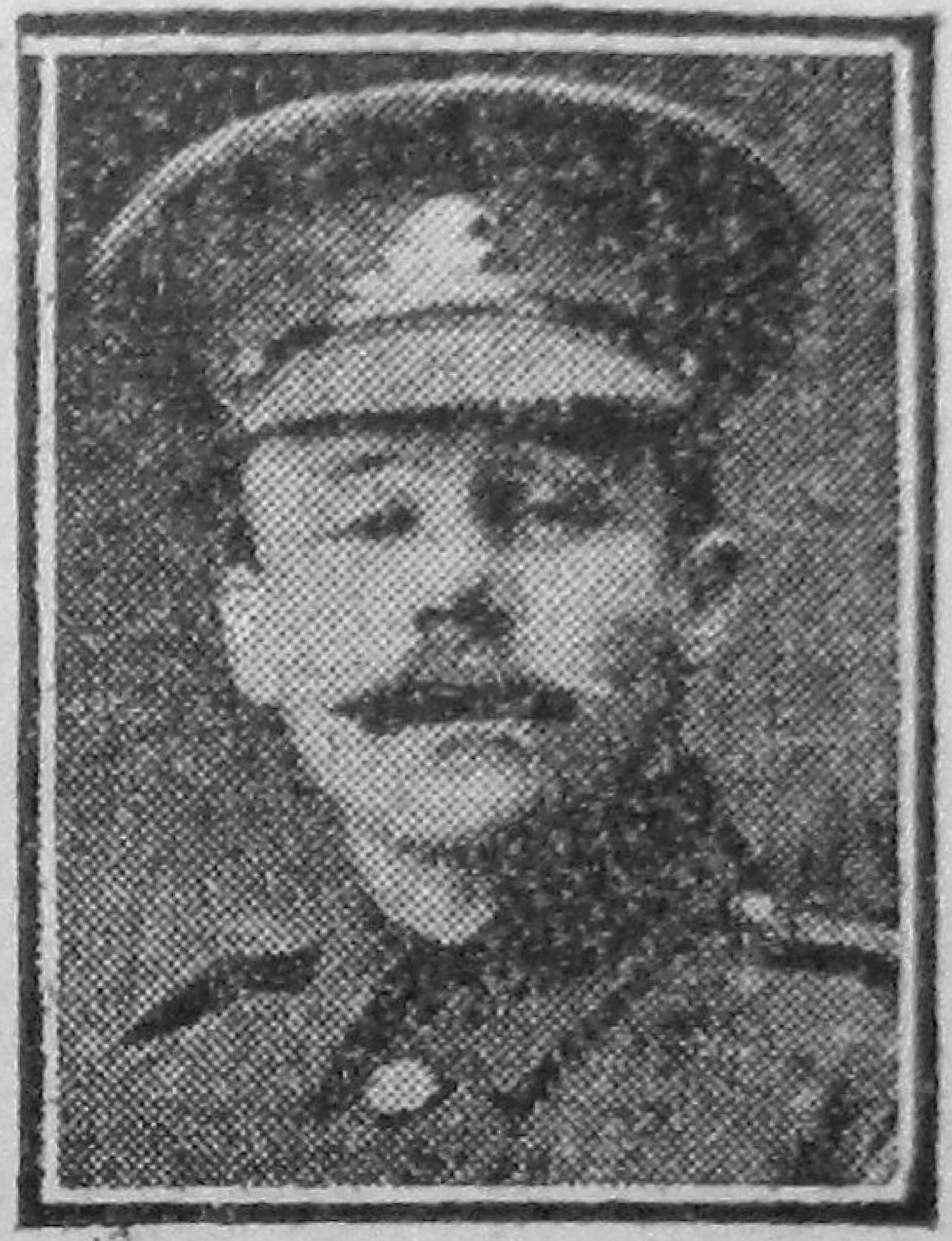
Early life:
George was the son of Charles Edward Athorn and Caroline Athorn née Jolliff who were married at Holy Trinity parish church of Armley Hall in Leeds on the 11th of June 1877. Charles was a bachelor aged 23 and a miller, Caroline was a 22 year old spinster and they were both living in the parish at the time.
George was born in 1879 and his birth was registered at Bramley in the second quarter of that year.
In the 1881 census George was aged just one and living with his maternal grandparents at 15, Hoyle Street in New Wortley, Bramley. They were Matthew Jollife aged 61 and Mary A. Jolliffe aged 63 and their son Matthew aged 19 and granddaughter Anney E. aged 14. George’s parents were away for the census, visiting at Goole with the Croysdale Family.
In the 1891 census George was aged eleven and living at 22, Colne Street in Keighley with his parents Charles aged 37 and Caroline aged 35. Charles was employed as a Corn Miller. Even though George was only aged eleven, he was working as a doffer in a worsted mill, although this was probably half time with school for the other half of the day. He had two brothers, Charles Matthew aged seven and Sidney J. aged five, plus two sisters Jane Elizabeth aged three and the baby of the family Lilly aged just three months.
By the 1901 census the family had moved to 17, Apple Street in the Eastwood area of Keighley. Charles was aged 47 and still working as a corn miller. Caroline was aged 46. George was aged 21 and employed as a worsted dyer’s labourer; Charles M. was aged 17 and a machine borer; Sidney was aged 15 and a bobbin setter at a worsted spinning mill; Jane E. was aged 13 and a spinner. Lily was aged ten. There were two more children in the family, who were Ernest aged seven and Oswald aged just one.
George married Mildred Annie Brown at Holy Trinity Church in Bingley on the 14th of June 1902. George was aged 23 and a bachelor employed as a machine man and living in Worth Village. Mildred was aged 22 and a spinster employed as a twister and living at Knight Street in Bingley.
Their first child was Douglas who was born on the 13th of October 1902. George and Mildred were living at 34, Myrtle Place and he was employed as a machine minder. Douglas was baptised on the 28th of January 1903 at Holy Trinity Church in Bingley. Douglas died just a few months later and his death was registered at Keighley in the second quarter of the year.
Their second child was Gladys who was born in Keighley, registered here in the third quarter of 1904. Sadly she died shortly afterwards and her death was registered here in the same quarter of the year.
Their third child was Elsie. She was born on the 9th of July 1908, so they appear to have waited a few years before trying again.
Elsie was baptised at Holy Trinity Church in Bingley on the 15th of November the same year. At that time they were living at 6, Portland Street in Bingley and George was employed as a labourer.
Their fourth child was Phyllis. She was born on the 28th of August 1909 and baptised at Holy Trinity Church in Bingley on the 17th of October the same year. The family were still living at 6, Portland Street in Bingley and George was employed as a mechanic.
By the time of the 1911 census they had moved back to Keighley. They were living at 3, Ribble Street in Worth Village in the North East ward of the town. George was 31 and employed as a slotter for a textile machine works (Probably Messrs. Prince Smith and Son.) Mildred was aged 31. The record shows they had been married for eight years and had four children, two of whom had died and as we know, they were Douglas and Elsie. Also recorded here during the census was and uncle, widower George Carter aged 71 who was employed as a yard man at the gasworks for Keighley Corporation.
According to the electoral rolls George was registered at 3, Ribble Street in Keighley between 1912 and 1915.
War service:
There are no surviving Army service records for George but we know from his initial regimental number (3082) that he was likely to be an early volunteer and he enlisted at Keighley. Several similarly numbered local men all enlisted in the last months of 1914. The war gratuity payment amount (see below) also suggests he enlisted around November 1914.
George is not however, listed in either the Keighley Town Clerk’s early enlistments or ‘Keighley’s Gallant Sons’ but he is named in the 2/6th Battalion’s nominal roll of men who went overseas with the battalion on the 5th and 6th of February 1917.
The Territorial Regimental numbering took place in early 1917 and George only has his six digit number appearing in his medal records, meaning that his number was changed on paper at least to 265947 prior to embarking overseas.
The 2/6th Battalion sailed from Southampton docks to Le Havre in three vessels which were the S.S. Caesara, S.S. Mona’s Queen and S.S. Huntscraft carrying a total of 33 officers and 953 other ranks.
On arrival and disembarkation the bulk of the battalion entrained for Belle Eglise and then route marched to Louvencourt. The remainder caught up with them the next day. On the 9th of February the whole battalion was housed in billets at Louvencourt.
George served with them until he went missing a couple of months later on the 3rd of May 1917. The war diary gives us a little insight into the events of that day.
WO-95/3087/1. War diary for the 2/6th Battalion, West Riding Regiment:
MORY.
2/5/17: Headquarters, A and B Companies under Lieutenant Colonel S. W. Ford proceeded to the Railway Embankment at U.26.c.7.0. in order to take part in an attack which the 62nd Division was making at 3.40 am on the 3rd May 1917 on BULLECOURT. (France sheet 51B S.W.4) and trenches of the HINDENBURG LINE West of BULLECOURT.
RAILWAY EMBANKMENT. U.26.c.7.0.
3/5/17:
The Battalion suffered severe losses during the attack on this date. Casualties: Officers: 1 killed, 5 wounded. Other ranks: 15 killed, 155 wounded, 88 missing.
The Battalion proceeded to camp at MORY. being relieved by the 2/5th Battalion Duke of Wellington’s Regiment to whom 2 officer and 80 other ranks were lent.
George was declared missing at the time and almost a year later was declared ‘missing, presumed killed’ on 3rd May 1917.
There is a far more detailed account of the operation on that day from the Headquarters of the 186th Infantry Brigade, which makes for interesting reading.
WO 95/3084/2. 186th INFANTRY BRIGADE:
REPORT ON OPERATIONS MAY 3rd 1917.
Reference: ECOUST ST.MEIN. Edition III. 1/10,000.
I beg to submit the following report on operations carried out on May 3rd as far as it affects this Brigade.
At 3.30 a.m. all Units were formed up on the taped lines, times to forming up lines proved satisfactory, and the last Battalion (2/8th West Yorkshire Regt.) reached their position at zero minus half an hour. Fortunately, the night was quiet on this Brigade front. At 3.10 a.m., a short burst from an enemy’s machine gun swept the ground but caused no casualties.
Eight minutes before zero, all troops moved forward as arranged, and all Units are agreed that the advance to the line of the Sunken Road U.27.a.60.65.-U.20.d.9.4. was made on the right line, with the exception that the 2/6th Duke of Wellington’s Regiment and 2/4th Duke of Wellington’s Regiment in the darkness closed in slightly towards their right. The right of the 187th Infantry Brigade also closed in this direction, with the result that there was a considerable mass of troops in U.21.c. shortly after our barrage opened.
The leading waves of the 2/5th and 2/6th Duke of Wellington’s Regiment had not reached the line of the Sunken Road in U.21.e. when the barrage opened, being about two minutes behind time. There is no doubt that the right of the 2/5th Duke of Wellington’s Regiment reached its first objective where touch was established with the 185th Infantry Brigade. This Battalion also occupied trench U.21.d.1.0.-U.21.d.2.4. A hostile machine gun at about U.27.b.05.80. which commenced firing shortly after zero hour caused the extreme right of the leading wave to check, and the right of the 2/8th West Yorkshire eventually reinforced this portion of the attack.
The wire on the right front proved no obstacle, but had to be traversed at certain places, and, apparently the 1st German line was occupied at intervals opposite these gaps, whilst “pockets” of the enemy intervened.
On the left of the Brigade front, the enemy’s wire appears to have been in much better repair and only passable at a few places. This caused a check to take place, during which, owing to hostile shelling, shell holes were occupied. Rear waves appear to have closed on the leading waves at this stage, and, coupled with the fact that Units had closed to their right, there was much congestion and confusion. While attempts were being made to cut the second belt of German wire, our parties were bombed and caught by enfilade M.G. fire from the North.
Sergeant Major Maude of 2/6th Duke of Wellington’s Regiment entered two enemy concrete M.G. posts and, after disposing of gunners, destroyed the guns. (These are constructed in front of trench. C.S.M. Maude can give accurate description).
Owing to this, and the fact that our barrage was now going away from them, the leading waves appear to have entrenched and established posts in shell holes.
An attempt was made by two Company Commanders of the 2/4th Duke of Wellington’s Regiment to reorganise the remainder on the line of the Sunken Road.
Owing to hostile barrage, this was found to be impossible and Captain Waller then gave the men the order to move back to the line of the Railway embankment. Here about 70 men of the 2/4th Duke of Wellington’s Regiment and a proportion of the 2/6th Duke of Wellington’s Regiment also reorganised and again went forward under their own officers. The second attempt proved ineffective, and the line of the Sunken Road in U.21.c. was finally occupied.
On the right at U.27.b.1.7. a hostile machine gun with 2 Officers and 6 Other Ranks were captured. The Gun was useless having been damaged by a Bomb and the officer and Other Ranks were wounded by German machine gun fire when being sent back to our lines. At 12 (noon) the party of 2/5th Duke of Wellington’s Regiment and 2/8th West Yorkshire Regt. were bombed out of this portion of trench and forced to occupy shell holes to the S. and S.W; of BULLECOURT, From information received from an Officer of the 1st R.W. Fusiliers, it has come to light that these men went forward with them into BULLECOURT on Z night, but nothing further has been heard of them.
A small party of 2/7th Duke of Wellington’s Regiment and 2/8th West Yorkshire Regt. are believed to have pushed forward through the 1st objective and to have reached the vicinity of the factory and square U.22.a. This was subsequently confirmed by aeroplane.
Note:
Sergeant Major Joseph Maude (of Haworth) received the Distinguished Conduct Medal for his part in this operation. Single handed, he destroyed two enemy machine guns and killed their crews.
The Keighley News Saturday 23rd February 1918:
LOCAL WAR CASUALTIES
KEIGHLEY
Private G. Athorne, West Riding Regiment, of 18, Peel Place, Keighley, who has been missing since May 1917, is now reported killed. He was formerly employed by Messrs, Prince Smith & Son, Keighley. He leaves a widow and two children.
Remembrance:
George’s body was never found and he has no known grave. He is commemorated on Bay 6 of the Arras Memorial.

Locally, he is named in the Borough of Keighley roll of honour book at Keighley Library. This gives very little detail and his name is spelled Athorne with an ‘e’ at the end. It also has no rank or number and he is given the intial J. rather than G.
We are sure it is him though as no other Athorn name is found locally and he does feature in the newspaper from which the Roll of Honour’s list of names was produced.
Post war:
His widow Mildred would have received any personal effects and was sent a payment from his Army account of £5 4s 2d on the 16th of July 1918. She also received a war gratuity payment of £11 10s 0d on the 29th of October 1919.
Mildred applied for a Dependant’s pension for herself and their two children. She received a £5 grant on 12th July 1918 and was awarded a weekly pension of 22 shillings and 11 pence for herself, Elsie and Phyllis beginning on the 31st of December 1917. Their element of this pension was only paid to them until their 16th birthdays. Elsie was 16 on the 9th of July 1924 and Phyllis, on the 28th of August 1925.
According to the Pension card, Mildred was notified of George’s death on the 3rd of December 1917, seven months after the day he died. This was when he was presumed to have died during the attack.
Mildred would also have received his medals which were the British War Medal and Victory Medal and these were usually sent out in 1920 or 1921. A bronze war memorial plaque and memorial scroll inscribed with his name would also have been sent to her around the same time.
Mildred remarried, to Thomas Edward Wilson in the first quarter of 1920. Mildred was living at 18, Peel Place in Keighley in 1919 and 1920. A later electoral roll shows she is Mildred Annie Wilson at the same address in 1923.
Getting remarried would certainly have affected her dependant’s pension but this is not mentioned on the pension card.
In the 1921 census Mildred Annie Wilson was living with her new husband Thomas Edward Wilson (an iron moulder for the Keighley Foundry Company.) at their home of 18, Peel Place in Keighley. Also here were Elsie Athorn aged 12 and Phyllis Athorn aged 11.
In the 1939 Register Mildred was aged 57 and on ‘domestic duties,’ living at the Clifton Arms, Lytham Road, Fylde, Lancashire. Her husband is Thomas aged 53. He is a licensed victualler and they have a barman living in, Priestley Shepherd aged 50.
Mildred died aged 79 on the 30th of November 1959.
Her probate record shows she died at Disley, Lytham Road, Warton near Preston and left £895 19s 4d to Thomas Edward Wilson retired licensed victualler and Elsie Athorn, spinster.
Information sources:
West Yorkshire, England, Church of England Marriages and Banns, 1813-1935.
England & Wales, Civil Registration Birth Index, 1837-1915.
1881 England Census.
1891 England Census.
1901 England Census.
England & Wales, Civil Registration Marriage Index, 1837-1915.
West Yorkshire, England, Church of England Births and Baptisms, 1813-1910.
England & Wales, Civil Registration Death Index, 1837-1915.
West Yorkshire, England, Church of England Births and Baptisms, 1813-1910.
1911 England Census.
West Yorkshire, England, Electoral Registers, 1840-1962.
Keighley News archives at Keighley Library.
Commonwealth War Graves Commission.
Soldiers Died in the Great War, 1914-1919.
British Army World War I Medal Rolls Index Cards, 1914-1920.
World War I Service Medal and Award Rolls, 1914-1920.
Army Registers of Soldiers’ Effects, 1901-1929.
World War I Pension Ledgers and Index Cards, 1914-1923.
England & Wales, Civil Registration Marriage Index, 1916-2005.
1939 England and Wales Register.
England & Wales, Civil Registration Death Index, 1916-2007.
England & Wales, National Probate Calendar (Index of Wills and Administrations), 1858-1995.
