
Private. B Company, 4th Battalion, Alexandra, Princess of Wales’s Own Yorkshire Regiment. Service Number 235308.
Previous service number 265353 with 6th Battalion, Duke of Wellington’s West Riding Regiment.
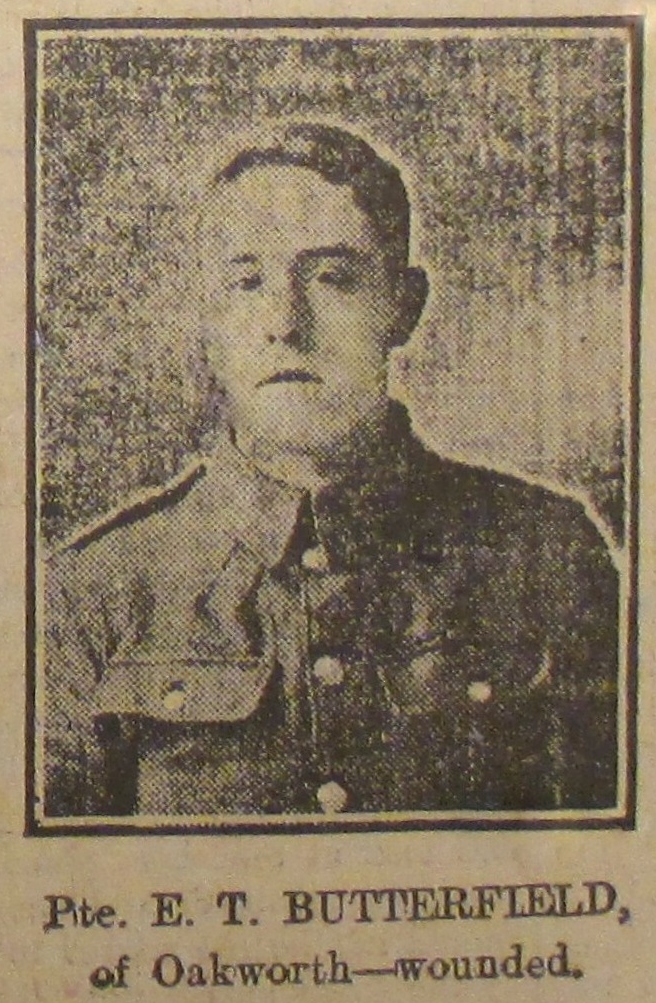
Early life:
Ellis’s parents were John Ellis Butterfield and Elizabeth Ann Butterfield, née Berry who had been married at St. Mary’s Church, Eastwood in Keighley on the 21st May 1887. John was 26 and a joiner. Elizabeth was 27 and a spinster.
They had four children who were Sarah Ann, born on 14th September 1890; James William, born on 6th September 1892; Ellis Taylor born on 29th September 1897 at Holmfield in Halifax and their fourth child was Norris, born in 1904.
Sarah Ann and James William were baptised together at St Michael and All Angels Church in Haworth on 5th May 1901 and Ellis Taylor was baptised two weeks later on 19th May 1901. The family was living at Stanbury and their father John was a now a farmer.
By 1901 Ellis was three and living at Enfield Side, Stanbury with his parents, sister Sarah and brother James. His father John was a farmer.
Enfield Side is the name of the hillside overlooking the Sladen Beck and from here you could look across the valley to the village of Stanbury. There were half a dozen farm houses located here on the South side of the Sladen Valley and they were almost certainly tenants of the farmhouse and land. Today this is quite familiar to many people who traverse the track along the ridge which leads to the popular beauty spot at Bronte Falls and runs alongside these farms.
By 1911 Ellis was aged thirteen and working as a doffer in a worsted spinning mill, probably the large Oakworth Mill in the village. His family was now living at Honey Hole Farm which is off Greyscar Road in Oakworth, with his parents, two brothers and one sister.
War service:
Ellis enlisted at Keighley with the 6th Battalion Duke of Wellington’s West Riding Regiment (service numbers 6266, then 265353) and was called up in his group under the Derby Scheme. He was later transferred to the 2nd Battalion Yorkshire Regiment with number 235308 and then transferred again to the 4th Battalion Yorkshire Regiment.
He was serving in France with the 4th Battalion when they were in the front line at Machelfort getting ready to make an attack on the German lines.
WO-95/2836/3_02 War diary.
4th Battalion Yorkshire Regiment. March 1918:
25th March:
In the morning the Battalion with the 4th Battalion East Yorkshire Regiment was ordered to attack the Enemy, who had crossed the RIVER SOMME by ST CHRIST BRIDGE. This attack was to be supported by French Troops, one tank, some armoured cars, and an artillery barrage, but nothing was ever seen of any of these. ZERO hour was constantly postponed, until about 10.0 am the enemy attacked. Our line was held until the Enemy worked round our flanks. Our line at this time was East of LICOURT.
One Company of the Battalion fought on until they were surrounded. The remainder fell back about half a mile in the direction of MISERY where they held an old trench for seven hours.
About 6 pm, as touch could not be obtained with any other unit and as S.A.A. (Small Arms Ammunition) was running short, Lt. Col. WILKINSON of the 4th Battalion East Yorkshire Regiment, who had taken over Command of the detachment, ordered a retirement to the railway line North West of MISERY. After about half an hour a further retirement was ordered to a line East of FRESNES. During the evening touch was obtained with 150th Brigade and orders were received to join the remainder of the Brigade at ABLAINCOURT, which place was reached about midnight.
Casualties 2nd Lt. W. THORNTON missing.
26th March:
Early in the afternoon the Brigade withdrew through LIHONS to ROSIERES-EN-SANTERRE, which place was reached about 5.0pm. The Brigade dug in here facing South East and held the held the position throughout the night and all the following day. We were in support with the 4th Battalion East Yorkshire Regiment on our left. The 5th Yorkshire Regiment and the 8th Durham Light Infantry were in the front line.
It’s likely that Ellis was part of the company which was surrounded, as he went missing on 25th March 1918, at Marchelpot. It was later learned that he had been taken prisoner on that date.
Red Cross – Prisoner of war records:
His mother had contacted the Red Cross on 17th June 1918 regarding his whereabouts with the reply ‘negatif envoyé’ – that he had not been found in their records.
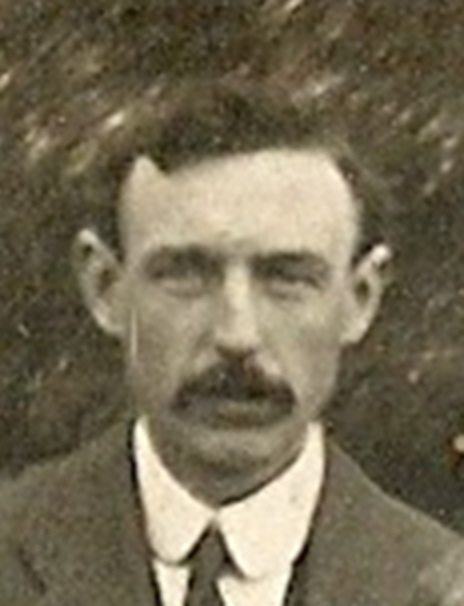
There was also some correspondence dated 14th September 1918, between the Red Cross and Joseph W. Proctor of 33, Gladstone Place, Oakworth regarding his whereabouts, possibly in response to his letter home (Gladstone Place is the last terrace of houses on the right side as you travel up Lidget from the centre of Oakworth, on the way to Keighley.)
Joseph William Proctor was the Head Teacher at Oakworth C. of E. School and may have been helping out because Ellis was a former pupil at the school along with his younger brother Norris and naturally Joseph had an interest in helping his parents.
Keighley News August 10, 1918, page 3:
Private Ellis Taylor Butterfield, Yorkshire Regiment, of Honey Hole, Oakworth, and formerly of Stanbury, who has been missing since March 26, has written stating that he is a prisoner of war in Saxony.
(From records, we believe he had died almost a month before this report appeared as according to one of the Dependant’s Pension cards he died of heart failure on 19th June 1918, whilst a prisoner of the Germans.)
Remembrance:
Ellis died aged 20 years on June 19, 1918 and was buried at the Albet Communal Cemetery German Extension but at some point the graves of several men were lost and their names now appear on a special memorial at Plaine French National Cemetery with the inscription: “Their Glory Shall Not Be Blotted Out.”
Ellis was posthumously awarded the British War Medal and Victory Medal for his war service. These, along with his personal effects went to his father John who was his next of kin. He would also have received a bronze war memorial plaque and scroll inscribed with Ellis’s name.
On 18th November 1919 John received a payment of £22 2s 6d which was from Ellis’s Army pay account and this included a £10 war gratuity payment. The gratuity was calculated by rank and the man’s length of Army service. This can be used to calculate an approximate date of enlistment, which for Ellis was around March 1916. From this we can assume that he was probably called up under the Derby Scheme.
Despite there being two Dependant’s Pension cards, neither gives any clue to whether any pension was received.
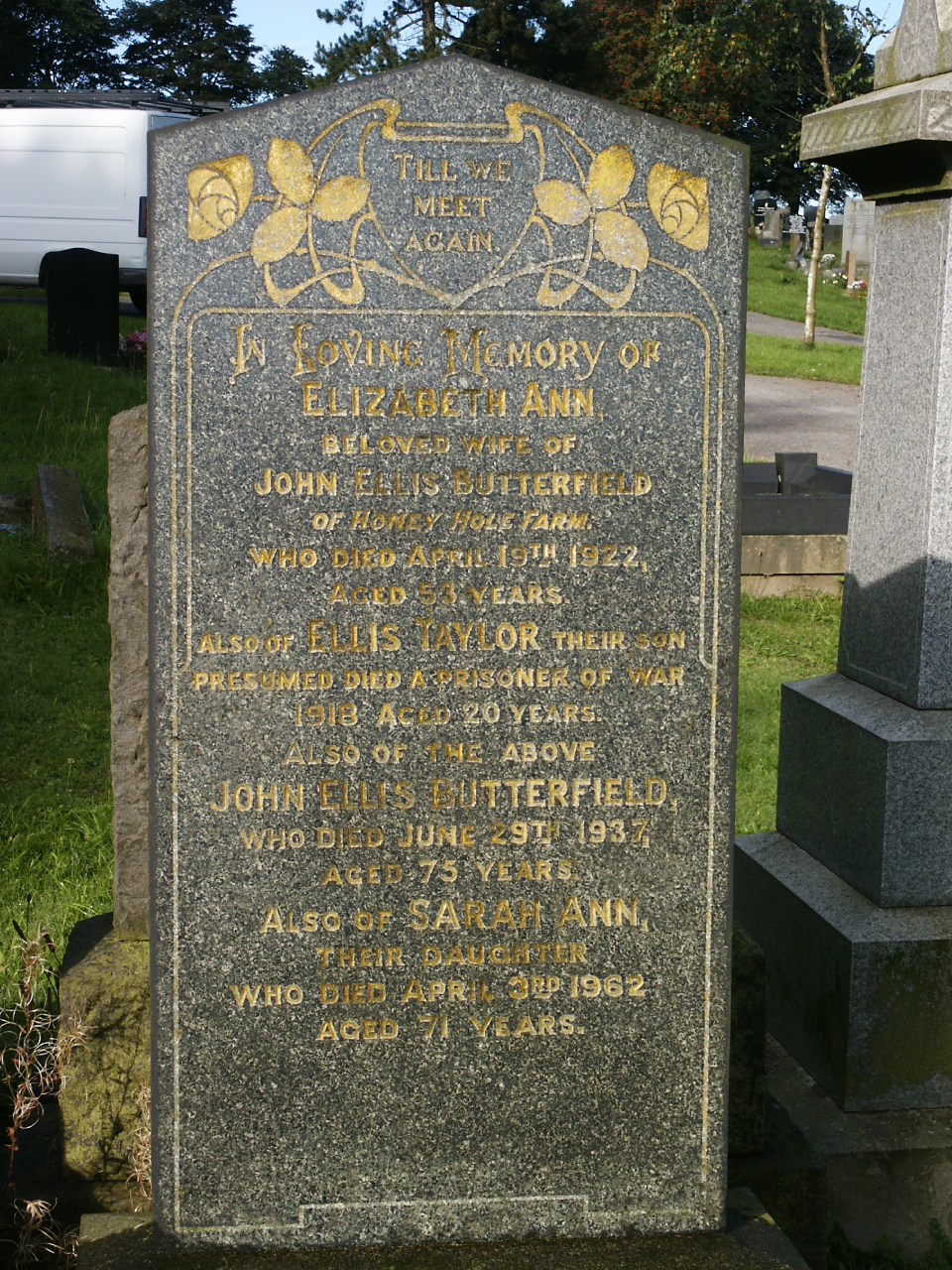
His name appears on the family gravestone in Oakworth Cemetery and reads: “Ellis Taylor their son, presumed died a prisoner of war 1918. Aged 20 years.”
He is also remembered on the Oakworth War Memorial in Holden Park, Oakworth.
Information sources:
West Yorkshire, England, Church of England Marriages and Banns, 1813-1935.
England & Wales, Civil Registration Birth Index, 1837-1915.
West Yorkshire, England, Church of England Births and Baptisms, 1813-1910.
England, Select Births and Christenings, 1538-1975.
1901 England Census.
1911 England Census.
WO-95/2329/2. War Diary for the 2nd Battalion, Yorkshire Regiment.
Commonwealth War Graves Commission.
Soldiers Died in the Great War, 1914-1919.
British Army WWI Medal Rolls Index Cards, 1914-1920.
WWI Service Medal and Award Rolls, 1914-1920.
Army Registers of Soldiers’ Effects, 1901-1929.
International Committee of the Red Cross historical archives.
(Prisoners of the First World War cards.)
Keighley News archives at Keighley Library.
‘Oakworth in My Time’ by Frank Wigglesworth
(published by Bradford Libraries. ISBN 0 907734 30 7.)
Photo of Mr. J. W. Proctor, Andy Wade’s collection.
