
Private. 10th Battalion, Duke of Wellington’s (West Riding) Regiment. Regimental number 60058.
Previously 8th Battalion, Duke of Wellington’s (West Riding) Regiment. Regimental number 13242.
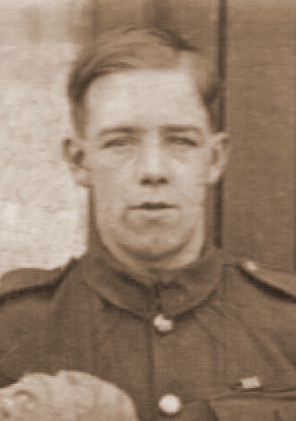
Early life:
William’s parents were Tempest Wigglesworth and Sarah Jane Wigglesworth née Wigglesworth, who were married at St John’s Church, Ingrow on the 16th of May 1896 They were both aged 21 and Tempest employed as a spindle grinder.
William was born on the 8th of September the same year and baptised at St John’s on the 11th of October. Their home address at this time was at Beech Grove and Tempest was a mechanic.
According to the 1900 Electoral roll, Tempest was recorded living at 33, Pitt Street in Keighley.
By 1901 they were living at 2, Quarry Street in the Park Wood Bottom area of Keighley, Tempest was 26 and employed as a spindle flyer turner. Sarah was also 26 and at home, looking after their children who were William aged four and Fred aged just one.
By the time of the 1911 census they had moved to 11, Thames Street in Park Wood which they had been renting from Rhoda Taylor since at least 1910. Tempest was aged 36 and still a spindle grinder, for a worsted machine works. Sarah was looking after the family home. They had been married for 14 years and their four children were William, now aged 14 and employed as a bobbin taker off at a worsted spinning mill. Fred aged eleven and Annie aged seven were both at school (probably Parkwood County Primary School just along the road from their home) The youngest child was James aged three and he would have been at home with his mother.
Because William and his brother Fred are named on the Sun Street Methodist Church roll of honour we know they must have been parishioners of that church, despite being baptised as Church of England.
War service:
A partial set of Army Pension records shows that William attested with the 6th Battalion, Duke of Wellington’s West Riding Regiment very early in the war, on the 27th of August in 1914. He gave his age as 19 years and 10 days and stated he was employed as a boring machinist. He was enlisted on the same date and issued with the Regimental number 13242.
William was actually ten days short of his 19th birthday and seems to have exaggerated his age a little. His next of kin was his father Tempest of 11, Thames Street.
He passed the Army medical at Keighley and his details were: 5 feet four inches tall, 106 lbs weight with a 32 inch chest. He had a slight build and good eyesight. His complexion was dark and he had blue eyes and light brown hair. His religion was Church of England.
Despite passing the medical and beginning his training with the 8th Battalion West Riding Regiment, initially at Halifax which would have been at the Wellesley Barracks. He was later found to have a medical problem and was diagnosed with an aortic stenosis which meant he was discharged. The form was signed at Grantham on the 12th of January 1915, suggesting that he was training at Belton Park Army Camp with the 8th Battalion at that time.
William was discharged under King’s Regulations under Paragraph 392, III c. This states:
Para 392 (iii) Not likely to become an efficient soldier
(c) Recruit within three months of enlistment considered unfit for service
Aortic stenosis was very serious and had no cure as open heart surgery was not possible at that time.
William appears to have re-enlisted at a later date with the regimental number 17891. There are no Army service records for this period so we can’t understand how he passed the medical with an aortic stenosis, which would be unlikely to get better of it’s own accord.
He went on to serve with the 10th Battalion Duke of Wellington’s West Riding Regiment including a period with the regimental number 60058. All of his overseas service was with them.
He served with the 10th Battalion in France, then Italy where he was awarded the Military Medal for bravery in the field on the 27th of October 1918. This was announced in the London Gazette.
London Gazette entry:
Issue dated 29th March 1919. Page 4130.
17891 Pte. Wigglesworth, W., 10th Battalion. (Keighley). (ITALY)
Usually the citations for the Military Medal are unavailable due to the original citations being poorly archived and for the most part, they no longer exist. Fortunately, William’s actions were reported in full in the Keighley News.
The Keighley News. Saturday 4th January 1919, page 3:
LOCAL WAR HONOURS.
Private William Wigglesworth, 10th West Riding Regiment, and of 11, Thames Street, Parkwood Street, Keighley, has been awarded the Military Medal for bravery in the fighting on the Piave on October 27 He has been in the Army about three years, and has seen service in France and Italy. A description of the deed which gained him the distinction reads as follows: “During the operations against the Austrian positions across the Piave on October 27, 1918, this man took command of a Lewis gun section and led it with the utmost gallantry and initiative against the enemy positions. When his gun was put out of action be rushed an enemy strong point of three machine guns and killed several of the enemy with his revolver, forcing the remainder to surrender. He then worked an Austrian machine gun for the rest of the day.” Private Wigglesworth’s brother has lost his life in the war.
We don’t have a date for when William was discharged from the Army, but he did survive the war.
His brother Fred was killed in action on the 11th of October 1918.
Post war:
William was awarded the British War Medal and Victory Medal for his overseas service. Because he had no Star awarded we are sure he did not serve abroad until the beginning of 1916.
In the 1921 census William was aged 24 years and 10 months and living at 1, Thames Street, Parkwood in Keighley and was a machine moulder for W & S Summerscales Ltd, Domestic Machinery Makers at Park Side Works. He was with his parents Tempest and Sarah Jane aged 46 and 47 and his siblings Annie aged 17, James aged 13 and Sarah aged eight. Frederick W. Wigglesworth aged 37 was also boarding here at the time.
William’s future wife Bridget Ann Durkin was aged 24 and living at 22, Colne Street in Keighley. She was employed as a worsted spinner by Ratcliffe and Maseman (sic – Magson?) Worsted spinners at Cabbage Mills, which was where the Morrison’s supermarket and car park is located today. Bridget was temporarily unemployed due to a coal strike which closed many mills for a while.
Note:
Her employers may have been James Ratcliffe and Fred Magson, Worsted weavers at Cabbage Mills.
William and Bridget were married in Keighley, registered in the last quarter of 1921, so not long after the census.
They had a child, Margaret, born in the third quarter of 1923 and registered in Keighley.
In the 1939 register William was aged 43 and an iron moulder (heavy work); Bridget was aged 42 and on unpaid domestic duties. There is a redacted record which may be Margaret, who would have been aged about 16 at that time.
They were living at 24, Holmroyd Avenue in Skipton, which still exists today and is on Holme Road.
William died aged 64, registered at Leeds in the first quarter of 1961.
Bridget died aged 64, registered at Worth Valley in the second quarter of 1962.
Information sources:
West Yorkshire, England, Church of England Marriages and Banns, 1813-1935.
England & Wales, FreeBMD Birth Index, 1837-1915.
West Yorkshire, England, Births and Baptisms, 1813-1910.
1901 England Census.
1911 England Census.
British Army WWI Pension Records 1914-1920.
British Army World War I Medal Rolls Index Cards, 1914-1920.
World War I Service Medal and Award Rolls, 1914-1920.
British Army Recipients of the Military Medal, 1914-1920.
The London Gazette.
Keighley News archives at Keighley Library.
1921 England Census.
England & Wales, Civil Registration Marriage Index, 1916-2005.
England & Wales, Civil Registration Birth Index, 1916-2007.
1939 England and Wales Register.
England & Wales, Civil Registration Death Index, 1916-2007.
West Yorkshire, England, Electoral Registers, 1840-1962.
