
Gunner. Royal Garrison Artillery. Regimental number 285369.
Early life:
Leslie was born on Saturday the first of July 1893 and his birth was registered at Skipton in the third quarter of that year. His parents were Frederick Ramsell and Mary Ramsell née Smith, who were married at Tamworth in Staffordshire in the first quarter of 1892. All three of their children were baptised together on the 21st of April 1895 at Christchurch in Skipton.
In the 1901 census Frederick was 34 and employed as a railway guard, having been a railway porter in the 1891 census. Mary was aged 29 and at home, the three children were Frederick Underwood aged eight, Leslie James aged seven and Millicent Amy aged six and they were living at number 69 Castle Street in Skipton.
By 1911 they had moved to 80 Cliffe Road in Bradford, Frederick was 43 and a railway foreman (shunting) for the Midland Railway. Mary was aged 38 and at home. The census shows that they had been married for 19 years and had three children. Frederick junior was aged 18 and a jobber in a silk mill, Leslie was aged 17 and a maker up and packer in a cloth warehouse, Millicent was a cardboard box maker.
War service:
There are no Army service records available for Leslie James Ramsell, but we have possible medal records for him which show he served overseas with the Royal Garrison Artillery but was not assigned to a battery. His regimental number was 285369.
In the 1921 census Leslie was aged 28 when he was boarding at 5b, Thorn Street in the Parkwood area of Keighley and was employed as a clerk in the Midland Railway office at Keighley. He was boarding with Elizabeth Williams, a 68 year old widow on home duties. Also living here were her daughter Elsie aged 27 and a Heald yarn winder for F. W. Carr, Reed and Heald makers; and grand daughter Elsie May aged 2 who was a rover for J. P. Heaton and Company, worsted spinners of Low Mill.
Leslie is recorded as a voter in the electoral rolls, living with Elizabeth Williams at 5, Wharf Street in 1921 and 1922.
Death:
Leslie died on Saturday 22nd of April 1922 when he was crushed by an engine at Haworth Railway Yard. He was aged 28 at the time. His death was recorded at Keighley in the second quarter of the year.
Leslie’s probate record dated 18th May 1922, shows he left the sum of £130 to his father Frederick Ramsell, railway inspector.
Notes:
No coroner’s report is available for the inquest but fortunately the circumstances of his death were recorded in the Keighley News which reported the proceedings of the coroner’s inquest which was held at the Haworth District Council offices.
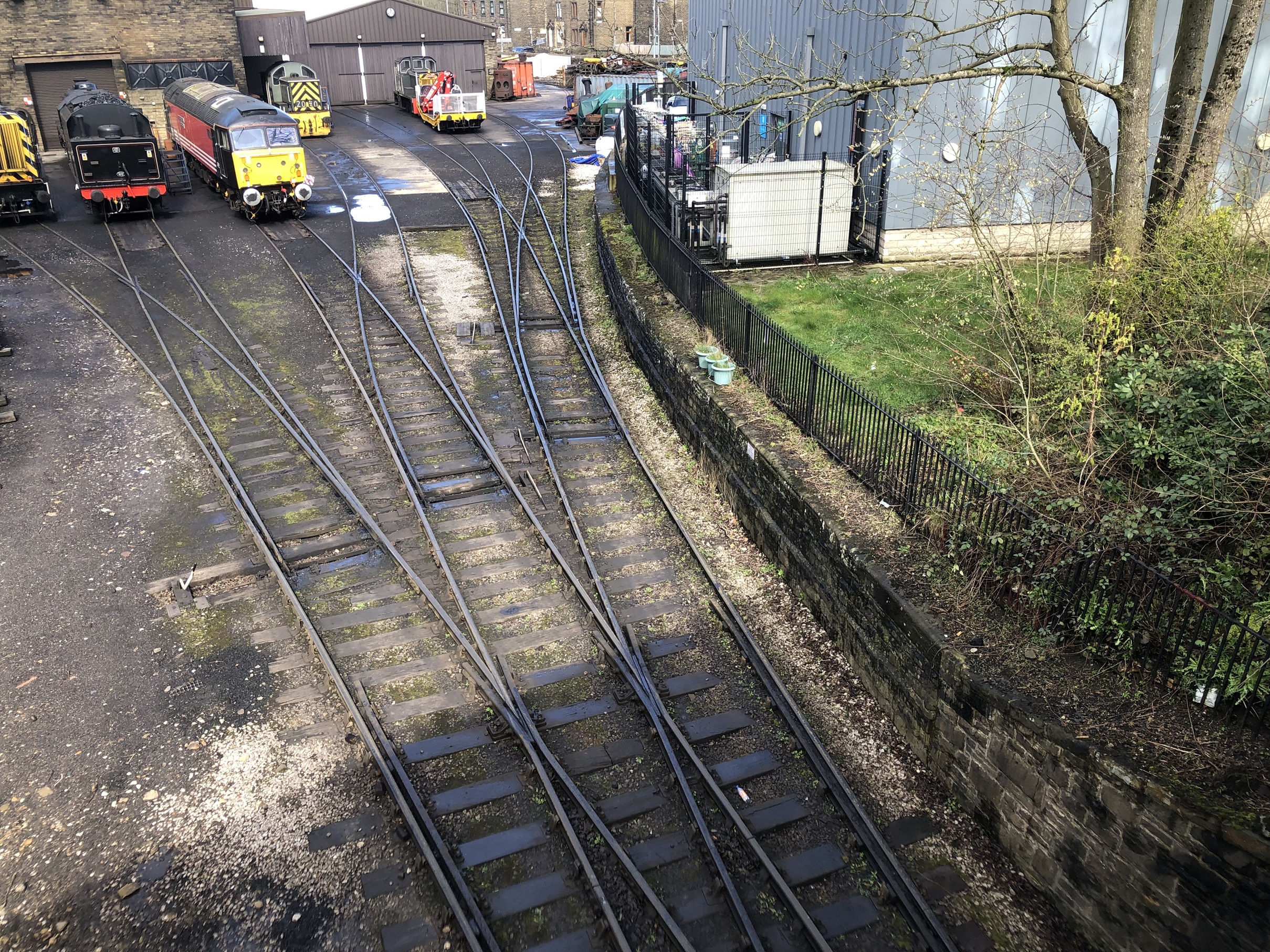
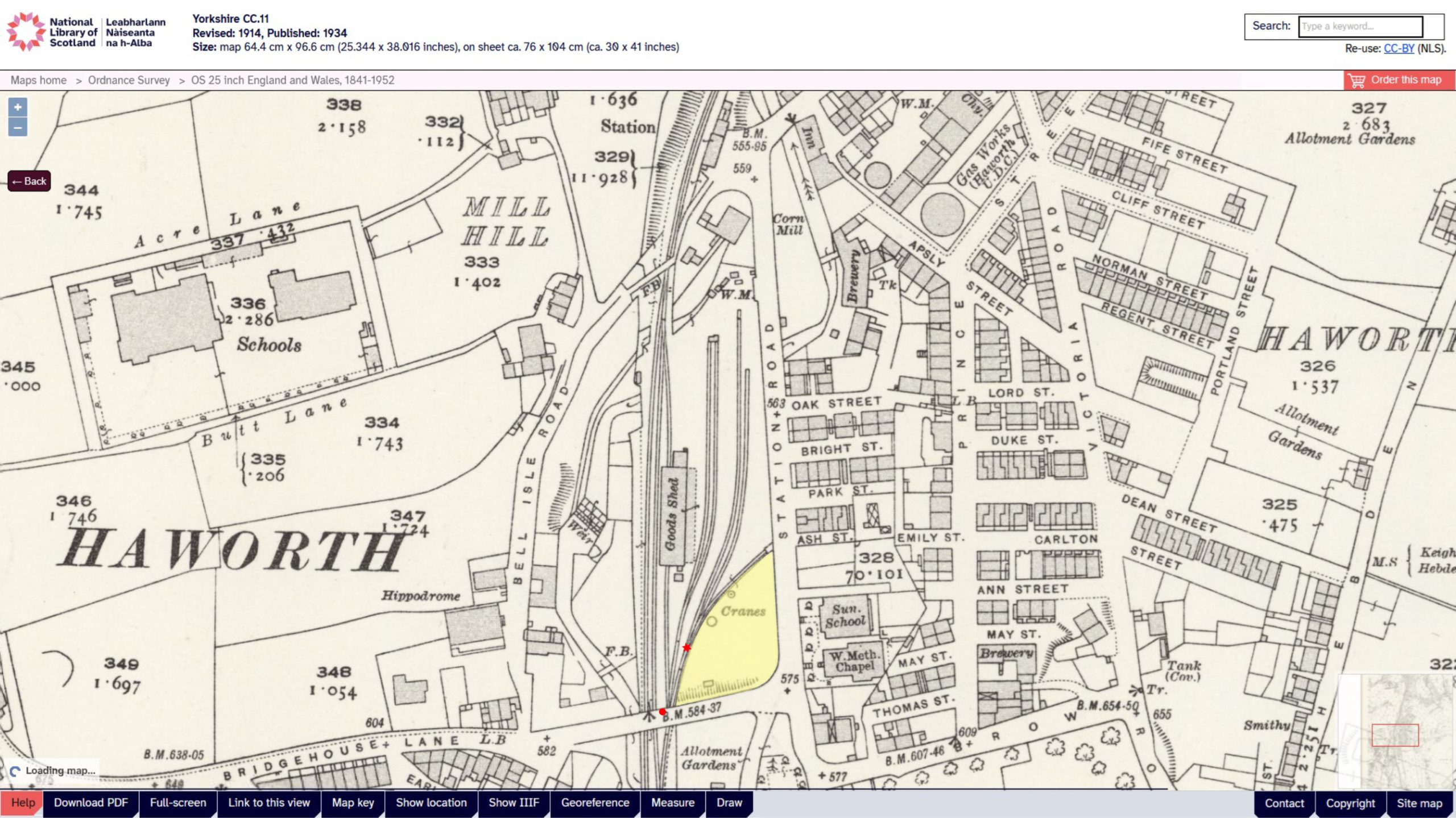
The ‘dock’ is believed to be the curved loading dock wall which forms the surround to the Cooperative Society building. At that time there were two cranes for loading and offloading of railway wagons and trucks. (See the photograph below which shows the curved wall and the map further down the page which shows where it was located in Haworth.)
Keighley News, Saturday April 29th, 1922:
GOODS GUARD KILLED AT HAWORTH.
CORONER’S INQUIRY.
CRUSHED BETWEEN DOCK WALL AND ENGINE
The goods yard at Haworth Midland Railway station was the scene of a fatal accident in the early hours of Saturday morning, in which Bradford man named Leslie James Ramsell (28), of 80, Cliffe Road, lost his life. Ramsell, who resided in lodgings at 5, Wharfe Street, Parkwood, Keighley, was a goods guard in the employ of the company, and in that capacity came down with a goods train from Oxenhope on Friday night. About 1.10 on Saturday morning, shunting operations were in progress in what is known as the stone yard at Haworth goods station. Ramsell was riding on the step of the engine, which was attached to some waggons, and the fireman, it is said, warned him to mind the stone dock. Ramsell was crushed between the wall of the dock and the engine. When picked up, he was badly injured about his chest, and died in twenty minutes.
Ramsell had been stationed at Keighley for about eighteen months. His father is sidings inspector at Manningham.
CHEST BADLY CRUSHED.
An inquest was held at the Haworth District Council offices on Monday afternoon by Mr. Edgar Wood (District Coroner); sitting without a jury. Mr. W. Whatley, traffic inspector, attended on behalf of the Midland Railway Co.; Mr. A. B. Clarkson represented the Associated Society of Locomotive Engineers And Firemen, and Mr. N. Rimmer, Leeds (District Secretary), was present on behalf of the National Union of Railwaymen.
Dr. W. J. McCracken said he was called to see the deceased at 1.20 on Saturday morning. He was lying on the track close to the waggons, on the side away from the dock. He was alive and conscious, and lived ten minutes. Witness made an examination and found that the chest bones were crushed and broken. Death had resulted from shock, set up by the injuries. The injuries he saw might easily have been caused by being nipped between an engine and the wall of the dock. He heard no suggestion that anyone had been to blame.
Evidence of identification was given by Frederick U. Ramsell, 29, Cliffe Road, Bradford, who stated that his brother had been employed by the company about six years. He considered him an experienced man, and able to do his work.
ENGINE STOKER’S EVIDENCE-
Arthur Riley, 29, Carlton Street, Keighley, engine stoker, employed by the Midland Railway Company, said he was employed on the engine at the time of the accident. Ramsell joined the train at Keighley and they proceeded to Oxenhope, where they carried out shunting operations. They then went to Haworth and pulled one or two waggons out of the first road. They hooked them up at the stone bridge and let them run into the warehouse, Ramsell breaking them off as they were running. They then drew the coal empties out of No. 3 road. Witness said that as he was stoking up, he heard someone say “Right!” and he told his mate to pull up.
The Coroner: Did you at that time see Ramsell?
Witness: No.
How far did you pull the waggons up?
About 100 yards; half way up the road to the dock.
They had pulled the waggons out of No. 3 road, and as he looked out he saw Ramsell riding on the bottom step near the door of the engine, on the side facing the dock in the Station yard.
Could you give me any idea of the speed you would be travelling?
Very slow. About, three miles on hour should think.
What sort of a gradient is it?
Uphill.
LOOK OUT: THERE’S THE DOCK!
How many waggons had you?
About 20, some full and some empty.
Did you realise as soon as you saw this man that he would be caught? Something seemed to tell me he was in danger.
Proceeding, Witness said that Ramsell was holding on to the rail of the engine with his right hand, with his face towards Oxenhope. Witness saw the lamp on the stone dock shining, and he shouted Look out! Leslie there is the dock.” Witness also shouted to the engine driver, and he put on the brakes at once.
How far would you, travel then?
About a waggon length.
When witness called out to Ramsell he saw him swing round with his right hand still hold of the engine door-rail, and he then had his back to the engine. He dropped the lamp and shunting pole which he was holding in his other hand, and the lamp dropped on the dock.
The Coroner: Unless he had had room between the engine and the dock, he had no chance of escape?
Not a bit.
When you saw him, he was too near the dock?
Yes.
Witness said that Ramsell had never been guard in charge before, as the other man went on his holidays the day previous, He had worked in the dock the week previous, but that was in the daylight.
So he would know the roads?
Yes.
If not very well?
No.
I suppose it is usual for these men to ride up and down on the steps?
Yes.
In reply to further questions by the Coroner, witness said it did not occur to him that Ramsell might ride on the step before they got to the dock. It was very dark, and when he was stoking up he did not see him.
A CRY FROM DECEASED.
You think he would not see the dock until he got close to it?
He did not see it until it was too late.
Do you think it would be better if they white-washed that side of the dock?
I should say a lamp would be better there.
In reply to Mr. Clarkson, witness said that when he shouted to the driver to stop the engine, he heard Ramsell shout out “Oh!” three times.
Mr. Rimmer: Am I correct in assuming there are no lamps in that yard?
Yes, there are lamps.
It is quite common practice for guards to ride on the step?
Yes.
Is it usual for men to work on the dock side when shunting?
I have never known it before.
George Tempest, 19b, Beta Street, Parkwood. Keighley, said he was driving the engine at the time of the accident, and the last he saw of Ramsell was when he left him taking a waggon down to the warehouse. On reaching the stone dock he heard the fireman shout to Ramsell, and he heard the latter say something, but he could not distinguish what it was. He thought Ramsell realised that he was in danger, and there was going to be an accident. Witness at once shut off steam and pulled up, and the body was brought out by the trailing wheel of the second waggon. Witness got out of the engine on to the dock, and found Ramsell’s lamp. He shouted his name twice, but received no answer. The space between the engine and the side of the dock was very narrow, and it was impossible for anyone to stand on the engine, even sideways, and escape being crushed.
SUGGESTION BY THE CORONER.
How would Ramsell have got to that side of the engine?
I cannot imagine, and it mystified me how he got there in the short time that had elapsed.
In returning a verdict of “Accidental death,” the Coroner said it had been an accident for which nobody was really to blame. He would like Mr. Whatley to consider the placing of a light on the dock, or devising some means of making it more prominent. Though the men knew it was there, it was easy for them to forget it when their attention was directed to something else. Mr. Whatley promised to act upon the suggestion.
Mr. W. Whatley, on behalf of the company; Mr. A. B. Clarkson, representing the Associated Society of Locomotive Engineers and Firemen, and Mr. W. Rimmer, district secretary of the National Union of Railwaymen, expressed regret at the accident, and extended their deepest sympathy to the relatives
Mr. Whatley said he got the deceased into the railway service himself. He had watched his career throughout, and he had been a good man at his work.
Prior to his transfer to Keighley Mr. Ramsell was employed at Cononley Station, where he earned the respect and esteem of all with whom he came in contact. He was in the village a few hours before his death, spending Friday evening with his fiancée, Miss M. Wilson. To the latter the sincere sympathy of the residents will go out. It is understood that the couple were to have been married within the next few months. The interment took place at Bingley on Wednesday.
Information sources:
England & Wales, Civil Registration Birth Index, 1837-1915.
1901 England Census.
1911 England Census.
British Army World War I Medal Rolls Index Cards, 1914-1920.
World War I Service Medal and Award Rolls, 1914-1920.
1921 England Census.
West Yorkshire, England, Electoral Registers, 1840-1962 for 1921 and 1922.
England & Wales, Civil Registration Death Index, 1916-2007.
Coroner’s inquest. Keighley News, Saturday April 29th, 1922.
National Library of Scotland Maps.
England & Wales, National Probate Calendar (Index of Wills and Administrations), 1858-1995.
