
Local men who served in the Peninsular War between 1808 and 1814 – 1815.
Rifleman. Captain C. Beckwith’s Company. 1st Battalion Rifle Brigade, 95th Regiment of Foot.
Early life:
Christopher’s father was Henry Ingham and his mother was Margaret Ingham (Peggy.)
A marriage banns record exists for a Henry Ingham and Peggy Hargreaves who were married at St. Bartholomew’s Church in Colne on the 2nd of October 1773. Neither of them could write and they both made an X as their signature.
We do not have a birth date for Christopher but a christening record shows a Christopher Ingham being baptised at St. Bartholomew’s Church in Colne, Lancashire on 1st April 1787.
No other records have been found about Christopher’s early life, leading up to 1809 when he joined the Army.
War service:
There is a discharge document for Christopher with the Chelsea Pensioners Service Records which gives details of his service in the Peninsular war, serving under Lord Wellington.
He enlisted at Winchester in the County of Hampshire on the 1st April 1809 – matching his date of birth with the christening record, although it gave his year and place of birth as 1788 and ‘Cowen’ in Lancashire. His age was recorded as 21 but he would have been aged 22 if he was born in 1787. It’s also likely that the clerk wrote Cowen because the pronunciation of ‘Colne’ would sound like that.
His discharge paper states he had served for 20 years and 21 days with an extra two years being added in respect of him being awarded the Waterloo Medal.
Christopher was discharged in consequence of a pulmonary affection, referred to as asthma. He had always been of good character and he had served through the whole of the Peninsular War and at Waterloo.
He acknowledged that he had received all of his pay, clothing and arrears of pay.
Christopher could not write his name and left his mark with an X.
Because he was discharged with a good record, the document would have been valuable to any future employer seeking a trustworthy man and for this reason, his physical description is included to prevent anyone using the document to gain employment under false pretences. It also served to give us an idea of what Christopher looked like:
He was aged forty and was five feet 7 inches tall with light brown hair, grey eyes and a fair complexion. By trade he was a weaver. The document was completed at Halifax on 21st of September 1828 and countersigned by the Commanding officer on the 14th of April 1829.
As he served for the whole duration of the Peninsula War he would have seen many battles and would have had nine clasps on the ribbon of his Silver War Medal (the Military General Service Medal) and he would also have had The Waterloo Medal.
His name appears in the Peninsular War medal roll with annotations for the battles. His name is also listed in the Waterloo Medal Roll, a copy of which is with the Royal Mint.
Post war:
After the war ended Christopher returned home and was employed as a weaver when he married widow Betty Heap at St. Bartholomew’s Church in Colne on the 5th of August 1832. Both Christopher and Betty made the mark X instead of their names. Their daughter Margaret would have been born around 1834 in Colne, Lancashire.
Christopher Ingham was licensee of the Reservoir by 1836. In that year he was fined 2/6d for allowing ‘tippling’ at the house during the hours of divine service. It was noted he had previously kept a pub at Colne. He was described as a weaver when he married in 1832 but as an innkeeper at the baptism of his daughter in 1833. (This information is by kind courtesy of Eddie Kelly.)
Christopher may have used his Army discharge paper to good effect when he became the landlord of the Reservoir Inn on Calversyke Hill in Keighley. He was aged 50 when he was recorded as ‘Inn Keeper’ in the 1841 census with Betty aged 45 and their daughter Margaret aged seven.
He was still an Inn Keeper (at Road Side) in the 1851 census his age was given as 63 and Betty was aged 58. Margaret was aged 17 and employed as an apprentice dress maker. All three were from Colne, Lancashire.
By the time of the 1861 census their address was given as Calversyke Hill in Keighley, Christopher was aged 75 and Betty was 69. Margaret is not recorded here at this time but she would have been about 27 years old.
Christopher died at the age of 79 and his death was recorded at Keighley.
The letters of administration record shows he left an amount under £50 to his wife and relict Betty who would have been aged about 74 at that time.
Transcription:
Ingham, Christopher. Effects under £50.
9 February
Letters of Administration of the Personal estate and effects of Christopher Ingham late of Keighley in the County of York Innkeeper deceased who died 9 September 1866 at Keighley aforesaid were granted at Wakefield to Betty Ingham of Keighley aforesaid Widow the Relict of the said Deceased she having been first sworn.
Several years later, Betty is recorded in the 1871 census living alone at Spring Lane in Colne, Lancashire. She was a widow aged 77 and a retired publican originally born at Colne in Lancashire.
Betty died at the age of 79 and a burial record shows she was buried at Keighley on the 5th of February 1872. We have not been able to locate her grave.
Remembrance:
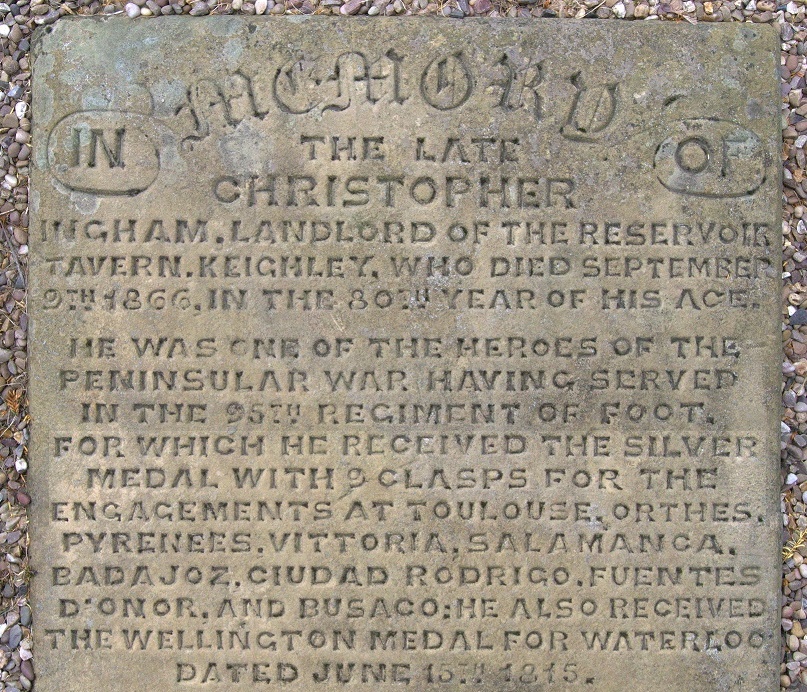
Christopher is buried at Utley Cemetery in Keighley and his large gravestone gives details of his exploits as a soldier in the Peninsular War.
Grave inscription:
In memory of the late Christopher Ingham, Landlord of the Reservoir Tavern, Keighley, who died September 9th 1866, in the 80th Year of his age.
He was one of the heroes of the Peninsular War having served in the 95th Regiment of Foot, for which he received the Silver Medal with 9 clasps for the engagements at TOULOUSE, ORTHES, PYRENEES, VITTORIA, SALAMANCA, BADAJOS, CUIDAD RODRIGO, FUENTES D’ONOR AND BUSACO: he also received the Wellington Medal for Waterloo. Dated June 12th 1815.
A note about the Bernard Cornwell series ‘Sharpe’
Every few years someone raises the question of whether Christopher Ingham was the inspiration for Bernard Cornwell’s ‘Sharpe’ books and the television series starring Sean Bean. Our position is that this is not true, no matter how much someone may wish it. Our evidence for this is below:
The author Bernard Cornwell has stated unequivocably that Sharpe was entirely a work of fiction and he had not heard of Christopher Ingham when he wrote the books. His comments can be seen on his own website forum here:
Bernard Cornwell – Your Questions.
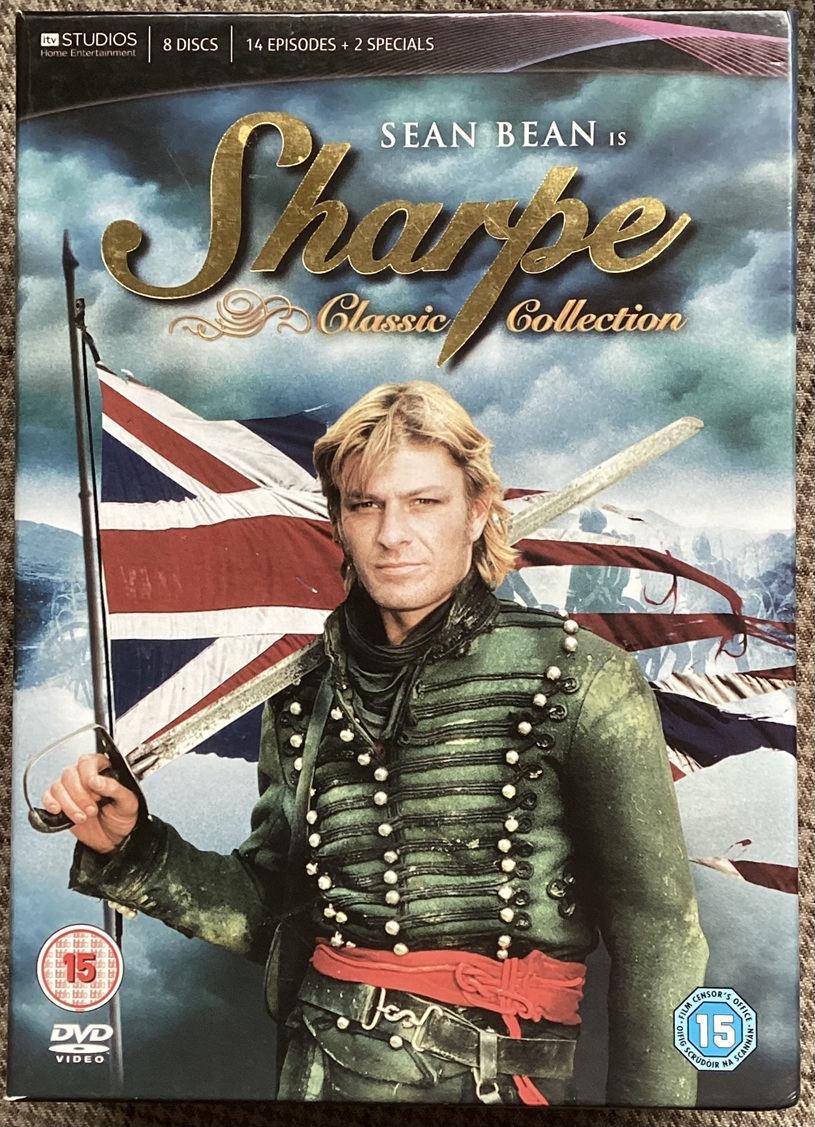
The gist of the series is that Sharpe was a private soldier, a rifleman in Wellington’s Army during the Peninsular War, fighting Napoleon’s French Army in Portugal and Spain. He was made Sergeant and then raised to Lieutenant by Wellington himself after an action in which he saved Wellington’s life. The subsequent stories see Sharpe placed in different situations requiring him to gain the respect of his subordinate soldiers as a man raised to be an officer, and the objections from the officer class to a upstart of a man who was out of his depth because he was not an officer and a gentleman.
The similarity is that Christopher Ingham was a rifleman who served in many of the battles in the war, but he never gained promotion above that of a private, whereas Sharpe eventually became a high ranking officer.
There was even an episode called ‘Sharpe’s Justice’ in which Sharpe returns home to Keighley, giving further credence to the rumour that Ingham was the inspiration. However, this episode was not written by Bernard Cornwell, but by Patrick Harbinson, for the TV series.
There are probably many other men buried in graves around the country who could claim to be the inspiration for Sharpe but Cornwell has been quite clear in his responses that the character was entirely a work of fiction.
Sergeant William Lawrence:
Here’s another man who could claim the same. Sergeant William Lawrence of Studland in Dorsetshire was a soldier who had served in the Peninsular War and was later serving in Paris when he a French woman called Clothilde Clairet at St. Germaine-en-Laye. They moved back to the UK and William (with Clothilde) spent his last days as the landlord of the Wellington Inn. His gravestone reads in a very similar way to that of Christopher Ingham and locally, the same stories come up from time to time about him being the inspiration for Sharpe.
Find-a-grave.com – Sergeant William Lawrence.
To the honoured memory of
SERJEANT WILLIAM LAWRENCE
(of the 40th Regiment of Foot)
Who after a long and eventful life
In the service of his country
Peacefully ended his days at STUDLAND
November 11th 1869.
He served with his distinguished regiment
In the war in South America 1805,
And through the whole of the Peninsular war 1808 – 1818.
He received a silver medal and no less than 10 clasps
For the battles in which he was engaged
ROLEIA, VIMERA, TALAVERA
CUIDAD RODRIGO
BADA-JOZ
(In which desperate assault being one of the volunteers
For the FORLORN HOPE, He was most severely wounded)
VITORIA, PYRENEES, NIVELLES
OTTHES, TOULOUSE.
He also fought at the glorious victory of
WATERLOO
June 18th 1815.
Information sources:
Lancashire, England, Church of England Marriages and Banns, 1754-1936.
Lancashire, England, Church of England Baptisms, Marriages and Burials, 1538-1812.
Peninsular Medal Roll 1793-1814.
The Royal Mint Museum Waterloo Medal Roll, 1815.
Chelsea Pensioners British Army Service Records 1760-1915.
Lancashire, England, Church of England Marriages and Banns, 1754-1936.
England, Select Marriages, 1538-1973.
1841 England Census.
1851 England Census.
1861 England Census.
England & Wales, Civil Registration Death Index, 1837-1915.
British Newspaper Death & In Memoriam Notices.
Grave inscription at Utley Cemetery in Keighley.
1871 England Census.
Find-A-Grave.com.
Licencee information by Eddie Kelly who wrote about Keighley’s War Memorial for us.
Christopher Ingham’s grave photo by Andy Wade.
