
23rd Battalion Northumberland Fusiliers (Tyneside Scottish), Regimental number 47502.
Previously Royal Artillery (home service only).
Also served overseas with 2nd Battalion Northumberland Fusiliers; Area Employment Company Labour Corps, Regimental number 578342; and Royal Fusiliers, Regimental number GS/107299.
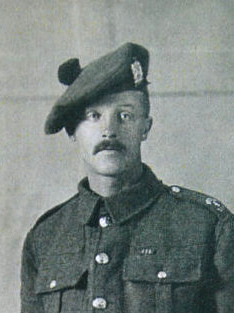
Early life:
Tom was a son of James Charnock and Sarah Charnock née Southam who were married at St. Andrew’s Church in Bradford on the 21st of November 1874. James was a 23 year old bachelor and tailor living at 23 Shearbridge Road in Bradford and Sarah was a 22 year old spinster and weaver living at Haworth.
Tom was born on the 30th of August 1881 and registered as Thomas Charnock at Keighley in the last quarter of that year. He was baptised at St. Michael and All Angels Church in Haworth on the 30th of October 1881. AT that time they were living in Haworth and his father James was a tailor.
In the 1891 census Tom is aged nine and living at 8, Cold Street in Haworth with his parents and a very large family. James is aged 40 and the head of the household, working as a Master Tailor. Sarah is aged 39 and looking after the family home. Their children were Edwin aged 19, a twister in a worsted mill; George aged 15, Richard aged 14, Sara Alice aged 12 and Mary Elizabeth aged 11, are all employed as spinners in a worsted mill full time – although we suspect Sarah and Mary might be half time with school.
The three youngest children are Tom (Thomas) aged 9 and Martha aged 5 who are at school and Walter aged three who would have been at home with their mother Sarah. 8, Cold Street would have been a very full home!
Their father James died at the age of 46 on the 30th of July 1897 and his death was registered at Keighley in the third quarter of the year. He is buried in the family grave at St. Michael and All Angels Church Yard in Haworth.
By the time of the 1901 census little has changed apart from Edwin moving out. He would have been aged 29 at this time. They have moved to 4, Pine Street in Haworth and Sarah is the head of the household. Also living here are George aged 25, a cloth weaving overlooker; Richard aged 24, a wool sorter; Sarah Alice aged 22 and Mary Elizabeth aged 21 were both cloth weavers; Tom aged 19 was now a butcher’s apprentice; Martha aged 15 and Walter aged 13 were both worsted spinners.
Tom was married on the 27th of April 1908 to Lily Annie Peacock. They tied the knot at St. George’s Church in Barnsley. Tom was a 26 year old bachelor and butcher of 28, Wellington Street in Barnsley and Lily was a 22 year old spinster of 3, Nelson Street in Barnsley.
Quite why or how Tom ended up in Barnsley is a mystery. 28, Wellington Street is the address of the Salvation Army Citadel. This building, although closed and in rather poor condition, is still there today.
In 1910 Tom was renting a house from William Brown’s Executors. This was number 24, Cold Street in Haworth.
His mother Sarah died on the 6th of August 1910 aged 58. She is buried in the family grave at St. Michael and All Angels church yard.
Tom was recorded on the 1911 electoral roll at 24, Cold Street, but by the time of the 1911 census he was aged 29 and living at 6, Green Street with Lily Annie aged 25 and their son James aged just two. Tom was employed as a butcher by the Cooperatives Stores, possibly their large building at the lower end of Haworth Main Street. He and Lily had been married for three years and had just one child recorded at that time.
In 1912/13 they moved from 6, Green Street to 4, Lindon Street, as recorded in the 1913 electoral roll.
War service:
There are no surviving Army Service Records for Tom. According to the local newspaper he enlisted in September 1916 and transferred to the Northumberland Fusiliers. His medal records only show who he was serving with when overseas so the Royal Artillery is not mentioned. However a grainy photograph from the newspaper archive shows him wearing the badge of the Royal Artillery.
Whilst he was overseas, the regiments he served with were as follows:
23rd Battalion Northumberland Fusiliers. Regimental number 47502.
2nd Northumberland Fusiliers. (same regimental number)
966 Area Employment Company Labour Corps. Regimental number 578342.
43rd Royal Fusiliers. Regimental number G.S./107299.
Tom earned the Military Medal during his service with the 23rd Battalion Northumberland Fusiliers and the newspaper refers to it being earned during the ‘big offensive last Easter’ which would be Easter 1917.
We have transcribed a section of their war diary for the battle he was involved in and survived, earning a card of honour for his brave service.
WO-95/2463/2/2. War Diary of the 23rd Battalion Northumberland Fusiliers.
1917.
LOUEZ.
8th April:
In the evening the Battalion proceeded from LOUEZ into their assembly trenches in the ROCLINCOURT AREA.
The 21st & 22nd. Northumberland Fusiliers took up their positions in the front trenches. The 20. Northumberland Fusiliers in support trenches and this unit in WEDNESDAY AVENUE. from A.29.c.20.20 to G.5.a.0.1, The Brigade in conjunction with troops on our right and left will attack enemy trenches in the morning of the 9th.
ROCLINCOURT.
Zero hour will be 5.30 a.m. The scheme for attack etc is shown in APPENDIX GN/S/6.
Casualties 4. OR’s Sick, Second Lieutenant. W.N. Collings wounded.
9th April. 5.30 a.m:
The artillery barrage opened at Zero hour and after 4 mins intense bombardment the barrage lifted and the leading waves of the 21st & 22nd Northumberland Fusiliers advanced, followed by the 20th Northumberland Fusiliers.
This Battalion was not due to attack until zero plus 2 1⁄2 hours.
There are 5 distinct objectives in the attack, viz. Black Line, Blue Line, West Brown Line, East Brown line and Green Line. The Brigade Limits through these 5 objectives are as follows.
BLACK LINE A.30 d.50.45. to G.6.b.90.25.
BLUE LINE B.25.d.90.70. to H.1.b.90.60.
WESTERN BROWN LINE B.27.c.70.85. to H.3.a.45.55.
EASTERN BROWN LINE B.27.c.70.85 to H.3.a.85.50.
The limits held by the Brigade prior to the attack were from A.30.c.45.20 to G.6.a.50.05.
At 8 a.m. The Battalion advanced to the attack from WEDNESDAY AVENUE. During the first stages of the advance up to the BLUE LINE the men were in artillery formation after which they extended into lines.
The casualties were slight up to the Blue line and the enemy barrage was not very heavy. As per orders this Battalion and the 20th Northumberland Fusiliers should form up astride the BLUE LINE and advance to the BROWN LINES. The frontage allotted the Battalion was from B.25.d.90.70. to B.25.d.90.25.
The position in which the Battalion formed up was a little to the right of the front laid down owing to the troops on our left having lost direction. The 103rd Infantry Brigade on our left were held up at the Blue line with the result that this Battalion advanced with the left flank in the “Air”.
The Artillery barrage had by this time become rather scattered and we lost several men from our own shelling. A thick belt of wire was encountered in front of the Western Brown Line – this wire was uncut.
Captain J.S. Heron M.C. did some good work and set a fine example by calmly cutting a lane through the wire, whilst being sniped at and whilst several of our own shells were falling in the wire. Lanes were eventually cut through and the Battalion continued their advance to the BROWN LINES. The WESTERN BROWN LINE was easily captured but the enemy put up a greater resistance at the EASTERN BROWN LINE. The artillery barrage by this time had lifted further forward and the enemy were able to re-organise and the Battalion met with heavy rifle fire. However by careful work and occasional rushes the Battalion got within charging distance of the EASTERN BROWN LINE and finally, carried this line successfully.
During the latter part of these operations Captain J.S. Heron MC and Second Lieutenant Kerridge MC were wounded and Second Lieutenant F. Ashworth was badly wounded (Later he died from wounds). During the evening the EASTERN BROWN LINE was consolidated. Very cold weather. Snow during night 9/10.
Casualties. Died of wounds: Second Lieutenant F. Ashworth, 2 OR’s. Killed: 19 OR’s. Wounded: Captain J.S. Heron M.C. and Second Lieutenant Kerridge M.C., 13 OR’s. Missing: 11. O.R’s.
10th April:
At dawn on the 10th reconnoitring parties went forward from the EAST BROWN LINE to reconnoitre positions to be taken up in the GREEN LINE. These reconnoitring parties captured a Field Battery (3 gums) 77 mm and 5 gunners. This Battery was situated at H.3.b.5.0. A little later another Battery was captured. This battery consisted of 4 field guns and is situated at. B.27.b.4.4.
These guns have been claimed for with a request that one or more of same be sent to the Tyneside Scottish Committee, Newcastle-on-Tyne. At 7 pm the Battalion advanced and took up a position in the GREEN LINE. The following dive was occupied.
During the day the enemy artillery was very active and caused several casualties.
The men are in a very exhausted condition. Water supply very difficult. Casualties NIL.
11th April:
On the 11th, orders were received to vacate our present positions and side – shift to the left rear. This was done and the following positions taken up.
One Company (A) front line B.27.d.38.40 to B.27.b.18.20.
Two Companies Support in EASTERN BROWN LINE and the Company Reserve occupying trenches in depth with Front line Company (A). Very bad weather – heavy snow storms. Men in a very bad condition – several evacuated from exposure.
Battalion HQ situated in a dug-out under Haystacks at B.27.d.25.85. Casualties: 18. OR’s Sick, 4. OR’s wounded.
Tom later earned the Military Medal and his name appears in the London Gazette, page 11963 of the Supplement dated 19 November 1917.
https://www.thegazette.co.uk/London/issue/30389/supplement/11963
His Majesty the KING has been graciously pleased to approve of the award of the Military Medal for bravery in the Field to the undermentioned Ladies, Non-Commissioned-Officers and Men:— 47502 Pte. T. Charnock, North’d Fus. (Haworth).
This news must have been told to Tom in October, who let his family know. It appeared in the local newspaper a month before the medal was gazetted (officially announced).
Unfortunately we don’t know which action he was taking part in when he earned the Military Medal.
Keighley News 20th October 1917 page 3:
Photo on page 3 of the same issue.
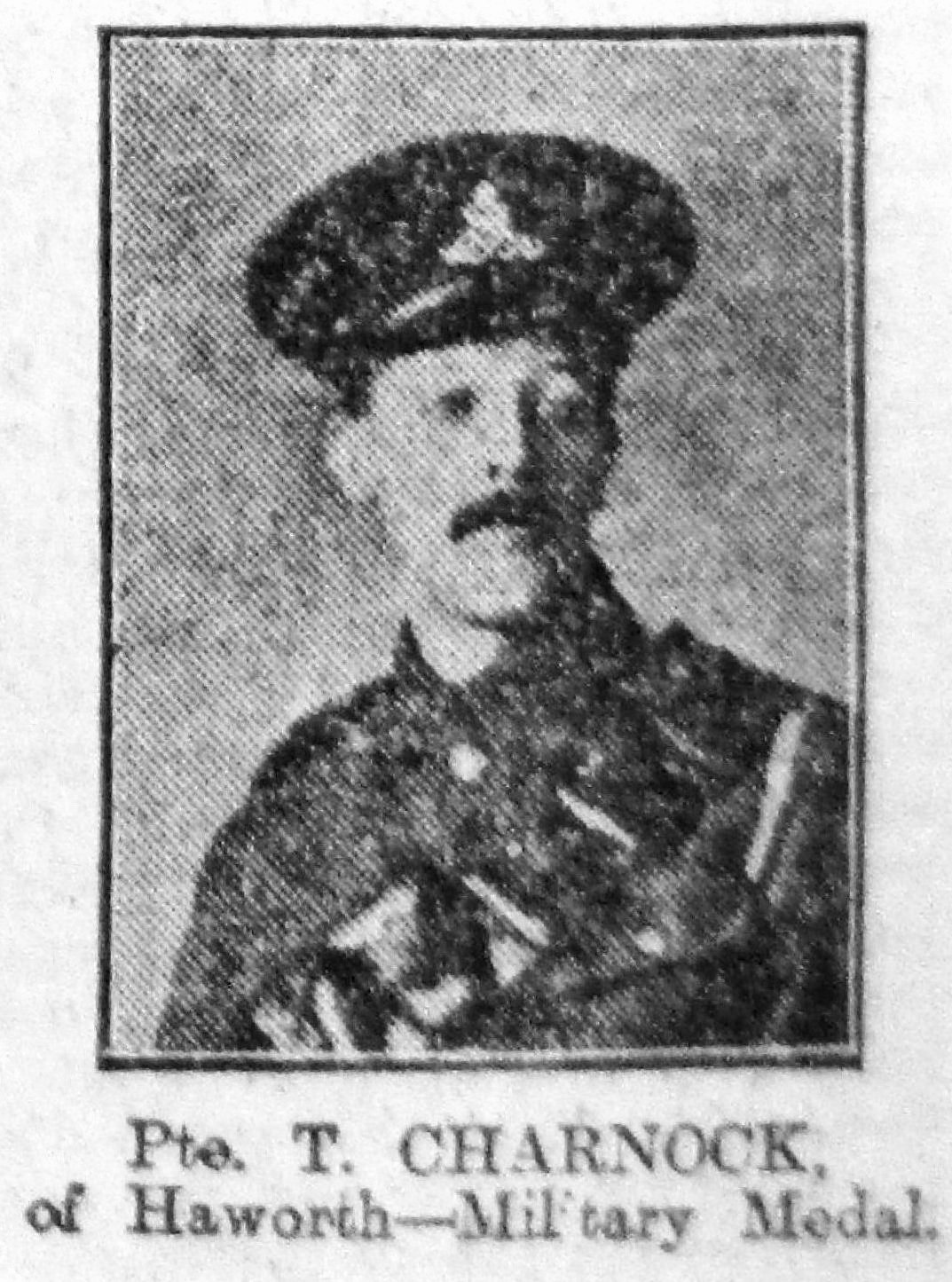
HAWORTH MAN WINS THE MILITARY MEDAL
News has been received that Private Tom Charnock, of the Northumberland Fusiliers, has been awarded the Military Medal. He joined the Royal Field Artillery in September, 1916, was transferred to the Northumberland Fusiliers a few months later, and whilst in France has taken part in some stiff fighting. He was awarded the card of honour for his conduct in the big offensive last Easter, and his further success will be gratifying to his many friends. Previous to enlisting, Private Charnock was in the service of the Haworth Co-operative Society as a butcher, and is well known in the Haworth district.
Remembrance:
Tom survived the war and returned home, but is remembered on the Grand United Order of Oddfellows roll of honour board at Wyedean Weaving, Bridgehouse Lane in Haworth.
Post war:
Tom received his war medals which were the British War Medal and Victory Medal. These were usually sent through in 1920 or 1921. He would also have had the Military Medal sent through. If it was presented to him locally we have no record of the occasion, nor the medal citation giving the reason why he was awarded it.
In 1919 Thomas and Lily were living at 2, Clay Brow in Haworth and Tom was described as an absent voter indicating he was still serving away with the voting qualification NM for Naval and Military voters.
By 1920 they had moved to 20, Sun Street in Haworth according to the electoral rolls
In the 1921 census Tom was aged 39 and was employed as a butcher for the Victoria Road Industrial Cooperative Society in Haworth. Lily was aged 34 and on home duties. Also living with them was their son James Charnock aged 12 who was a part-time worsted doffer for Merrall and Sons Ltd of Lees Mills, Haworth.
By 1928 they were moving from Sun Street to Cold Street in Haworth and in 1939 they had moved for a short while to 17, Ash Field Terrace.
In the 1939 Register they were living at 6, Hill Street which is just up the hill off Cold Street in Haworth. Tom was aged 58 and a butcher and storekeeper whilst Lily was 53 and on unpaid domestic duties. They were still there in the 1940 electoral roll.
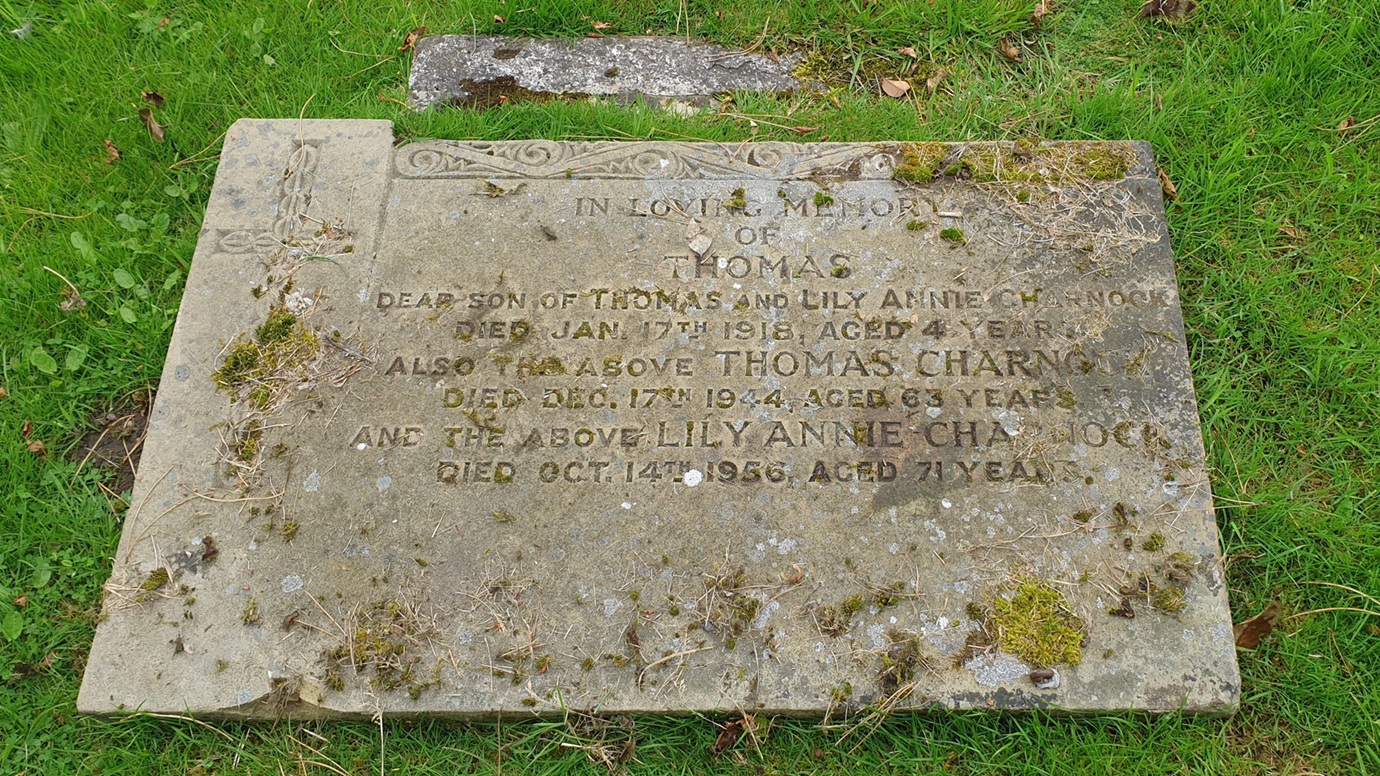
Tom died at the age of 63 on the 17th of December 1944. His death was recorded in Keighley in the last quarter of that year.
He was buried in a grave at Haworth Cemetery on Penistone Hill.
Lily’s home address was 8, School Street in Addingham when she died at Raikeswood Hospital in Skipton, at the age of 71 on the 14th of October 1956. Her death was recorded at Staincliffe in the last quarter of the year.
She was buried in the same grave as her husband Tom.
Lily left the sum of £1177 1s 3d in probate to Edgar Middleton, farmer on the 28th of November 1956.
Information sources:
West Yorkshire, England, Church of England Marriages and Banns, 1813-1935.
England & Wales, Civil Registration Birth Index, 1837-1915.
West Yorkshire, England, Church of England Births and Baptisms, 1813-1910.
England, Select Births and Christenings, 1538-1975.
1891 England Census.
England & Wales, Civil Registration Death Index, 1837-1915.
1901 England Census.
West Yorkshire, England, Tax Valuation, 1910.
UK and Ireland, Find a Grave® Index, 1300s-Current.
St. Michael and All Angels Churchyard.
West Yorkshire, England, Electoral Registers, 1840-1962.
1911 England Census.
Keighley News archives at Keighley Library.
British Army World War I Medal Rolls Index Cards, 1914-1920.
World War I Service Medal and Award Rolls, 1914-1920.
British Army Recipients of the Military Medal, 1914-1920.
The London Gazette.
1921 England Census.
1939 England and Wales Register.
England & Wales, Civil Registration Death Index, 1916-2007.
England & Wales, National Probate Calendar (Index of Wills and Administrations), 1858-1995.
Haworth Cemetery.
