
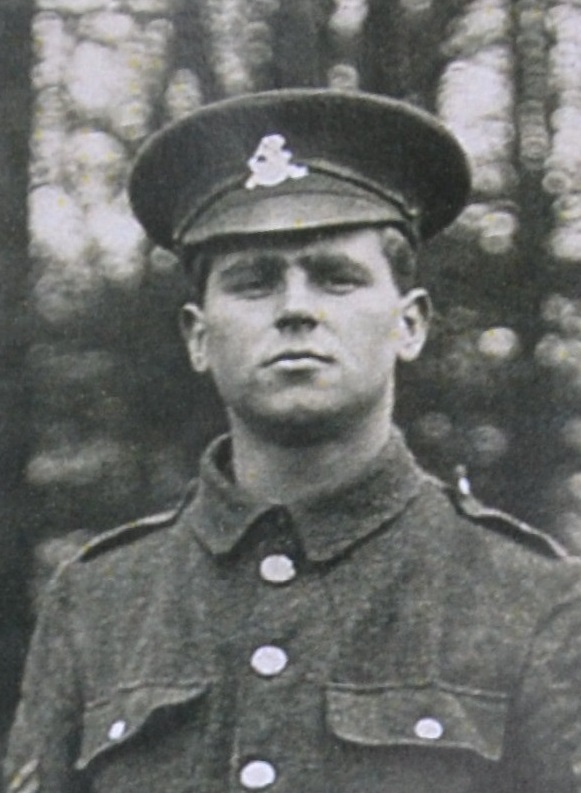
6th Battalion, Duke of Wellington’s West Riding Regiment. Regimental number 4077.
Early life:
William was born in Haworth in 1865, registered in Keighley in the second quarter of the year. Parents Joseph and Mary Ann Bearsley.
In 1871 he was six and living at Hall in Haworth with his parents and two sisters. His father Joseph was a worsted power loom weaver.
In 1881 he was fifteen and living at Ebor in Haworth with his parents, five sisters and one brother. Joseph was still a worsted weaver and William was a piece hooker in a worsted mill.
On June 12, 1886 William married Alice Moore at St Michael and All Angels in Haworth. He was 21 and she was 22 years old. William was a woolsorter at that time. By 1891 they were living together at 27, Prince Street in Haworth. William was a wool sorter and Alice was a cotton winder.
By 1901 William was 35 and they had moved to 5, Albert Street in Haworth and they’d had a child, Mary. William was a wool sorter.
Territorial service:
On April 3, 1908 William joined the 6th Battalion of the Duke of Wellington’s West Riding Regiment as a local volunteer, service number 146. He had been with the 3rd Volunteer Battalion West Riding Regiment since January 29, 1884 and had steadily risen to the rank of Sergeant by January 1, 1909 and had completed twenty years service by January 1, 1910. He was awarded the Volunteer Long Service Medal.
In 1910 he was renting 2, River Street in Haworth from the Haworth Conservative Club.
By 1911 they were living at 2, Tyne Street with their daughter Mary. They’d had three children but two had died. William was a wool sorter for Messrs. Merrall & Sons.
War service:
On March 20, 1915 he attested in the Army with the 3/6th Battalion West Riding Regiment Service number 4077, and was soon appointed with a Lance Corporal’s stripe. Sadly he died of cancer of the bladder on August 19, 1915 at the 2nd Northern General Hospital at Beckett’s Park in Leeds. He was fifty years old and his death was registered in Keighley.
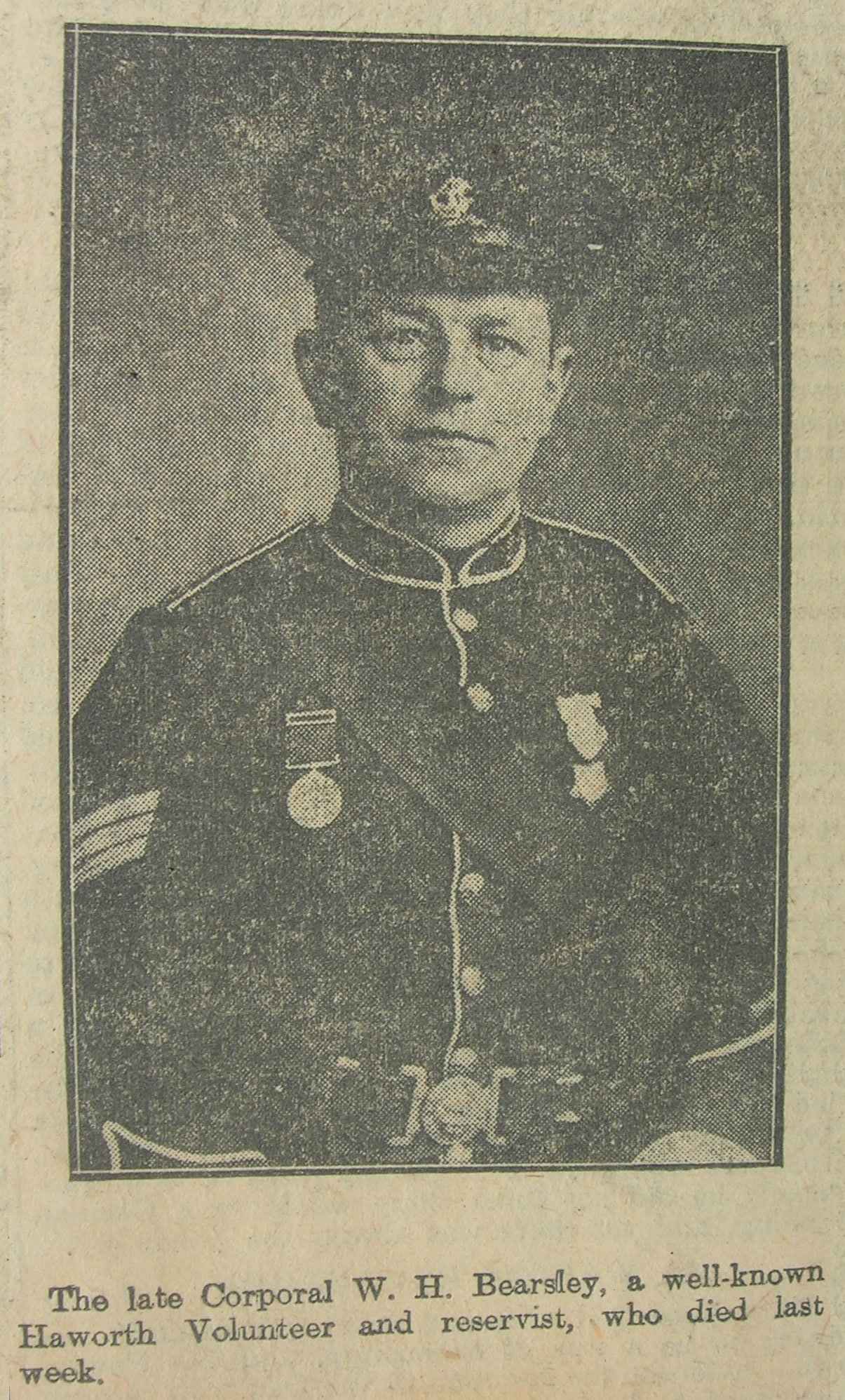
Keighley News Saturday 28th August 1915:
MILITARY FUNERAL
The funeral of the late Corporal W. H. Bearsley, of Haworth, took place on Saturday last, and was largely attended. After the more immediate mourners there was a very considerable procession, consisting of a contingent of about fifty men, in charge of Lieutenant Blakey, from deceased’s regiment, now stationed at Skipton; about fort members of the local Volunteer Training Corps with the Battalion Major (Dr. Maggs) and Platoon Commander Greenwood Crabtree; the Navvy Mission Boy Scouts; representatives from the Victoria Hall Sick Club and Haworth Cooperative Society, and a number of the general public.
Six men from the third 6th West Riding Regiment bore the coffin at the cemetery, where the Rev. D. F. James (Vicar of Cross Roads) conducted the last rites. At the conclusion two buglers from the regiment sounded “The Last Post.”
Corporal Bearsley was fifty years of age, and had been a sergeant in the old Haworth Volunteers, gaining the long service medal. He was also a National Reservist, and re-entered the Army five months ago. After being taken ill he was removed from Skipton to Beckett’s Park Hospital where he underwent an operation. Although much better the improvement was not lasting and he died at home.
Corporal Bearsley was very well known, and, at one time, enjoyed a great popularity as a humorist. For several tears he was closely allied with the work of the Haworth Co-operative Society. During his volunteer days he was one of the crack shots in the Duke of Wellington’s West Riding Regiment, and became the possessor of a two-barred medal in connection with the shooting for the Bingham Trophy. He leaves a widow and one daughter, who is married.
By now Alice had moved to 103 Hebden Bridge Road. Because William’s death was not caused by the war, Alice was not entitled to a war widow’s pension from the Army although she did receive a letter from the war office in December 1915 that a Statutory Committee about to be established might look at her case.
A Pension Card shows that Alice was granted a Dependant’s pension of 15 shillings per week beginning on the 4th of April 1917. A note in red ink states that this ‘short pension entitlement’ granted her 15 shillings per week for the duration of the war and for one year after.
William had not served overseas in a war theatre so no medals were forthcoming.
Remembrance
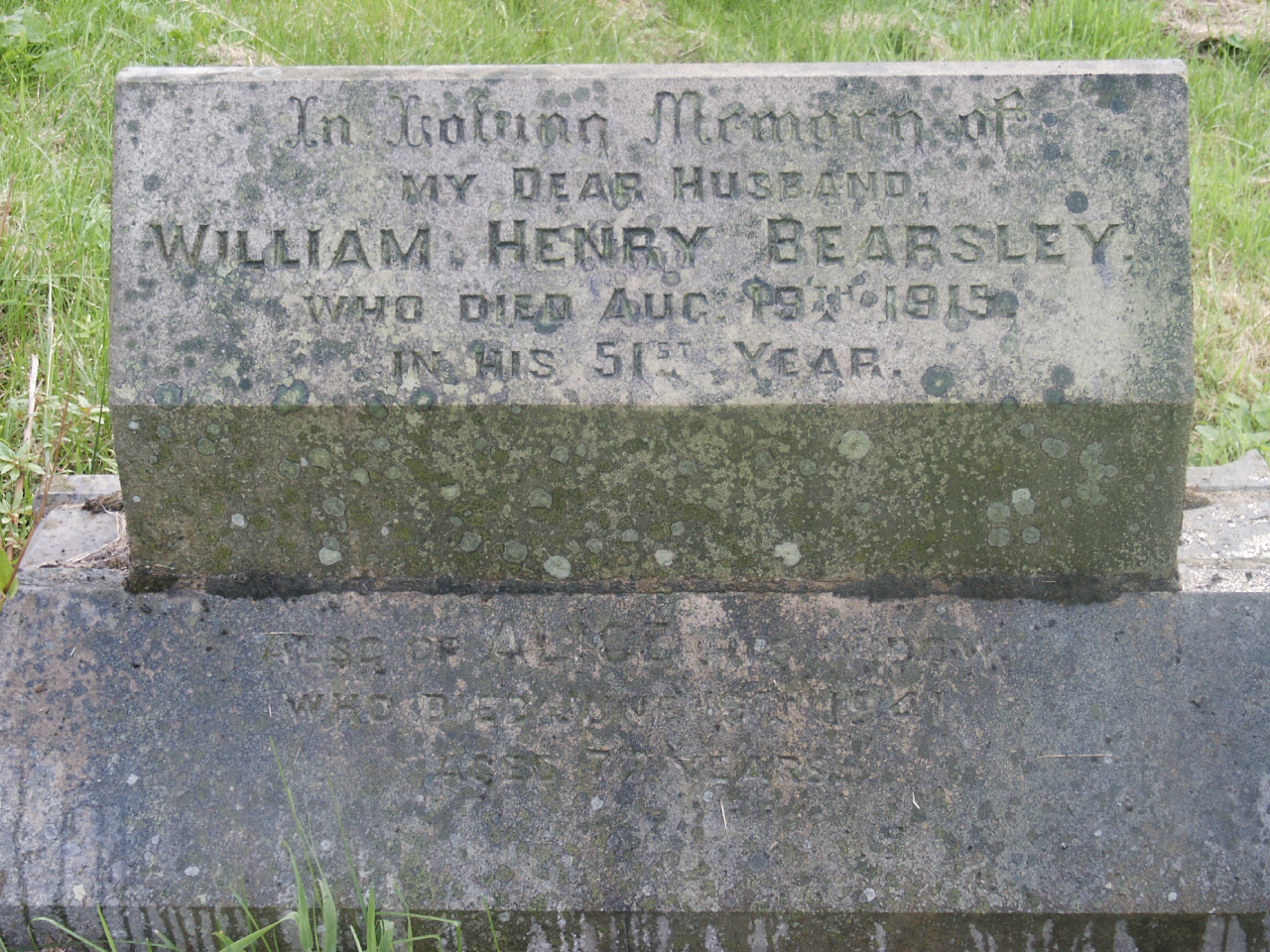
William is remembered on the Haworth War memorial and is recognised by the Commonwealth War Graves Commission, as he died whilst in service during the war, although it is a private headstone on his grave.
He is also remembered on the Haworth Oddfellows roll of honour in the care of Wyedean Weaving in Haworth.
Source information:
Birth, marriage and death records.
1871, 1881, 1891, 1901 and 1911 census.
Army service records.
Keighley News archives, Keighley Library.
The Commonwealth War Graves Commission.
